Clinical

We advance human health and well-being by providing an extensive portfolio of in-vitro diagnostic (IVD) systems, reagent kits, and software used by thousands of hospitals and laboratories worldwide. Most notably, Waters delivers technologies for newborn screening, an area of clinical diagnostics that has made a healthy adult life possible for millions.

  • Reducing Risk, Rework, and Cost Through Chromatographic Stability

    As clinical LC‑MS adoption continues to grow across toxicology, endocrinology, therapeutic drug monitoring, and metabolic testing, laboratories face an increasingly difficult challenge: delivering results that are not only sensitive, but routine, reproducible, and economically sustainable. While investment decisions often focus on mass spectrometry (MS) detection, experience across clinical laboratories shows that chromatography is frequently the…

  • The Hidden Cause of Variability in Clinical LC-MS

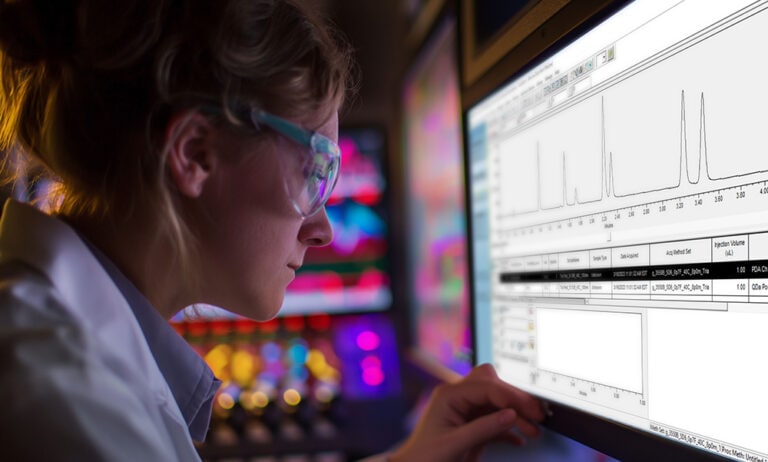
    When variability appears in clinical liquid chromatography-mass spectrometry (LC‑MS) data, the mass spectrometer is often the first place that laboratories look. Changes in signal intensity, quantitative drift, or failed batches are frequently attributed to detector performance, ion optics, or acquisition settings. Chromatography is often the root cause of the variability observed at the mass spectrometer….

  • Retention Time Stability: The Foundation of Robust Clinical LC-MS

    In clinical liquid chromatography-mass spectrometry (LC‑MS), sensitivity and specificity often dominate the conversation. But behind every reliable result is a less visible parameter that determines whether workflows scale smoothly or struggle under pressure: retention time stability. As clinical laboratories increasingly rely on LC‑MS for high‑throughput, multi‑analyte testing, retention time stability has become a defining factor…

  • Why Chromatography Still Matters in the Age of More Sensitive Mass Spectrometry

    Mass spectrometry (MS) is more powerful than ever. Modern clinical MS systems deliver extraordinary analytical sensitivity, selectivity, and quantitative performance, opening the door to broader test menus with lower detection limits. With capabilities like these, it’s tempting to ask a simple question: Does chromatography still matter as much as it used to? The short answer…

  • Collaborating with MilliporeSigma to incorporate CCS values

    Accurate screening for extractables and leachables (E&Ls) is imperative for consumer safety, no matter the product. Be it a pharmaceutical, an item of food packaging, or a medical device, consumers place their trust in manufacturers to protect them from the thousands of potentially harmful chemicals that can leach into their products.

  • Waters and the University of Tokyo Collaborate on Lipidomics Research

    Digging deep into the human biome, Professor Yoshiya Oda of the Graduate School of Medicine at the University of Tokyo looks to ion mobility technology to uncover deposits of insight It’s an established fact that the more people age, the more they tend to engage with health care providers than they did when they were…

  • Why does biomedical research matter?

    Summer break is coming to a close and the thought of fall quickly approaching hangs heavy in the air. The mornings are cool and pleasant, perfect for sleeping. And, here I am, sipping coffee at 5:30AM. Why is it that on mornings like this, when most of the world is asleep, so many biomedical researchers are…

  • The Importance of Newborn Screening: A Mother’s Perspective

    After completing my undergraduate degree, I began work at the New England Newborn Screening Program (NENBS) in Jamaica Plain, Massachusetts. It wasn’t long before I realized the magnitude of the job I held in serving the public and my role in the life-saving tests that the program performed. The NENBS program consists of five testing…