
Retention Time Stability: The Foundation of Robust Clinical LC-MS
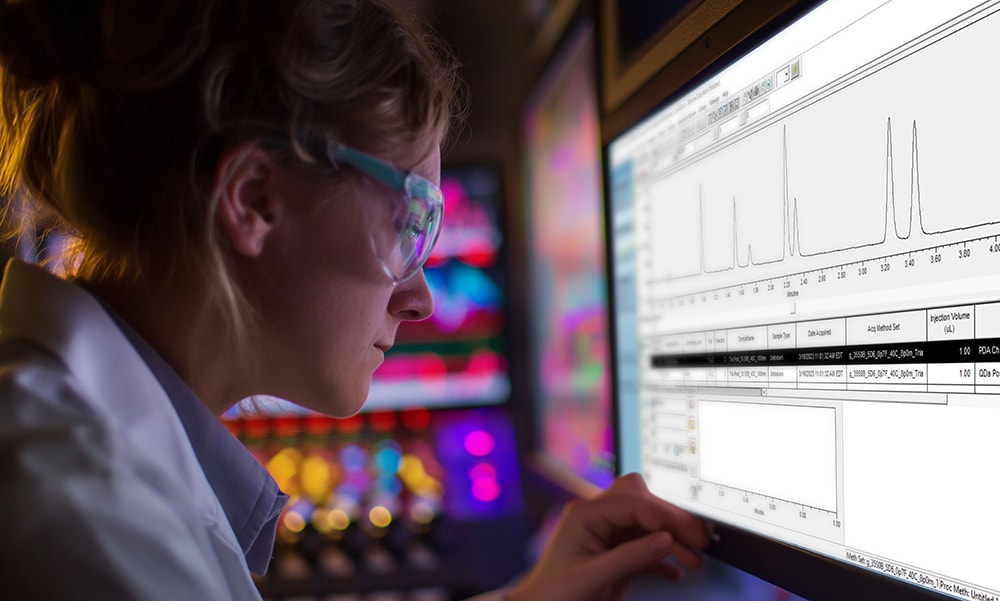
In clinical liquid chromatography-mass spectrometry (LC‑MS), sensitivity and specificity often dominate the conversation. But behind every reliable result is a less visible parameter that determines whether workflows scale smoothly or struggle under pressure: retention time stability.
As clinical laboratories increasingly rely on LC‑MS for high‑throughput, multi‑analyte testing, retention time stability has become a defining factor in assay robustness, data quality, and operational confidence.
Why does retention time stability matter in clinical workflows
In research settings, small shifts in retention time may be tolerable. In clinical laboratories, they are not. Clinical LC‑MS assays are expected to deliver:
- Consistent results across long assay lifetimes
- High throughput with minimal manual intervention
- Defensible data in regulated and audited environments
When retention times drift, laboratories are forced to widen MS acquisition windows to avoid missing analytes. This creates a cascade of downstream effects, including:
- Reduced dwell time per transition
- Fewer data points across each chromatographic peak
- Increased susceptibility to interference
- Compromised quantitative precision, particularly for low‑level analytes
In large panels, even modest variability can lead to missed detections, increased manual review, and higher rates of reruns or batch failures. In practice, retention time stability is a prerequisite for scalable, high‑confidence clinical LC‑MS.
The link between retention time stability and MS performance
MModern tandem mass spectrometers are capable of extremely fast acquisition, but their performance is fundamentally constrained by chromatographic predictability.
Stable retention times enable laboratories to:
- Use narrow, well‑defined acquisition windows
- Optimize dwell time for each transition
- Increase the number of data points across peaks
- Maintain consistent peak integration and quantitation
When chromatography is unstable, mass spectrometry efficiency is lost, not because of the detector, but because the acquisition strategy must compensate for uncertainty upstream.
In this way, chromatography does not merely precede detection. It defines how effectively MS technology can be used in routine clinical workflows.
Why is UHPLC critical for retention time stability
Ultra-High Performance Liquid Chromatography (UHPLC) is often associated with sharper peaks and faster separations. In clinical LC‑MS, however, its most important contribution is reproducible chromatographic behavior over time. UHPLC systems designed for clinical use offer:
- Improved control of mass transfer and dispersion
- Greater consistency across injections and batches
- Reduced sensitivity to small changes in system conditions
These attributes translate directly into more stable retention times, which is particularly important when operating large panels in complex biological matrices. However, achieving retention time stability in a clinical environment requires more than high pressure alone. It requires systems engineered explicitly for robust, routine operation.
Retention time stability as a risk‑reduction strategy
From a clinical perspective, retention time stability is not just an analytical parameter, it is a risk‑reduction mechanism. Stable chromatography supports:
- Lower rates of assay failure and reanalysis
- Reduced manual data review
- Cleaner trending of system suitability metrics
- Greater confidence during audits and inspections
Conversely, unstable retention times can drive deviation investigations, complicate method maintenance, and erode trust in results over time.
For laboratories managing regulated workflows, chromatographic stability directly supports quality and compliance objectives.
Waters ACQUITY UPLC I‑Class PLUS IVD System: Designed for retention time confidence
The ACQUITY UPLC I‑Class PLUS IVD System has been engineered to deliver the level of retention time stability required for routine clinical diagnostics. This design philosophy reflects the realities of clinical laboratories, where consistency across shifts, operators, and time is paramount.
By providing highly reproducible retention times, the ACQUITY UPLC I‑Class PLUS IVD System enables:
- Narrow acquisition windows
- Efficient use of MS dwell time
- Reliable quantitation across high‑volume sample sets
- Sustained performance throughout the assay lifecycle
Chromatography expertise matters in clinical implementation
Retention time stability is not achieved by hardware alone. It reflects decades of chromatographic understanding applied to system design and clinical use cases.
Waters leadership in UHPLC technology, and its long experience supporting regulated laboratories has shaped how systems, like the ACQUITY UPLC I‑Class PLUS IVD System, are optimized for real‑world clinical operation.
In today’s clinical laboratory, retention time stability is not just a technical detail. It is the foundation of trust in LC‑MS results.
Discover how UPLC can elevate your clinical analysis.
Related posts
Is it Possible to Have High Analytical Sensitivity and Robustness in Clinical Mass Spectrometry?
For decades, mass spectrometry (MS) developers and users have lived with a familiar trade‑off. Instruments designed for the highest analytical sensitivity often come with implicit costs: fragility, frequent maintenance, and performance that drifts under the pressures of routine use. Conversely, the most robust systems have sometimes been viewed as blunt tools—reliable workhorses, but lacking the…

Reducing Risk, Rework, and Cost Through Chromatographic Stability
As clinical LC‑MS adoption continues to grow across toxicology, endocrinology, therapeutic drug monitoring, and metabolic testing, laboratories face an increasingly difficult challenge: delivering results that are not only sensitive, but routine, reproducible, and economically sustainable. While investment decisions often focus on mass spectrometry (MS) detection, experience across clinical laboratories shows that chromatography is frequently the…

The Hidden Cause of Variability in Clinical LC-MS
When variability appears in clinical liquid chromatography-mass spectrometry (LC‑MS) data, the mass spectrometer is often the first place that laboratories look. Changes in signal intensity, quantitative drift, or failed batches are frequently attributed to detector performance, ion optics, or acquisition settings. Chromatography is often the root cause of the variability observed at the mass spectrometer….
Popular Topics
ACQUITY QDa (17) bioanalysis (14) biologics (17) biopharma (50) biopharmaceutical (60) biotherapeutics (24) case study (22) chromatography (16) data integrity (28) HPLC (17) informatics (12) LC-MS (36) liquid chromatography (LC) (35) mass detection (17) mass spectrometry (MS) (68) method development (16) particle analysis (21) regulatory compliance (16)