
AI in GMP: Navigating Evolving Expectations for Regulated Labs

Why 2026 marks the shift from guidance to enforcement and what it means for your organization now.
Written by Tracy Hibbs and Tony Sacchetti, Waters Corporation
Regulators are already inspecting AI use, how prepared is your organization?
For years, the pharmaceutical industry has anticipated regulatory clarity on the use of artificial intelligence (AI) and machine learning (ML) in regulated labs. This clarity has emerged, not only through guidance, but also through enforcement. For quality control (QC) labs, this moment signals both opportunity and accountability. AI can deliver speed, consistency, and efficiency, but only with strong AI governance and when deployed under conditions that preserve transparency, traceability, and scientific integrity.
Foundations: The regulatory path that got us here
In 2021, the Danish Medicines Agency (DKMA) became one of the first European regulators to address AI in pharmaceutical quality systems when they took a bold step toward defining the role of AI in regulated environments by publishing a draft guidance entitled “Suggested Criteria for Using AI/ML Algorithms in GxP.”1
Their work informed reflection papers and draft guidance from the European Medicines Agency (EMA) and the U.S. Food and Drug Administration (FDA), all formally recognizing AI and ML as viable tools in regulated pharmaceutical operations, including QC. These documents do more than permit AI—they define the conditions under which it can be trusted.
2021 DKMA Suggested Criteria for Using AI/ML Algorithms in GxP emphasizes:
- Use of static, supervised models for critical functions
- Independent test data and bias mitigation
- Strong data integrity and validation practices
2023 EMA Reflection Paper on the Use of Artificial Intelligence (AI) in the Medicinal Product Lifecycle2 emphasizes:
- Transparency and explainability
- Risk-based validation
- Human oversight
2025 EMA with Pharmaceutical Inspection Convention and Pharmaceutical Inspection Co-operation Scheme (PIC/S) Draft Guidance Annex 22: Artificial Intelligence3 explicitly excludes adaptive or generative AI from critical GMP applications and mandates:
- Static, deterministic models only
- Locked training data and independent test sets
- Explainability tools (e.g., SHAP, LIME) and confidence scoring
- Defined operator roles in human-in-the-loop (HITL) systems
2025 FDA Draft Guidance Considerations for the Use of Artificial Intelligence to Support Regulatory Decision-Making for Drug and Biological Products4 introduces a risk-based credibility assessment framework, focused on:
- Model transparency and traceability
- Data governance and independence of training/test sets
- Lifecycle management of AI models
- Context-of-use validation
Ten principles, two regulators, and one path
The FDA and EMA jointly published Guiding Principles for Good AI Practice in Drug Development.5 The synchronized framework is significant, indicating a renewed alignment between two influential regulatory agencies and signaling that organizations operating across jurisdictions can plan against a stable target.
The joint announcement highlights 10 critical areas:
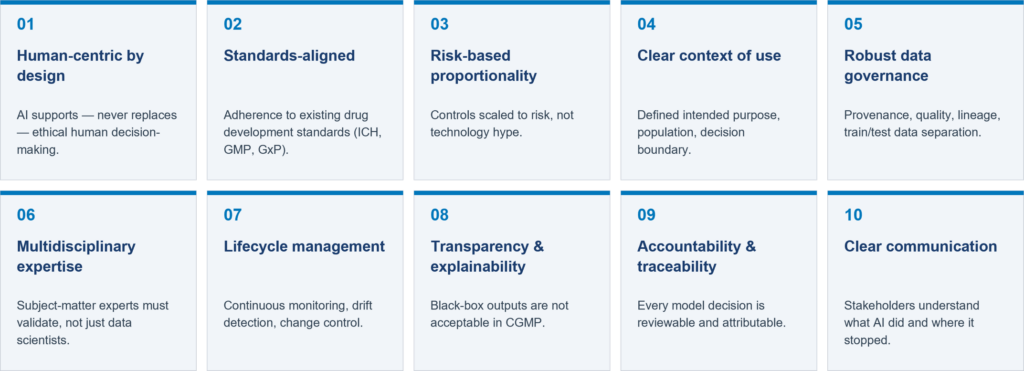
Apply critical thinking
Core skills developed across your organization, from risk management to data governance and vigilant monitoring, become more critical when leveraging AI. Your organization remains accountable for your quality.
- AI reliability: Data quality is foundational, requiring strict data segregation, traceability, and version control. Lifecycle management is a cornerstone, as are data integrity and bias mitigation.
- AI successful implementation: Collaboration is an imperative requiring cross-functional teams including your analysts, QA, IT, AI ethics team, data integrity officer, and regulatory affairs team.
- AI decision impact: Understanding the criticality of the decision is not optional. Risk assessment good practices and data flow and workflow maps identifying your intended use underpin your implementation.
- AI oversight: Knowing the number of decisions being made and applying vigilant monitoring at each decision point are fundamental.
Why this matters: The risk to product quality and patient safety
The stakes in pharmaceutical QC are uniquely high. Every decision in QC labs has downstream implications for product quality, compliance, and, ultimately, patient safety. AI systems that are opaque, unvalidated, or poorly governed have the potential to introduce detrimental risks, including:
- Undetected anomalies in chromatographic data could allow substandard or contaminated products to reach patients.
- Adaptive models that change behavior over time may produce inconsistent results, undermining batch release decisions.
- Lack of explainability can obscure the rationale behind critical decisions, making root cause analysis and regulatory inspections more difficult.
- Insufficient validation or biased training data can lead to systematic errors, disproportionately affecting certain product types or patient populations.
This is why regulators are drawing a clear line. AI must not compromise the scientific rigor, traceability, or reproducibility that underpin GMP. Instead, it must enhance them.
What does this mean for QC labs?
For QC labs, this is a pivotal moment. AI/ML can now be deployed to:
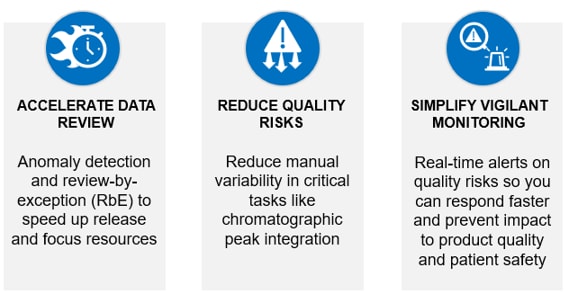
But adoption must be deliberate. Labs and quality teams must ensure:
- Models are locked and validated before use.
- Outputs are interpretable and reviewable.
- Human reviewers remain accountable and trained.
- Strong quality oversight persists.
This is not about replacing analysts. It’s about amplifying your deep expertise and focusing attention where it matters most.
Looking ahead: The message is straightforward
Regulatory direction is clear: AI use in GMP areas is permitted, provided it operates within a framework of transparency, reproducibility, and oversight. As regulators continue to refine expectations, particularly around validation standards, model updates, and governance of agentic systems along with real-time monitoring, QC labs that invest now in compliance-enabled AI will be better positioned for the future.
Is your lab ready for the AI era?
Connect with our experts to explore how Waters is enabling labs to take the next step toward intelligent, always audit-ready systems.
References
- Danish Medicines Agency (DKMA), Suggested Criteria for Using AI/ML Algorithms in GxP (2021).
- EMA Reflection paper on the use of Artificial Intelligence (AI) in the medicinal product lifecycle (Draft 2023, Final 2024).
- EMA GMP Annex 22 (Draft 2025).
- FDA Considerations for the Use of Artificial Intelligence to Support Regulatory Decision-Making for Drug and Biological Products (Draft January 2025).
- FDA and EMA Guiding Principles of Good AI Practice in Drug Development (January 2026).
Additional Resources
Related posts

AI Maturity in GMP: Accelerating Your Digital Journey at Warp Speed, Safely
Most AI projects fail. The organizations that succeed are the ones that build governance before they build velocity. Written by Tracy Hibbs and Tony Sacchetti, Waters Corporation Artificial intelligence (AI) is poised to take routine work and shift it to fully automated workflows. Currently, 80% of AI projects fail.1 As with most paradigm-shifting technology, it…

Is Your Organization Ready for AI Inspection?
Inspecting AI is not new to regulators. The expectations are already well-established. The key question is whether your organization can reliably demonstrate them. Written by Tracy Hibbs and Tony Sacchetti, Waters Corporation Exploring artificial intelligence (AI) and machine learning (ML) in regulated laboratories governed by Current Good Manufacturing Practices (CGMP) may be new for your…

Built on Control and Backed by Data: Why Vigilant Monitoring Matters in Pharma QC
Stage 3 verification: Establishing and maintaining a state of control In pharmaceutical quality control (QC), consistency should mean more than an analyst ending a shift relieved that the results were repeatable and there were no obvious failures. It should mean having enough confidence in the process, the controls, and the data to know that those…
Popular Topics
ACQUITY QDa (17) biologics (17) biopharma (50) biopharmaceutical (59) biotherapeutics (24) case study (22) chromatography (16) data integrity (27) food analysis (12) HPLC (17) informatics (12) LC-MS (33) liquid chromatography (LC) (32) mass detection (16) mass spectrometry (MS) (68) method development (16) particle analysis (21) regulatory compliance (15)