
A Toxic Pollutant, a Surprising Polymer, and the CDMS Data That Connected the Dots
Water microdroplets can convert carbon disulfide (CS₂), a toxic industrial pollutant, into a solid polymer at room temperature and without a catalyst. It is a striking example of green chemistry: transforming harmful waste into useful materials under exceptionally mild conditions.
But a compelling hypothesis still needs proof. Did a polymer really form, and how did it grow? These questions are hard to answer. The product won’t dissolve, and conventional mass spectrometry (MS) saw nothing above 210 Da.
A new Journal of the American Chemical Society study from Zhejiang University and Jianghan University (China) reports this first microdroplet-driven polymerization. Among the many analytical techniques applied in the study, only the Waters Xevo™ CDMS provided direct molecular-weight evidence, showing the molecular-weight distribution shift from approximately 100 kDa to 300 kDa within 30 minutes.
Why does this matter
For a new polymerization pathway, molecular weight is the ultimate proof point. It confirms that a polymer has formed and provides a window into how the reaction unfolds. Tracking molecular-weight growth helps researchers understand the underlying mechanism and evaluate whether the process could eventually be optimized and scaled.
The analytical challenge
The product to be analyzed was an amorphous, highly cross-linked powder, nearly insoluble in eight common solvents, which complicates the solution-based methods typically used to size polymers.
Spectroscopy filled in the chemistry. FTIR, Raman, XPS, and solid-state NMR confirmed the C=C, C–S, S–S, and C=S bonds, and pyrolysis GC-MS identified the fragments released on heating. But these methods described the building blocks, not the size of the assembled polymer.
Conventional MS hit a wall too. ESI-MS of the reaction filtrate found small sulfur ions but no polymer, and online microdroplet MS saw species of no more than four carbons, all below 210 Da. As mass and heterogeneity rise, conventional MS loses the charge-state resolution that accurate mass depends on.
What CDMS delivered
CDMS measures the mass-to-charge ratio and the charge of each ion individually, so it can size large, heterogeneous species without resolved charge states.
Applied to samples taken at 10, 20, and 30 minutes, it enabled the team to:
- Confirm polymer formation – detecting macromolecular populations in the tens to hundreds of kilodaltons, roughly a thousandfold larger than anything conventional MS could see in the same reaction.
- Track growth over time – showing the overall distribution shift from about 100 kDa at 10 minutes to about 300 kDa at 30 minutes, with the high-mass population increasing markedly as the reaction proceeded.
- Resolve coexisting populations – distinguishing species near 40 kDa and 105 kDa at 10 minutes, and a separate higher-mass, higher-charge population emerging by 30 minutes.
Sample preparation was minimal. The team filtered the reaction suspension through a 0.45-µm membrane, loaded it into a 2-µm glass capillary, and analyzed it directly, with no dissolution, derivatization, or upstream separation.
Building the full picture
No single method could tell this story alone. Each answered a different question, and CDMS answered the one in between: how big the polymer gets and how it grows.
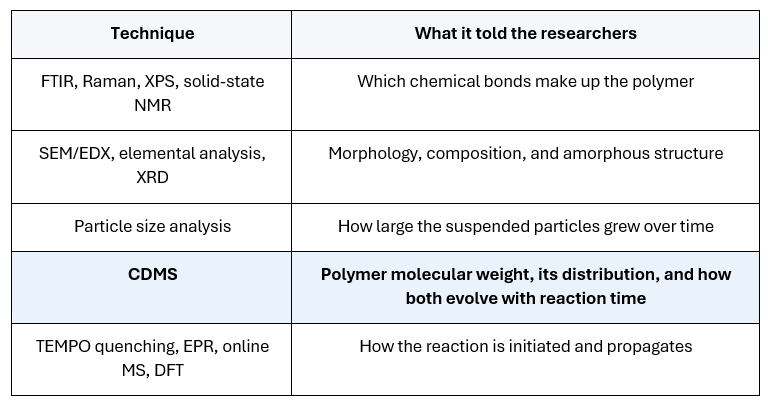
When a sample is insoluble, cross-linked, or polydisperse, CDMS adds the molecular-weight evidence that completes the picture, wherever the question is how big, and how heterogeneous, including for these applications:
- Polymers
- Supramolecular assemblies
- Viral particles
- Gene therapy vectors
- Protein complexes
Read the full study, “Spontaneous Room-Temperature Polymerization of Carbon Disulfide in Water Microdroplets”, and see the CDMS data in the Supporting Information, Figures S14–S17.
Related posts
A New Era for Regulated Labs: AI/ML Innovation as a Real Laboratory Capability
Life sciences organizations are building the next generation of laboratory excellence and are poised for it to be more than just an idea. Over the years, we’ve heard aspirational concepts ranging from a paperless laboratory to Pharma 4.0. We’ve debated concepts and what might be possible someday. The pace of artificial intelligence (AI) advancement has…
From Hidden Assemblies to Drug Target Insight with CDMS and Cryo-EM
A recent JACS study by Prof. Siavash Vahidi and collaborators at the University of Guelph (Canada) highlights how Charge Detection Mass Spectrometry (CDMS) can uncover hidden protein assemblies that conventional methods often miss. By guiding cryogenic electron microscopy (cryo-EM) toward structurally distinct populations, CDMS enabled a deeper understanding of the active architecture and substrate recognition…
From Transcript to LNP Formulation: Measuring Intact mRNA with CDMS
mRNA therapeutics are advancing rapidly, but a major analytical challenge remains: how do you verify that a large, full-length transcript remains intact throughout manufacturing and formulation? A recent Analytical Chemistry article by scientists from Pfizer and Megadalton Solutions demonstrates how charge detection mass spectrometry (CDMS) helped to close this gap. The researchers directly measured intact…
Popular Topics
ACQUITY QDa (17) bioanalysis (14) biologics (17) biopharma (50) biopharmaceutical (60) biotherapeutics (24) case study (22) chromatography (16) data integrity (29) HPLC (17) informatics (12) LC-MS (38) liquid chromatography (LC) (36) mass detection (17) mass spectrometry (MS) (70) method development (16) particle analysis (21) regulatory compliance (16)