
Where Did My Sample Go?

A case of non-specific binding (NSB)
We’ve all been there. You spend hours (sometimes days) in the lab preparing your samples. You carefully walk them to the autosampler, lovingly load up your sample queue, and press play. Of course, you’re running these overnight because instrument time is precious and someone else needs to use it tomorrow. You come into the lab in the morning and immediately get settled in to process your data.
And there’s nothing there.
Did you forget to inject? No. Maybe you didn’t spike in your analyte at all? You’re starting to question your sanity.
“So, where did my sample go?”
If you’re confident that you haven’t made the usual mistakes (which we all do), and you know that your sample should be there, but it’s not, where did it go?
Peptides and proteins are especially prone to non-specific binding (NSB) or adsorption to solid surfaces. These surfaces could be pipette tips, sample storage containers, or injection needles. Now, we all know ways to mitigate adsorption, like:
- using carrier proteins (which can add unwanted complexity to our samples) or
- using lab supplies with high performance surfaces to help stop adsorption from happening in the first place.
However, in many cases, we may choose to go without addressing the problem.
Are you prepared to face the consequences of non-specific binding in your sample analysis?
These include:
- Low recovery
- High variability
- Poor Sensitivity
- Insufficient linear dynamic range
Lets examine these consequences further.
Low recovery
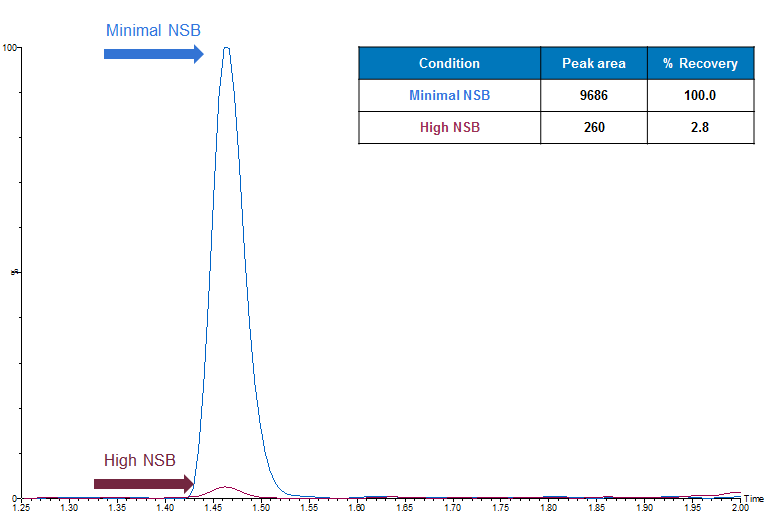 Developing analytical methods for peptides can be challenging. During LC-MS method development, we often use samples prepared in neat solution to optimize chromatography, identify MS fragments, and estimate linear dynamic range of the assay. However, this can be problematic for peptides. For instance, pramlintide (MW 3949.4 Da) a large, hydrophobic peptide can be completely lost to NSB when in neat solution. To make it worse, the degree of NSB observed is not only dependent on the peptide, but also its concentration. If we do not take steps to mitigate NSB during method development, we may walk into work in the morning and see no analyte signal at all. Or, we may incorrectly estimate the possible limits of detection of our assay. All of this adds up to extra time in our day that none of us can afford to lose.
High variability
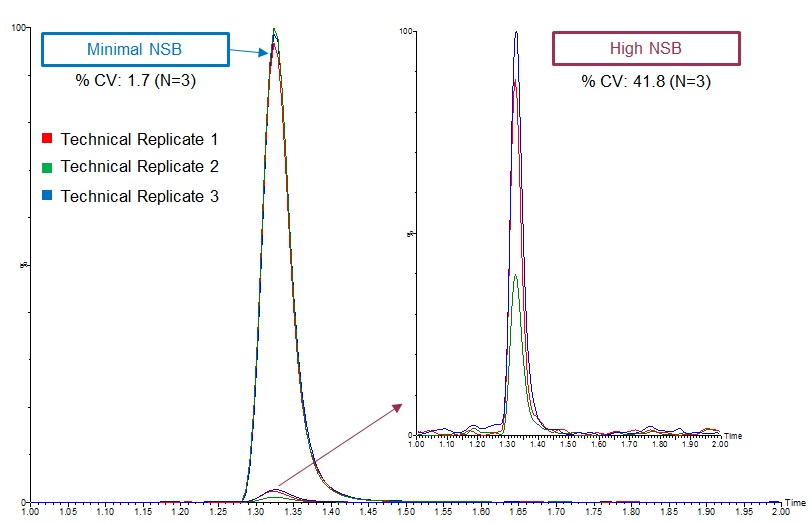 If we choose not to combat NSB in some way, how can we be sure that our sample replicates are adsorbing at the same rate? Or in the same amount? We can’t. And this can lead to high variability. In this example, recovery of leuprolide (MW 1209.4 Da) in neat solution was only 2%, leading to very high variability with a % CV of 41.8 (N=3). In contrast, leuprolide prepared with proper mitigation of NSB resulted in peak area CVs of 1.7% (N=3). The high variability associated with our ‘neat solution’ samples is unacceptable in any bioanalytical assay. The data would be rejected and the lower limits of quantification of the assay would be higher than desired.
Poor sensitivity
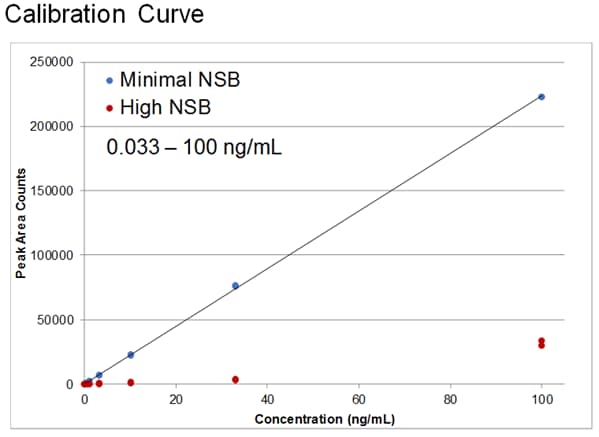 With low recovery and high variability for our analyte at low concentrations, the linear dynamic range of our assay is going to be severely limited. When developing pharmacokinetic assays, you need to be able to quantify your analyte over a large range, and at potentially very low levels. As the results of these assays can guide key decisions in drug development, it is critical that we have confidence in our quantification results. Properly accounting for NSB can therefore be the difference between a successful and a failed assay.
The next time you walk into the lab and find your analyte is missing, ask yourself this:
“Did I do enough to combat non-specific binding?”
If you’re not sure, be sure to ask our scientists here at Waters for help!
Watch out for our next Blog post “Lost samples in the container: non-specific binding and the impact of blocking agents” by Moon Jung, Ph.D.
Additional resources:
Related posts
Identifying Critical Quality Attributes in Drug Products: Your Key to Ensuring Safe and Effective Therapeutics
In drug manufacturing, there is no room for error. Every decision, from early formulation to final release, must ensure a product is safe, effective, and consistent. At the center of this process are critical quality attributes (CQAs), the measurable properties that define whether a drug meets its required standards. In this blog, we break down…
Unlocking Faster, More Confident Antibody Analytics with Modern Protein A Affinity Chromatography
Biologics developers today face unprecedented pressure: tighter timelines, increasingly complex antibody formats, and a growing need for real-time process understanding. Yet many analytical workflows still rely on methods that can’t deliver the speed, sensitivity, or depth required for modern bioprocessing. That’s where advances in Protein A (ProA) affinity chromatography are making a meaningful difference, reshaping…
Enzymatic Digestion: Accelerating Bioseparations with Novel Enzymes
The Role of Enzymes in LC-MS Analysis of Modern Biotherapeutics Enzymes are nature’s catalysts, enabling precise and efficient biochemical transformations. In analytical workflows, enzymatic digestion is a cornerstone technique for breaking down complex biomolecules into smaller, more manageable fragments. This process is critical for applications such as peptide mapping in protein characterization and oligonucleotide mapping…
Popular Topics
ACQUITY QDa (17) biologics (17) biopharma (50) biopharmaceutical (59) biotherapeutics (24) case study (20) chromatography (16) data integrity (27) food analysis (12) HPLC (17) informatics (12) LC-MS (30) liquid chromatography (LC) (31) mass detection (16) mass spectrometry (MS) (65) method development (16) particle analysis (21) regulatory compliance (15)