
Solid-Phase Extraction: From Fundamentals to Modern Analytical Workflows

Chromatography and mass spectrometry sample preparation is one of the most critical (and underrated) steps in analytical chemistry—ensuring samples are clean and concentrated enough for accurate, reproducible analysis. Shortchanging sample preparation can compromise data accuracy, reduce method robustness, and even cause timely downtime of expensive instrumentation when it matters most.
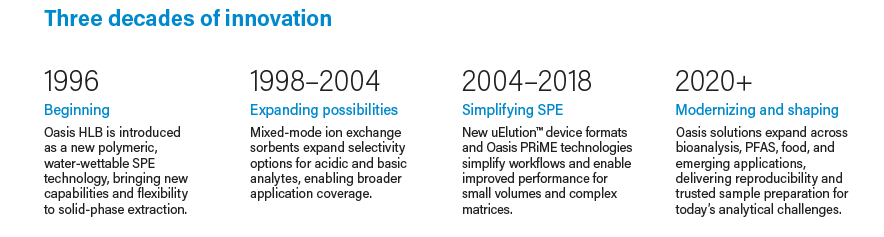
While the fundamental goals of sample preparation have remained the same, the technologies used to achieve them have evolved considerably. Since Oasis HLB first launched in 1996, three decades of innovation in sorbent chemistry and workflow design have transformed SPE from a specialized technique into an everyday tool for analytical labs—a journey worth taking a closer look at.
What Are the Challenges in Sample Preparation?
The importance of sample preparation and cleaning up your samples comes down to one major challenge: matrix interferences. These interferences can introduce data variability, compromise method reliability, and cause problematic issues with instrumentation— especially in LC-MS workflows. Cleaning up your samples provides the added benefit of increased sensitivity by concentrating analytes of interest, improving the accuracy and precision of analytical results, and removing interfering substances.
While matrix effects remain a common challenge today, modern SPE technologies have significantly improved laboratories’ ability to remove interferences efficiently and reproducibly. Over the past 30 years, advances in sorbent chemistry have enabled analysts to achieve cleaner extracts with fewer processing steps, helping support both routine and highly regulated workflows.
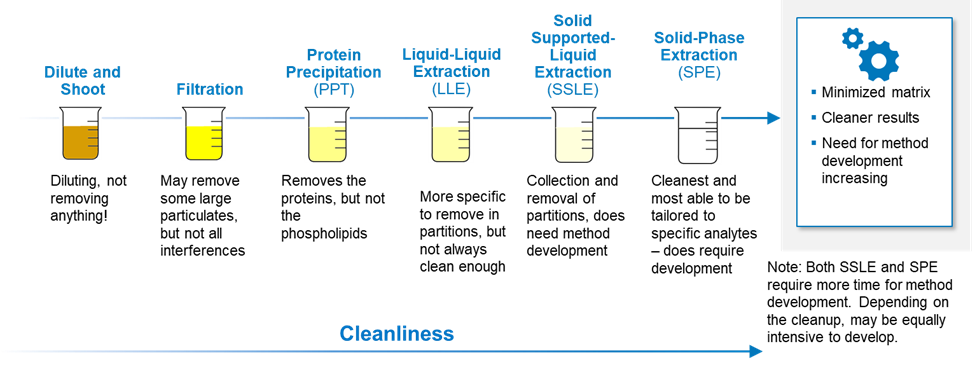
There are many sample preparation techniques, ranging from simple methods like filtration and protein precipitation to more selective and sensitive techniques like solid-phase extraction (SPE), which produces the cleanest extracts. While there are many sample preparation techniques, SPE stands out for its ability to deliver cleaner extracts, reduce matrix interferences, and improve sensitivity, especially in challenging applications. Let’s take a closer look.
The Evolution of SPE for Modern Analytical Workflows
As analytical labs have taken on increasingly complex sample matrices, stricter regulatory expectations, and higher throughput demands, SPE technologies have advanced in step—moving from traditional cleanup approaches to highly selective, application-specific solutions built for modern workflows.
The introduction of water-wettable polymeric sorbents, mixed-mode chemistries, high-throughput plate formats, and simplified extraction protocols has helped make SPE more robust, reproducible, and accessible than ever before.
Automated SPE platforms can work together with these modern SPE sorbents to further enhance reproducibility and make method development more turnkey, while reducing hands-on-time and supporting higher sample throughput.
Today, scientists can choose from a broad range of SPE chemistries and device formats designed to address challenges ranging from pharmaceutical bioanalysis and PFAS testing to food safety and clinical research.
How Does Solid-Phase Extraction Work?
SPE works by passing a liquid sample through a solid adsorbent material (sorbent) that retains the analytes of interest by selecting appropriate solvents and sorbents selective per the analyte. Different sorbent chemistries, such as silica-based, polymer-based, and ion-exchange materials, are used depending on the nature of the analytes and the sample matrix.
Common SPE protocols typically work in one of two ways:
- Load-wash-elute, which consists of loading the sample, washing away interferences, and eluting
- Pass-through, where interferences are captured in the sorbent and cleaned analytes pass through.
Choosing Your SPE Sorbent
At Waters, we provide a diverse range of Sep-Pak Sorbents, including many silica-based options designed to help you tackle even the most complex challenges in the lab. Oasis Sorbents are polymeric sorbents, all based on the backbone of Oasis HLB, each designed to handle different types of analytes and sample matrices with simplified protocols.
For 30 years, Oasis sorbents have helped scientists address evolving sample preparation challenges through continuous innovation in polymeric SPE technology. From the original Oasis HLB chemistry to Oasis PRiME HLB and mixed-mode ion-exchange solutions, Oasis SPE supports a broad range of analytes, matrices, and analytical objectives.
- Oasis HLB Sorbent is a hydrophilic-lipophilic balanced sorbent that provides high capacity for acids, bases, and neutrals, making it ideal for a wide range of applications.
- Oasis PRiME HLB Sorbent adds additional capabilities to further remove complex matrix interferences, like phospholipids and salts, when preparing a sample for LC-MS analysis.
- Oasis Mixed-Mode Ion Exchange Sorbents (MM-IEX, MCX, MAX, WCX, WAX) offer the highest level of specificity and sensitivity for analytes demanding more selectivity.
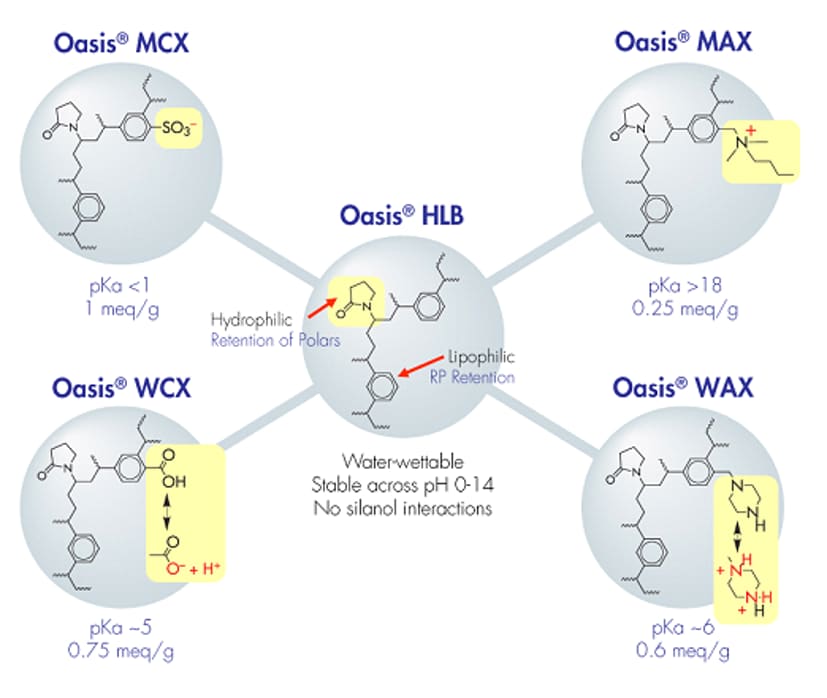
SPE is widely used in various fields, including environmental analysis, pharmaceuticals, food safety, and clinical diagnostics. Routine sorbents used in SPE include Oasis HLB, MM-IEX, C18, C8, and Silica Sorbents, each selected based on specific application and analyte properties. Some unique examples include using WAX sorbents for PFAS due to the ability to bind to the acidic nature of many PFAS, MCX for basic drugs and tryptic peptides, or even Sep-Pak PSA Sorbent for fatty acid cleanup.
Choosing Your SPE Device Format and Sample Processing Options
Selecting the appropriate device format, such as cartridges, 96-well plates, or µElution Plates, depends on the sample volume, sample throughput requirements, and the nature of the analytes.
- Easy sample prep of one individual sample – A syringe-based plus-style cartridge can be used for quick cleanup of a sample, such as potentially with food
- Large sample batch size – 96-well options can increase efficiency, such as with bioanalytical assays
- Peptide samples – Peptides could undergo non-specific binding, reducing sensitivity. µElution Plates provide additional concentration to increase sensitivity with a unique design that minimizes analyte loss attributable to sticking to the walls of collection plates.
- Versatile sample prep – Traditional vacuum cartridges are a widely used format across all industries. They are well-suited for processing individual samples or small batches, with a variety of sorbent capacities to fit different analytical needs.
Proper vial selection for labs is also a crucial aspect of sample preparation. Sample processing options include manual, semi-automated, and fully automated systems, each offering different levels of efficiency and convenience.
As laboratory throughput requirements have increased, SPE device formats have evolved to support workflows ranging from individual sample preparation to fully automated, high-throughput analysis. Modern cartridge, plate, and µElution formats provide flexibility to balance productivity, sensitivity, and scalability.
How to Evaluate Your SPE Protocol
Evaluating your SPE protocol involves measuring three key parameters to determine success.
- % recovery: The percentage of analyte recovered from the sample.
- Matrix effect: The impact of other substances in the sample on the analyte’s detection.
- Mass balance: The total amount of analyte accounted for in the extraction process.
Beyond recovery and matrix effects, many labs also assess method reproducibility across analysts, batches, and instruments. Consistent performance over time remains one of the most important indicators of a robust sample preparation workflow, particularly in regulated environments where data confidence is critical.
If recovery is low, matrix effects high, and reproducibility poor, you may need to troubleshoot the protocol. This involves adjusting the sorbent type, elution solvents, and sample loading conditions. With method optimization, you can ensure that your SPE protocol is robust and reliable for routine use.
Getting Started with SPE
Solid-phase extraction remains one of the most powerful and versatile sample preparation techniques available to analytical scientists. Whether the goal is reducing matrix interferences, improving sensitivity, increasing reproducibility, or simplifying workflows, selecting the appropriate SPE chemistry and format can have a significant impact on analytical performance.
Over the past 30 years, advances in SPE technology have helped labs address increasingly complex analytical challenges while improving workflow efficiency and confidence in results. As analytical science continues to evolve, SPE remains a foundational tool for generating cleaner samples and more reliable data.
For more information on how to optimize your SPE protocols and to explore our full range of SPE products, including our sample prep kits and vials for labs, visit our page on sample preparation. For more on getting started with SPE, check out our Beginner’s Guide to SPE or watch our recent webinar.
Related posts
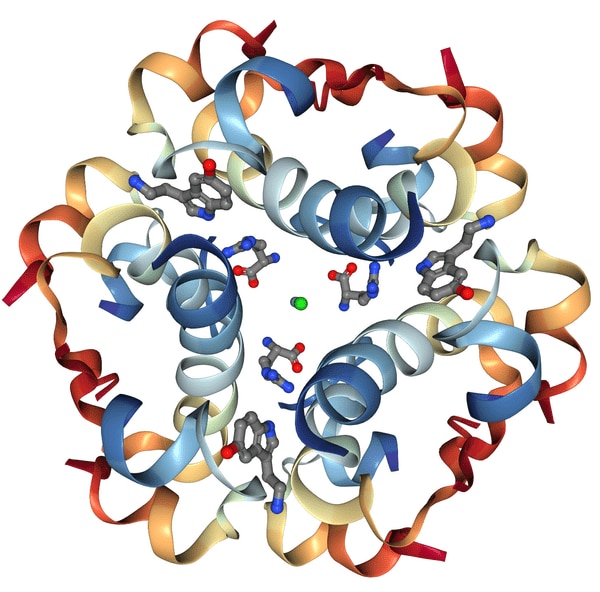
From Hidden Assemblies to Drug Target Insight with CDMS and Cryo-EM
A recent JACS study by Prof. Siavash Vahidi and collaborators at the University of Guelph (Canada) highlights how Charge Detection Mass Spectrometry (CDMS) can uncover hidden protein assemblies that conventional methods often miss. By guiding cryogenic electron microscopy (cryo-EM) toward structurally distinct populations, CDMS enabled a deeper understanding of the active architecture and substrate recognition…

From Transcript to LNP Formulation: Measuring Intact mRNA with CDMS
mRNA therapeutics are advancing rapidly, but a major analytical challenge remains: how do you verify that a large, full-length transcript remains intact throughout manufacturing and formulation? A recent Analytical Chemistry article by scientists from Pfizer and Megadalton Solutions demonstrates how charge detection mass spectrometry (CDMS) helped to close this gap. The researchers directly measured intact…

From Complex Workflows to Conversation: How Waters is Bringing Governed, Practical AI Into Laboratory Software
Artificial intelligence (AI) is changing how people interact with software. However, in the lab, innovation must do more than make technology easier to use, it must also support scientific confidence, protect access to data, and fit within established governance. Waters AI Link is designed for that reality, providing a conversational connection to waters_connect Software that…
Popular Topics
ACQUITY QDa (17) bioanalysis (14) biologics (17) biopharma (50) biopharmaceutical (60) biotherapeutics (24) case study (22) chromatography (16) data integrity (28) HPLC (17) informatics (12) LC-MS (36) liquid chromatography (LC) (35) mass detection (17) mass spectrometry (MS) (68) method development (16) particle analysis (21) regulatory compliance (16)