Food & Environmental

Public health and environmental testing laboratories rely on our instruments, software, reagents, and consumables products to help ensure the safety of drinking water and that foods are authentic and free of adulterants or contaminants. Our instruments help our customers identify PFAS (aka: “forever chemicals” that can be harmful to humans and the environment) at very low levels to study their persistence and toxicity. Waters also provides both technology and expertise to help advance the science of plant-based and alternative protein foods.

  • Choosing the Correct Column for Chromatographic Selectivity

    When developing a method for the routine multiresidue analysis of pesticides in food commodities there are several factors that need to be considered when selecting which liquid chromatography (LC) column to use. The requirements include: Good retention for a range of physiochemical properties (polar, non-polar, base, acid). Moderate to high resolution (peak capacity). Sample extracts…

  • Retained or Not Retained? How Much is Enough Retention?

    In the various pieces of collateral we have published at Waters on highly polar pesticides, such as glyphosate or chlormequat, one of the main parameters we discuss is retention. But what do we mean by the word retention? The retention time (RT) is the time between the start of an injection to the emergence of…

  • Visions of the Technological Future

    As technology evolves at an ever-increasing rate, the future draws nearer. An 11-year-old today is expected to see a 64-fold increase in computing power by the time they finish high school.[1] From global internet connectivity to smart phones, the incredible innovations from the last few decades have become building blocks to transform life as we…

  • Sustainable Solutions for Plastics: The Future Role of Lignins

    Plastics – Friend and Foe If you’re like me, you’ve probably seen images of all the floating plastic in the Great Pacific garbage patch or perhaps you’ve seen the images of wildlife rescuers trying to remove a plastic straw from a sea turtle’s nose. These images can be quite disturbing and destructive to the reputation…

  • Sample Profiling of Pesticide Formulations Using UV and MS Detection for Component Identification

    For the agricultural chemicals industry, the analytical quality control of pesticide products ensures that a consistent and effective product reaches the farm. More specifically, the detection, characterization, and quantitation of the active ingredient(s) as well as all other components in the formulation, including impurities and degradation products, are necessary to support product development, quality control,…

  • Nourishing Food and Water Research

    Opening this week in Singapore is a new resource for scientists in the challenging position of needing analytical insights as part of their food and water research, but who lack access to state-of-the-art instrumentation … we’re so excited we wanted to share a preview!

  • Lake Fear?

    Determining whether the cyanobacteria present in a water body are producing toxins requires laboratory testing. However, detection of microcystins is a challenging problem for water testing laboratories.

  • What’s the Key to Long-Term Success in a Food Testing Laboratory? Reliability.

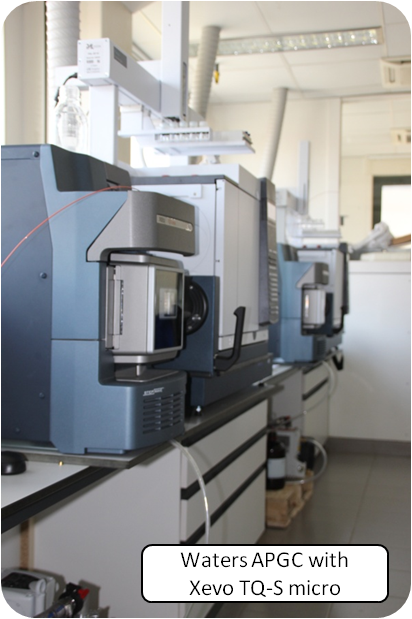
    Waters Corporation and PRIMORIS Belgium… a reliable relationship It makes sense, doesn’t it? No one likes being let down; disappointed. Especially when the consequences are significant. Take, for example, a specialized food testing laboratory – PRIMORIS Belgium – which is responsible for processing more than 60,000 samples (and analyzing more than 20,000,000 results!) annually. They…

  • Listening to Underground Music at Washington State University

    Dr. Weller is Research Leader of the U.S. Department of Agriculture’s Agricultural Research Services Wheat Health, Genetics and Quality Research Unit at Washington State University (WSU). His specialty is plant pathology, and the cutting-edge research that his research unit conducts, now with ion mobility mass spectrometry, solves problems affecting the production of small grains, wheat, and barley.