
USP <326>: What the New SEC-MALS Chapter Means for Vaccine Labs
What is USP <326>?
A new General Chapter is about to become official in the United States Pharmacopeia–National Formulary and, if your lab touches polysaccharide vaccines, it’s worth clearing space on your calendar for it. USP <326>, “Molar Mass Determination of Bacterial Polysaccharides Used in Human Vaccines by Size Exclusion Chromatography with Multiangle Light Scattering Detection,” becomes official on December 1, 2026.
For labs that have been running SEC-MALS informally, or that are still relying on calibration-dependent methods, USP <326> is the first chapter to codify a validated, absolute molar mass method specifically for this molecule class. Below, we break down what’s in the chapter, why it matters to you, and what you should consider if a MALS system is currently on your capital-equipment roadmap.
What does USP <326> cover?
USP <326> specifies a validated method for measuring the molar mass and polydispersity of bacterial polysaccharides, the sugar-coating antigens behind vaccines for Haemophilus influenzae type b, Streptococcus pneumoniae, Neisseria meningitidis, and typhoid. These vaccines reach tens of millions of people annually, and molar mass is a critical quality attribute, affecting immunogenicity, conjugation efficiency, stability, and lot-to-lot consistency.
Traditional column-calibration methods estimate molar mass by comparing elution time to standards like dextrans or globular proteins. That works reasonably well for simple, well-behaved molecules, but bacterial polysaccharides vary widely in branching and conformation depending on their bacterial source, and structurally dissimilar calibration standards can’t account for that variation. The result is systematic, undetectable errors that calibration alone can’t correct.
SEC-MALS avoids this problem entirely by measuring molar mass directly from first principles of light scattering, with no column calibration curve required. That’s why USP <326> specifies it as the method of choice.
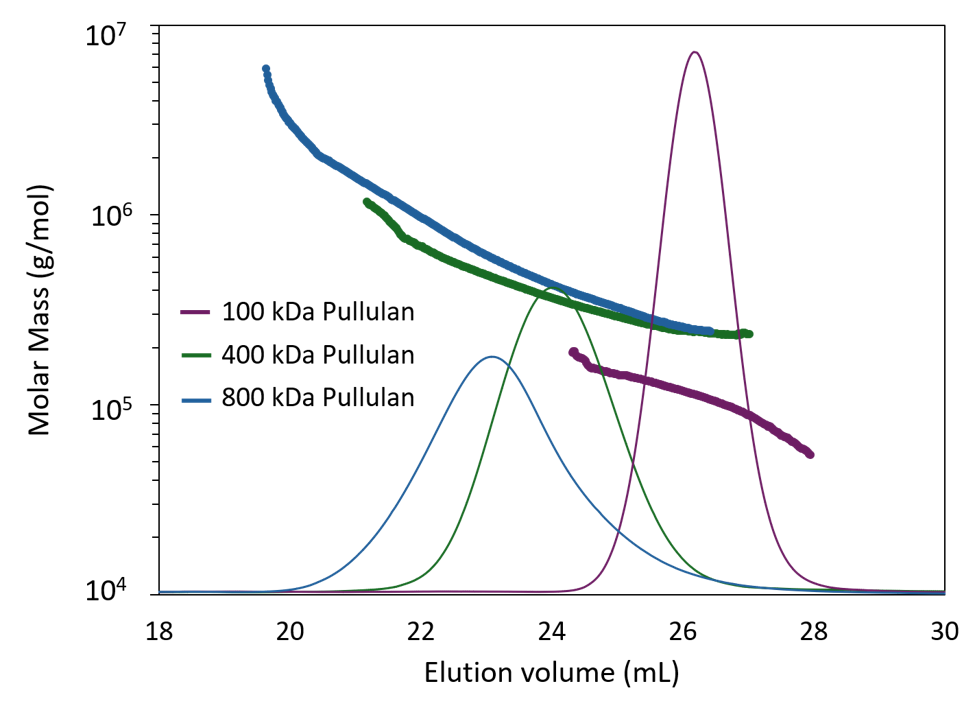
dRI chromatograms of pullulan standards run using the new USP method. The molar mass measured by MALS is overlaid on each peak.
To that end, the chapter defines the full method: a three-column SEC train, mobile phase, flow rate, run time, and a MALS detector paired with an RI detector, along with system suitability testing against four USP reference standards chosen to bracket the target polysaccharide’s molar mass range.
What is the USP <326> SEC-MALS method?
An abbreviated version of the USP <326> SEC-MALS method is provided below; for full details, see the general chapter.
The chapter specifically calls for a series of three L39 columns. This three-column series accounts for the highly polydisperse nature of bacterial polysaccharides, especially prior to depolymerization.
| Parameter | USP <326> Specification |
| Mobile Phase | 10 mM sodium chloride, 200 µg/mL sodium azide, 20% acetonitrile |
| Columns (analytical) | Three L39 columns in a series |
| Temperature | 35 oC |
| Flow rate | 1 mL/min |
| Injection volume | 100 µL |
| Run time | 50 minutes |
| Detector | MALS coupled to an RI detector |
| Additional detector | UV 280 |
USP <326> dn/dc determination
The dn/dc is the change in the refractive index (dn) of a solution relative to a change in solute concentration (dc). Getting dn/dc right, whether through a published value, offline determination, or online determination, is foundational to an accurate molar mass result.
USP <326> recognizes three acceptable dn/dc determination approaches:
- Published Value – must be corrected for differences between the published and actual experimental conditions (polysaccharide structure, mobile phase, instrument settings).
- Offline Determination – inject the solvent and at least five sample concentrations into the RI detector; the slope of RI vs. concentration gives dn/dc.
- Online Determination – calibrate the RI detector with a standard of known dn/dc, then calculate the sample’s dn/dc from its own injection (gradient or single injection, given sufficient recovery).
Schedule a consultation to learn how Waters instruments and software can support dn/dc measurement.
USP <326> system suitability requirements
USP <326> proposes four system suitability standards, though fewer may be used if the materials selected bracket the molar mass range of the polysaccharide being tested.
The chapter specifies accuracy requirements for both molar mass and polydispersity, along with a repeatability requirement across all standards. For the monodisperse standards (BSA or albumin), molar mass and polydispersity must fall within a tighter tolerance of the certificate of analysis (COA) value. For the polydisperse pullulan standards, molar mass must fall within a wider tolerance, typically around 20% of the certificate value. Across all standards, two injections must agree within a specified repeatability limit.
| System Suitability Standards |
| USP BSA for Molar Mass Determination RS or USP rAlbumin Human RS |
| USP Pullulan for Molar Mass Determination (100 kDa) RS |
| USP Pullulan for Molar Mass Determination (400 kDa) RS |
| USP Pullulan for Molar Mass Determination (800 kDa) RS |
What does USP <326> mean for your lab?
USP <326> doesn’t just affect QC release testing—it touches the full development lifecycle. Process development and analytical development teams that standardize on SEC-MALS early avoid a costly technology transfer and revalidation cycle later.
While calibration-based methods won’t disappear overnight, labs relying on them should expect growing pressure to demonstrate equivalence as SEC-MALS becomes the recognized compendial reference method. Method-bridging studies take time to plan and execute, which means the real window for evaluating instrumentation should happen earlier than later.
How can you prepare for USP <326> compliance?
As you evaluate MALS detectors for your polysaccharide vaccine characterization workflows, a few questions are worth asking of any supplier:
- Will this instrument pay back your capital investment over its lifetime?
- What training will you and your team receive to get the most out of it?
- If something goes wrong, is there a light-scattering expert who can answer your question?
- Will the software handle the polymer branching and protein conjugation analyses your work requires?
- Will it support the compliance workflow?
Waters is the primary manufacturer, designing and building every MALS instrument in-house. Our DAWN MALS Photometer line benefits from continuous hardware development and continuous software development, with new features in every release. Behind the instrument sits a dedicated team of light-scattering engineers, software developers, applications scientists, and a customer success team, the kind of support a USP <326> method qualification depends on.
Additional resources
This is a fast-moving compliance topic, and a blog post can only cover so much.
Download our full USP <621> FAQ for a complete breakdown of the new regulations.
Schedule a consultation with our team to talk through what USP <326> readiness looks like for your lab.
Related posts
The Next Frontier in Nitrosamines Testing: Detection and Risk Assessment in Packaging and IV Infusion Bags
Nitrosamine analysis continues to push analytical labs to new levels of sensitivity, while the evolving regulatory landscape is expanding the conversation beyond traditional testing. As attention turns to other N-nitroso species (i.e., o-NNOs) and potential extractables and leachables (E&L) from packaging materials, such as IV bags, labs face new challenges in detection, quantification, and method…

AI Maturity in GMP: Accelerating Your Digital Journey at Warp Speed, Safely
Most AI projects fail. The organizations that succeed are the ones that build governance before they build velocity. Written by Tracy Hibbs and Tony Sacchetti, Waters Corporation Artificial intelligence (AI) is poised to take routine work and shift it to fully automated workflows. Currently, 80% of AI projects fail.1 As with most paradigm-shifting technology, it…

Is Your Organization Ready for AI Inspection?
Inspecting AI is not new to regulators. The expectations are already well-established. The key question is whether your organization can reliably demonstrate them. Written by Tracy Hibbs and Tony Sacchetti, Waters Corporation Exploring artificial intelligence (AI) and machine learning (ML) in regulated laboratories governed by Current Good Manufacturing Practices (CGMP) may be new for your…
Popular Topics
ACQUITY QDa (17) bioanalysis (14) biologics (17) biopharma (50) biopharmaceutical (60) biotherapeutics (24) case study (22) chromatography (16) data integrity (30) HPLC (17) informatics (12) LC-MS (40) liquid chromatography (LC) (37) mass detection (17) mass spectrometry (MS) (71) method development (16) particle analysis (21) regulatory compliance (16)