
Two Truths and a Lie About Solid‑Core Particle Efficiency
Solid‑core (or superficially porous) particles are the foundation of solid core HPLC columns and have earned a reputation for delivering higher efficiency separations than similarly sized, fully porous particles. Chromatographers see this play out repeatedly across small- and large-molecule applications under a wide range of operating conditions.
But why solid‑core particles are more efficient is often misunderstood.
Let’s separate reality from misconception with two truths and a lie about solid‑core particle efficiency.
Truth #1: Longitudinal diffusion plays a major role – but not for the reason you might think
Yes, solid‑core particles exhibit reduced longitudinal diffusion. But the reason has little to do with a shorter diffusion path length.
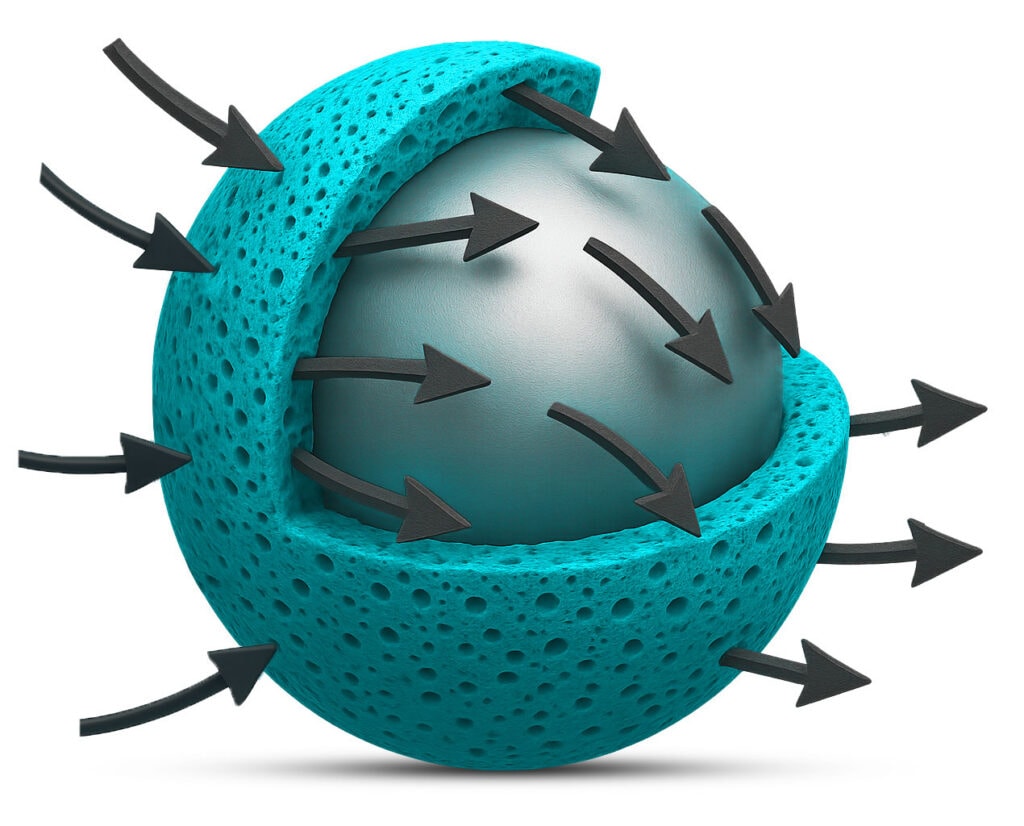
The real driver is the mobile phase volume inside the particle.
In a fully porous particle, analytes can diffuse throughout the entire internal pore volume. That gives the sample band more space to spread out along the column length.
In contrast, a solid‑core particle contains an impermeable core, which dramatically reduces the volume inside the particle that is accessible to the mobile phase. With less internal space for analytes to explore, longitudinal diffusion is naturally limited.
The result:
- Less band broadening
- Sharper peaks
- Higher efficiency—especially for small molecules operating at or below the optimum flow rate
Truth #2: Eddy dispersion, particle morphology, and packing uniformity significantly impact efficiency
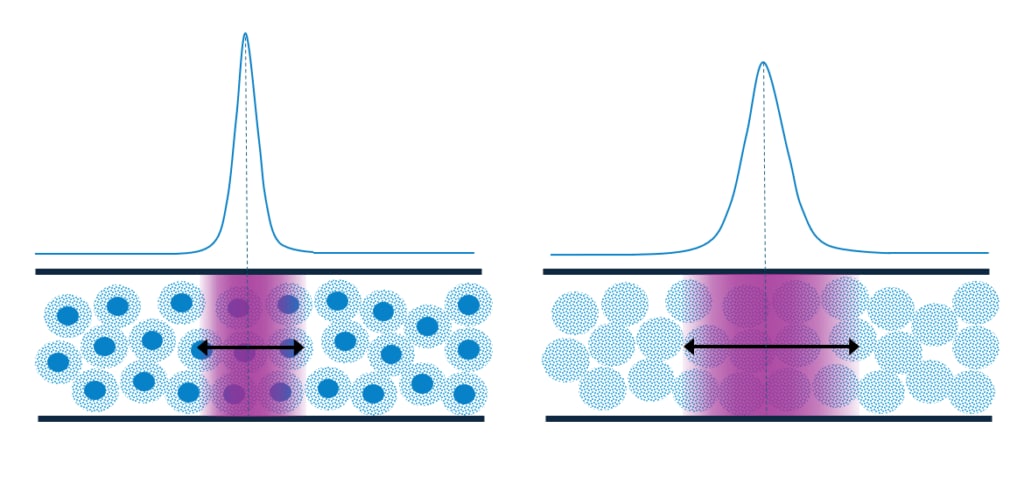
One of the most underestimated contributors to efficiency is how particles pack inside the column.
In any packed bed, the structure near the column wall differs from that in the center. These structural differences create variations in flow velocity across the column radius, which contribute to eddy dispersion.
This is where solid‑core particles used within solid core HPLC columns have an advantage.
Because of their surface characteristics, particularly increased surface roughness, solid‑core particles pack more uniformly across the column diameter than smoother, fully porous particles. A more homogeneous packed bed leads to:
- A more consistent flow velocity profile
- Reduced radial heterogeneity
- Less band broadening caused by eddy dispersion
This improved packing uniformity can make a meaningful contribution to efficiency gains.
The Lie: Solid‑core particles are more efficient because they significantly reduce mass transfer resistance
This is more of a misconception than an outright lie. Mass transfer plays a smaller role in solid-core efficiency than it is usually credited with.
The argument goes like this: solid‑core particles have a thin, porous layer around a solid core, which shortens the diffusion path inside the particle, which in turn reduces the mass transfer resistance for the analyte (the C-term in the Van Deemter equation).
Shorter path equals less mass transfer resistance, which equals higher efficiency.
That sounds reasonable, but it doesn’t hold up when you look at the data closely.
- For small molecules: Mass‑transfer resistance is already very low for both fully porous and solid‑core particles. At typical flow rates, differences in solid‑to‑liquid mass transfer are negligible — certainly not large enough to explain the consistently higher efficiency observed with solid‑core materials.
- For large molecules: It is true that shorter diffusion paths in the porous shell can improve mass transfer. However, even in this case, mass transfer is not the only contributor to the overall efficiency gain.
So, while reduced mass transfer resistance exists, it plays a relatively small role in the improved efficiency of a solid‑core particle.
The bottom line
When you put everything together, the efficiency advantage of solid‑core particles comes down to two main contributors:
- Eddy dispersion – More uniform packing leads to a more consistent flow profile distribution and reduced band broadening.
- Longitudinal diffusion – Reduced mobile phase volume inside the particle limits band broadening and sharpens peaks.
Mass transfer can contribute to efficiency, but it is not the primary driver of solid-core particle performance. Shorter diffusion paths in the porous shell can reduce mass transfer resistance for large molecules, but for small molecules this impact is minimal.
So, the next time someone says solid‑core particles are more efficient because of improved mass transfer, you’ll know the truth!
For more on the benefits of solid-core particles, check out the following resources:
Infographic: Upgrading to Solid-Core Particles
Video: What Drives Higher Efficiency in Solid-Core Columns?
Application Note: Improving Separation Efficiency with CORTECS Premier Columns that Feature Solid-Core Particles
Blog Post: The Quest for Maximum LC Performance
Related posts
Breaking the Megadalton Barrier: Benchtop CDMS Arrives
A recent bioRxiv paper by Dr. Jakub Ujma and colleagues at Waters Corporation, in collaboration with Prof. Martin Jarrold from Indiana University and Megadalton Solutions, describes a major advance—the first commercial benchtop charge detection mass spectrometer (CDMS) based on electrostatic linear ion trap (ELIT) technology. Why does this matter CDMS is uniquely suited for analyzing…

What’s Really Happening Inside the Capsid of Norovirus VLPs?
Norovirus virus-like particles (VLPs) are structurally heterogeneous, built from a single capsid protein that self-assembles into multiple geometries, making full characterization by conventional mass spectrometry (MS) extremely difficult. A recent bioRxiv paper by Dr. Charlotte Uetrecht and colleagues at the Centre for Structural Systems Biology (CSSB) in Hamburg, Germany, in collaboration with Waters scientists, demonstrates…

Advancing Oligonucleotide Purification with MaxPeak Premier OBD Prep Columns
Oligonucleotide therapeutics continue to grow in complexity, and so do the purification challenges that come with them. Scientists need reliable, scalable solutions for preparative oligonucleotide purification. MaxPeak Premier Oligo OBD Columns provide a powerful solution for these workflows, now expanded to include 19mm ID formats. These columns reduce non-specific adsorption, improve recovery, and enable consistent…
Popular Topics
ACQUITY QDa (17) biologics (17) biopharma (50) biopharmaceutical (59) biotherapeutics (24) case study (22) chromatography (16) data integrity (27) food analysis (12) HPLC (17) informatics (12) LC-MS (33) liquid chromatography (LC) (32) mass detection (16) mass spectrometry (MS) (68) method development (16) particle analysis (21) regulatory compliance (15)