​​​​Future-proofing today for the genetic medicine of tomorrow


Today’s gene therapy development teams face significant analytical uncertainty. Repurposed assays are introducing high variability, consuming precious low-yield samples, and slowing development. Confidently accelerating your development is critical, but to do that, your team needs analytical solutions purpose-built for unique genetic medicine demands.​

With Waters solutions, your team can:​

  • Reveal more attributes with greater precision, lower variability, and minimal sample use ​
  • Get an opportunity to detect everything, regardless of size ​
  • Bring advanced analysis into routine release with guided workflows​
  • Maximize uptime and guide scale-up with expert service teams​

Capsule pill with DNA helix inside on blue background
A translucent capsule open with a DNA helix inside on a blue gradient background.

Start with consistency. Leave no detail to chance.​


In genetic medicine, analytical uncertainty slows development. Obtaining clear, reliable data can be a challenge as scarce, low‑yield samples are easily lost to adsorption, metal interactions, and secondary‑interaction effects.​

With Waters column and prep solutions, your lab can:​

  • Reduce sample loss and improve size-appropriate separation with low‑adsorption MaxPeak Premier High-Performance Surfaces (HPS) Technology and GTxResolve SEC 450 Å  1000 Å and 2000 Å Columns. Minimize surface interactions and achieve higher, more consistent recovery and size‑appropriate separation for scarce AAV capsids, long‑mer mRNA, lipid nanoparticles (LNPs), and other metal‑sensitive nucleic acids.​​
  • Improve reproducibility for complex nucleic acids with batch-tested GTxResolve Columns and ACQUITY Premier Oligonucleotide Columns that limit secondary interactions for more reliable recovery and quantitation. ​
  • Protect limited material throughout prep with recovery‑focused sample‑handling tools and kits — so your lab can get more accurate quantitation and cleaner downstream data.​

Reveal more insights, faster.


Understanding critical quality attributes (CQAs) often requires multiple assays, driving up sample consumption, fragmenting data, and slowing decisions. Now, your team can bring these insights together with high‑resolution, multi‑attribute analytics that reveal more from every run.​

Waters technologies enable your lab to:​

  • Identify up to five CQAs for adeno-associated viruses (AAVs) or mRNA‑encapsulated lipid nanoparticles (LNPs) using a SEC‑MALS system that adapts easily to different serotypes.​
  • Achieve 2–10× faster analyses with 20× less sample than legacy sedimentation assays with the Xevo Charge Detection Mass Spectrometer (CDMS) that provides high‑resolution, multi‑attribute mass measurements for large, complex biologics, including AAVs.​
  • Reduce low yields and failure rates for AAVs by measuring empty and full capsids during bioprocessing in real-time for better decision-making with ultraDAWN Instrument for real-time multi-angle light scattering (RT-MALS).​
  • Improve LNP formulation stability with either the DynaPro ZetaStar DLS/ELS/SLS Instrument, which enables teams to optimize electrophoretic and colloidal stability, or with the Aura Subvisible Particle Analysis System (>1 μm), which uses 100× lower sample volumes than repurposed particle‑analysis tools to deliver low‑volume, high‑throughput particle detection and surface stability risks earlier.​
Scientist looking at a glass test tube

Navigate complexity as regulations evolve


Agencies across regions are updating their guidance and expectations, refining clinical, chemistry, manufacturing, and controls (CMC), and long‑term safety frameworks as programs mature. Together, these global shifts reflect a regulatory environment that is more structured and demanding, just as more genetic medicines approach commercialization.​

Navigating these complex, changing requirements can be challenging for today’s genetic medicine labs. Waters helps your lab by:​

  • Providing a clear, compliant‑ready framework with our AAV standard operating procedure(SOP) for SEC-MALS that simplifies characterization requirements, standardizes workflows, andhelps you generate defensible data even as regulatory expectations evolve.​
  • Bridging to tomorrow’s deeper sequence confirmation requirements with an integrated ecosystem that streamlines sample prep, intact mass analysis, and sequence confirmation, providing ready‑to‑activate MS capability with RapiZyme MC1, RapiZyme Custativin Enzymatic Kits, and waters_connect Software.​
Young female nurse speaking with female patient in bright room

Tailored services for uninterrupted growth


Analytical solutions purpose-built for unique genetic medicine needs are a requirement, but significant downtime in implementing those solutions shouldn’t be. Scaling up your lab and the associated tech transfer is risky, and every deviation or downtime event costs time, material, and momentum.

With Waters, your lab can mitigate these risks with purpose-built hardware and methods that transfer cleanly across sites and support and scale with your program.

Waters helps you:

  • Ensure reliable operation with Flexible Service Plans (Gold/Platinum), remote diagnostics, and instrumentation built for uptime with installation qualification/operational qualification (IQ/OQ) options when you need it​
  • Maximize uptime with FlexCHOICE Service Plans, providing priority on‑site and remote support, certified field engineers, and comprehensive repair coverage​
  • Strengthen process performance qualification through validated workflows and professional services that guide method transfer and ensure reproducible execution​
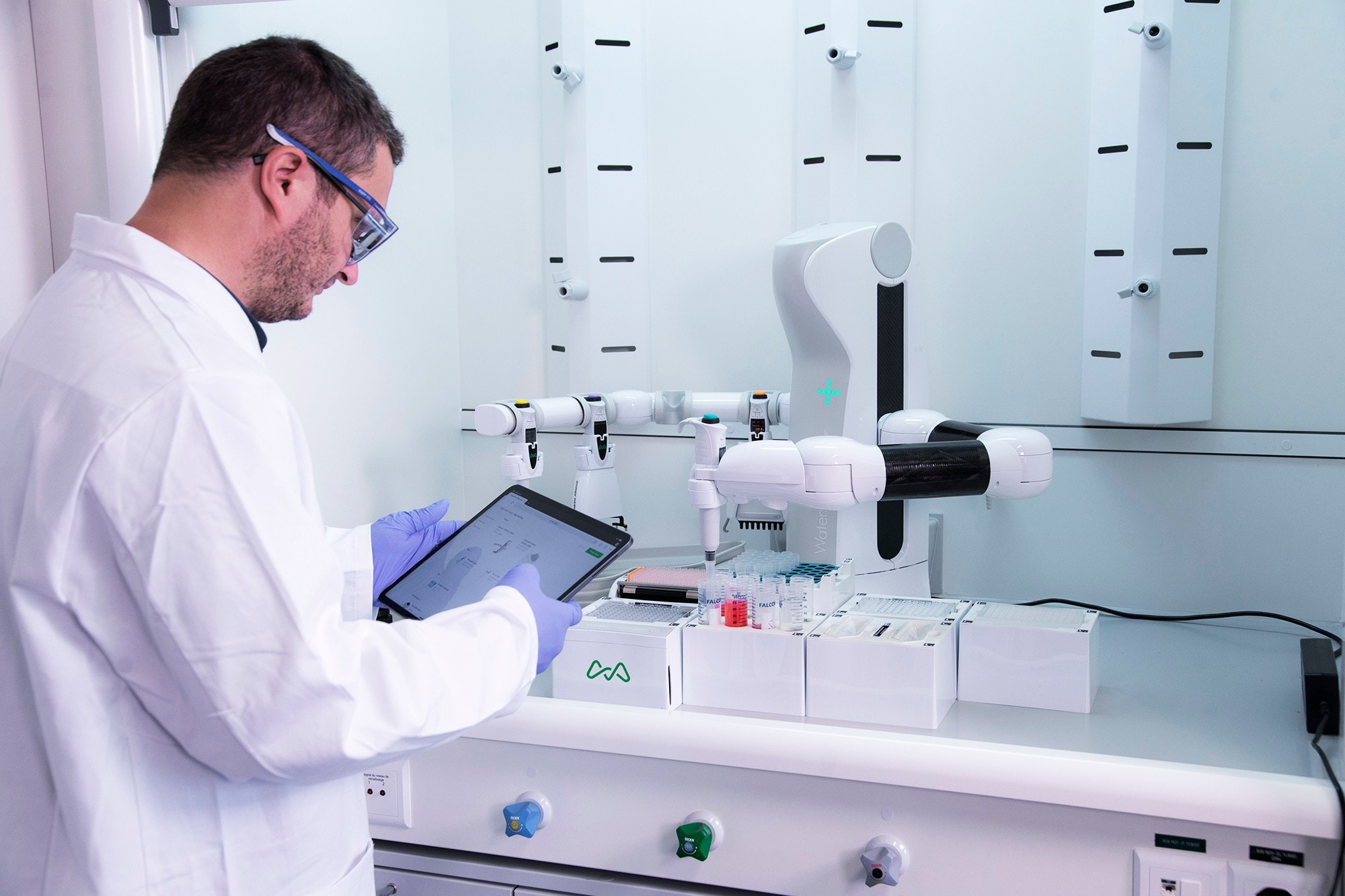
Scientist with Andrew+ and tablet running OneLab app

Frequently Asked Questions

Waters MaxPeak Premier Columns with MaxPeak HPS Technology are specifically engineered to minimize surface interactions that drive non‑specific adsorption in AAV, mRNA, and other nucleic‑acid‑rich samples. This reduces passivation time, improves recovery, and delivers more reproducible results across workflows.​

Waters GTxResolve Columns and ACQUITY Premier Oligonucleotide Columns limit secondary interactions that commonly suppress oligo recovery. Combined with optimized mobile phases and low‑adsorption instrument surfaces, these columns deliver cleaner peaks, higher recovery, and more consistent quantitation for ssDNA, dsDNA, and mRNA components.

The simplest way is with IEX-UV-UV, at 260 and 280nm. More advanced solutions like multi‑angle light scattering (MALS) with the appropriate GTxResolve SEC 450 Å,  1000 Å, and 2000 Å Columns, or CDMS, provide high‑resolution, non‑destructive quantitation of empty and full AAV capsids without relying on calibration curves. CDMS can further distinguish partially filled capsids, while MALS provides information on aggregation in-solution. Together, these solutions can measure capsid size, mass, titers, and heterogeneity directly, making them powerful for development, comparability, and scale‑up. ICH guidelines endorse orthogonal analytical methods to strengthen method validation and improve confidence in product quality.

For LNP‑mRNA products, MALS with FFF and RT‑MALS provide size, particle concentration, and payload‑related attributes in real time or offline. These measurements help assess LNP integrity and detect differences associated with encapsulation efficiency. When combined with LC‑MS‑based mRNA integrity and identity workflows, developers gain a complete picture of mRNA encapsulation and product quality.​

Dynamic light scattering (DLS) and MALS measure particle size, size distribution, and polydispersity for mRNA‑LNP systems. Forprocess‑development environments, RT‑MALS (ultraDAWN Detector) provides real‑time monitoring of size and particle concentration duringproduction, helping track uniformity and detect instability events as they occur. Larger sub-visible particles can be investigated with the Aura backgrounded membrane imaging (BMI) Solution.​

LC‑MS workflows enable identity and integrity confirmation for long‑chain nucleic acids. High‑resolution MS provides sequence mapping, intactmass verification, and detection of structural variants or degradation products. These tools support evaluation of capping efficiency, sgRNA purity,and mRNA structural integrity, critical for therapeutic activity and regulatory expectations.

Genetic medicine developers rely on orthogonal quantitation approaches. SEC‑MALS and FFF‑MALS measure capsid particle concentration andgenomic titer directly from light‑scattering intensity paired with in-line UV-UV, while complementary methods like UV, RI, and ddPCR quantify genome‑containing particles. Using both approaches helps reduce assay bias and improves dose accuracy across AAV programs.​

The ultraDAWN RT‑MALS Detector delivers real‑time measurement of CQAs—including particle size, molar mass, particle concentration, and empty/full behavior, during chromatography, filtration, or formulation steps. This enables immediate feedback, more precise pooling decisions, and earlier detection of process drift.​

Regulators expect strong analytical packages for AAV, mRNA, and LNP modalities. This typically includes:​

  • CQAs such as aggregation, empty/full capsid ratios, titer, genome integrity, and impurity profiles​
  • Identity and integrity confirmation of nucleic acids via LC‑MS or sequencing​
  • Stability and size analysis using MALS/DLS for viral vectors and LNPs
  • Potency‑related analytics, often tied to genome integrity, capsid attributes, or delivery efficiency​

Learn how Waters can help your lab future-proof today for the genetic medicinesof tomorrow.​

Voltar ao início Voltar ao início