
Robust Capillary and Low-Microflow LC-MS with Improved Acidic Peptide Recovery Using BioResolve™ 300 µm ID Columns
Caitlin M. Hanna, Stephan M. Koza, Balasubrahmanyam Addepalli
Waters Corporation, United States
Published on June 01, 2026

Abstract
In this application note, the performance of Waters BioResolve Premier Peptide 300 µm internal diameter (ID) Columns incorporating MaxPeak™ High Performance Surfaces (HPS) Technology is evaluated for LC-MS proteomics analyses. These columns provide superior recovery and improved peak shape for acidic peptides compared to conventional stainless-steel columns while maintaining comparable peak capacity. In addition, excellent column-to-column reproducibility is demonstrated. These results underscore the value of HPS Technology for robust, high-performance capillary and low-microflow LC-MS proteomics workflows, particularly those targeting acidic and phosphorylated peptides.
Benefits
- Higher recovery and improved peak shape for acidic peptides
- Consistent performance from the first injection with minimal column conditioning required
- Robust and reproducible capillary and low-flow separations with excellent column-to-column reproducibility
Introduction
Capillary and microflow LC-MS are increasingly adopted in proteomics to improve sensitivity while maintaining robustness. Columns with a 300 µm ID enable operation at low-microflow and capillary flow rates, which significantly reduces sample and solvent consumption and improves ionization efficiency. These attributes are particularly beneficial for proteomics workflows, where sample amounts are often limited and sensitivity is critical.1
Waters 300 µm ID columns deliver high chromatographic efficiency and robust performance for LC-MS-based applications, enabling confident peptide identification and quantitation.2,3 However, interactions between column hardware and acidic peptides can negatively impact chromatographic performance. These interactions may result in reduced recovery, peak tailing, and increased variability, which can compromise quantitative and qualitative proteomics results.
Waters MaxPeak Premier Columns address these challenges through MaxPeak HPS Technology, which minimizes unwanted analyte interactions with stainless-steel column hardware. HPS Technology has been shown to improve recovery and peak shape for acidic peptides while reducing the need for extensive column conditioning.4–8 In this application note, the performance of Waters BioResolve Peptide 300 µm ID Columns with MaxPeak Premier Technology in LC-MS proteomics workflows is evaluated.
The BioResolve Peptide MaxPeak Premier 300 µm Columns demonstrate improved recovery and peak shape for acidic peptides compared to equivalent stainless-steel columns, while maintaining comparable peak capacity. Additionally, these columns exhibit excellent column-to-column reproducibility and stable performance over repeated injections. Together, these results highlight the suitability of these columns for routine capillary and low-microflow LC-MS proteomics analyses, including workflows targeting acidic peptide populations.
Experimental
Sample Description
Waters MassPREP™ Enolase Digest with Phosphopeptides Mix ( p/n: 186003286) was reconstituted in 100 µL of 0.1% formic acid in water.
Calculations
4σ peak capacities were determined based on the following equation:

LC Conditions
|
LC system and setup: |
ACQUITY™ UPLC™ M-Class System 25 µm ID x 20” ZenFit tubing (p/n: 700011466) to connect the Micro Sample Manager (µSM) to the Micro Binary Solvent Manager (µBSM), 40 µm ID x 20 in ZenFit tubing (p/n: 430004967) to connect µBSM to column. Flow diverted straight from the column to the MS source with 40 µm ID x 30 in tubing (p/n: 700011516). |
|
Columns: |
Waters BioResolve Peptide C18 RP Column, MaxPeak Premier Technology, 1.7 µm, 300 Å, BEH™ Column, 0.3 x 50 mm (p/n: 186011501) nanoEase M/Z Peptide BEH C18 Column, 300 Å, 1.7 µm, 300 µm x 50 mm (p/n: 186009263) |
|
Column temperature: |
60 °C |
|
Sample temperature: |
6 °C |
|
Injection volume: |
0.5 µL |
|
Mobile phase A: |
0.1% Formic Acid in H2O |
|
Mobile phase B: |
0.1% Formic Acid in ACN |
|
Sample vials: |
QuanRecovery™ MaxPeak 12 x 32 mm Propylene 300 µL Screw Cap Vials (p/n:186009186) |
Xevo G3 Detector Settings
|
ESI probe: |
Low-flow probe (p/n: 186007529) |
|
Mass range: |
50–2000 m/z |
|
Mode: |
ESI+ |
|
Sample rate: |
2 Hz |
|
Cone voltage: |
30 V |
|
Source temperature: |
120 °C |
|
Desolvation temperature: |
250 °C |
|
Capillary voltage: |
2.50 kV |
|
Cone gas: |
50 L/h |
|
Desolvation gas: |
350 L/h |
|
Lockmass: |
LeuEnk (556.27658 m/z) |
|
Informatics: |
MassLynx Software (data acquisition) and waters_connect™ Software (data processing) |
Gradient Table
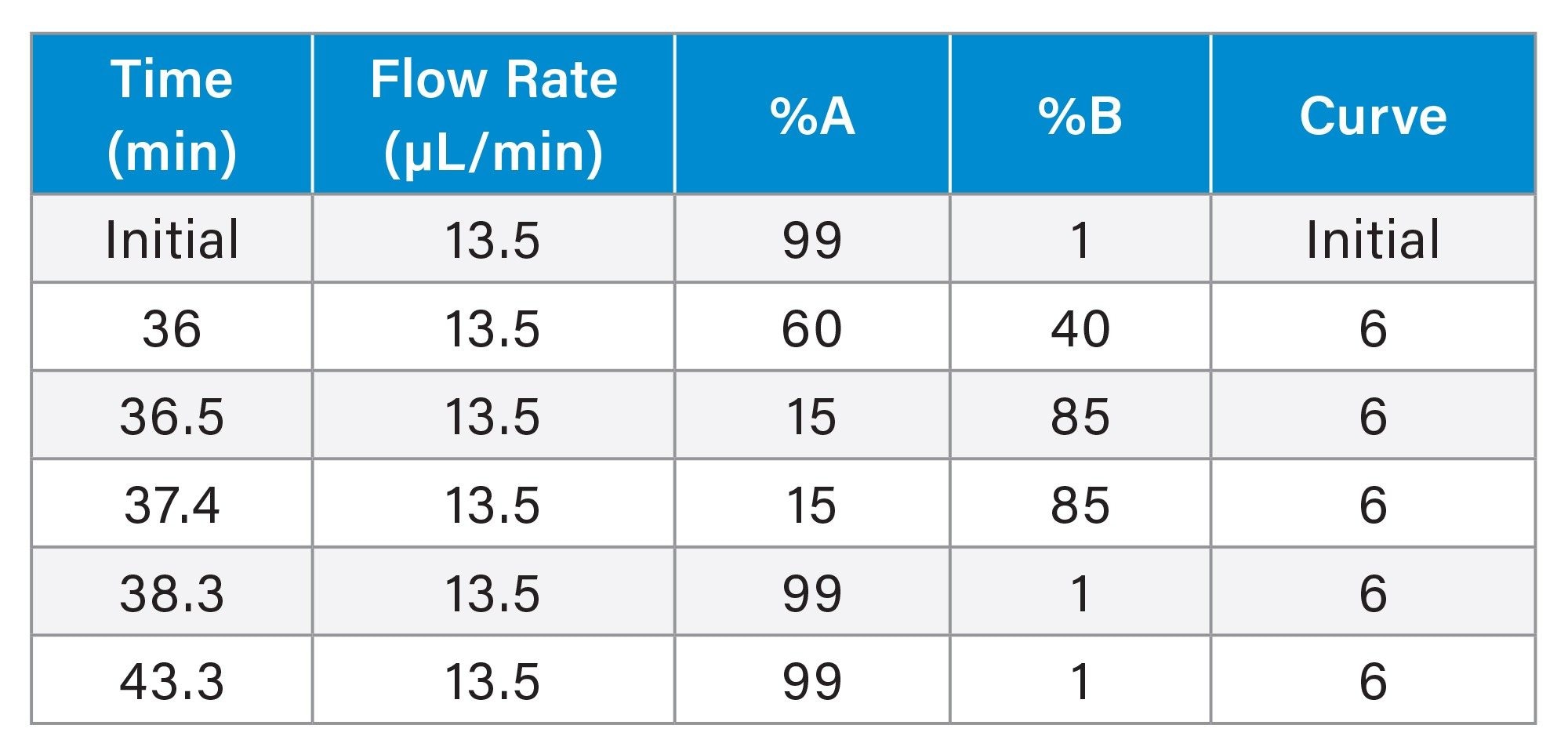
Peptide Sequences
|
Peptide |
Sequence |
|
T11 |
NVNDVIAPAFVK |
|
T18 |
NVPLYK |
|
T18p |
NVPLpYK |
|
T19p |
HLADLpSK |
|
T23 |
IGSEVYHNLK |
|
T50 |
LNQLLR |
|
T51 |
IEEELGDNAVFAGENFHHGDK |
Results and Discussion
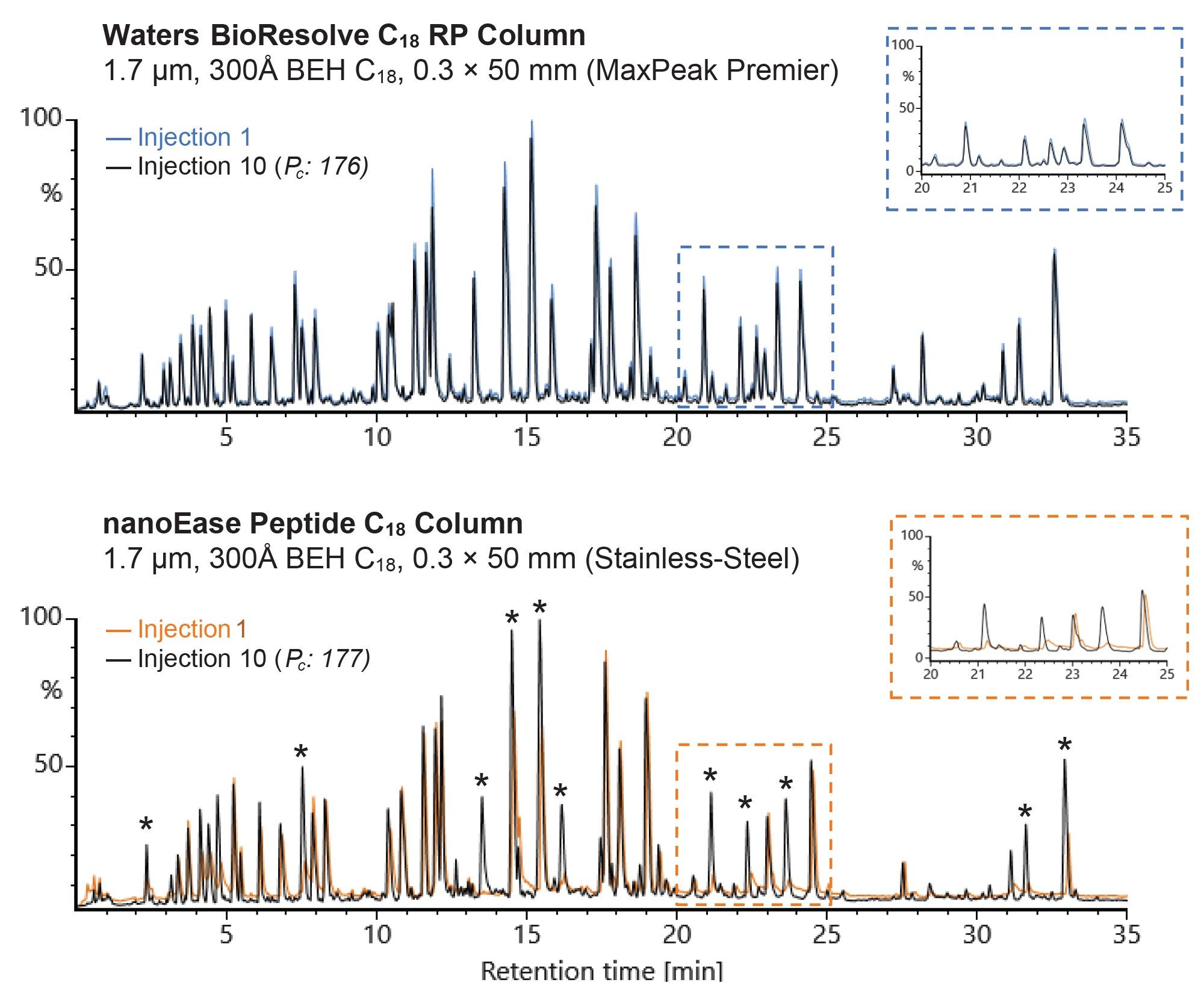
Figure 1 shows the total ion chromatograms (TICs) of the MassPREP Enolase Digest with Phosphopeptides Mix on a BioResolve C18 RP Column and a stainless-steel nanoEase Peptide C18 Column. The first injection is shown in blue (top) and orange (bottom), and the tenth injection on each column is shown in black. On the BioResolve C18 RP Column, the first and tenth injections are comparable, demonstrating that minimal column conditioning is required when using MaxPeak Premier hardware. In contrast, the nanoEase Peptide C18 stainless-steel column requires substantial conditioning. Peaks marked with an asterisk show a pronounced increase in intensity from the first to the tenth injection, indicating non-specific analyte-hardware interactions during the initial injection. Column conditioning reduces these interactions, resulting in increased peak intensities by the tenth injection. The inset highlights a region of significant change on the stainless-steel column between the first and tenth injection; the same region shows little change between the first and tenth injections on the MaxPeak Premier Column. Notably, on the tenth injection, both columns display comparable peak profiles and equivalent peak capacities.
HPS hardware mitigates unwanted interaction between acidic analytes and column hardware, resulting in higher recovery and improved peak shape relative to stainless-steel. Figure 2 shows the extracted ion chromatograms (XICs) of two acidic peptides (T19p and T51) and a non-acidic reference peptide (T18) analyzed on a Waters BioResolve C18 RP Column (left) and a nanoEase Peptide C18 Column (right). The T51 peptide contains three consecutive glutamic acid residues, an additional glutamic acid residue, and two aspartic acid residues, while T19p contains one aspartic acid residue and a phosphorylated serine residue. Data from the first and tenth injection on each column are shown. Visual inspection reveals superior recovery of the T51 peptide and improved peak shape for the T19p peptide on the BioResolve C18 RP Column during the first injection. In contrast, on the first injection of the nanoEase Peptide C18 Column, recovery of the T51 peptide is minimal and the T19p peptide exhibits pronounced peak tailing.
The plots on the right of Figure 2 summarize the relative peak area of the acidic T51 peptide and the USP tailing factor of the phosphorylated T19p peptide as a function of injection number for both columns. The BioResolve C18 RP Column demonstrates high T51 recovery on the first injection, with a modest increase in relative peak area over the first three injections before stabilizing by the fourth injection. In contrast, the stainless-steel nanoEase Peptide C18 Column exhibits very low T51 recovery on the first injection. Although recovery improves with conditioning, comparable response levels to the BioResolve C18 RP Column are not achieved until the tenth injection. Similar trends are observed for the peak shape of the T19p phosphopeptide. On the first injection, T19p exhibits significantly greater tailing on the stainless-steel nanoEase Peptide C18 Column compared to the BioResolve Peptide C18 RP Column, with comparable tailing factors not observed until the fifth injection. Collectively, these results highlight the improved recovery and peak shape afforded by HPS technology for capillary and low-microflow separations of acidic peptides.
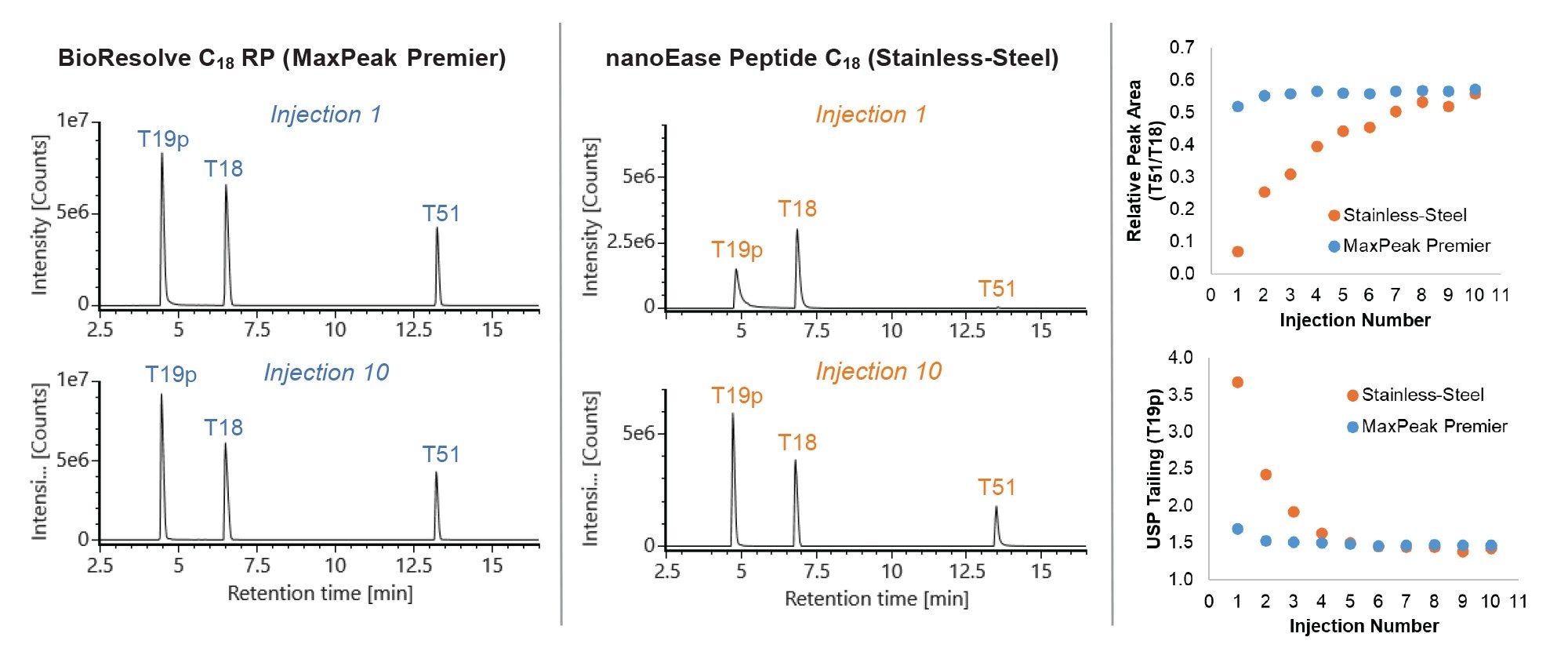
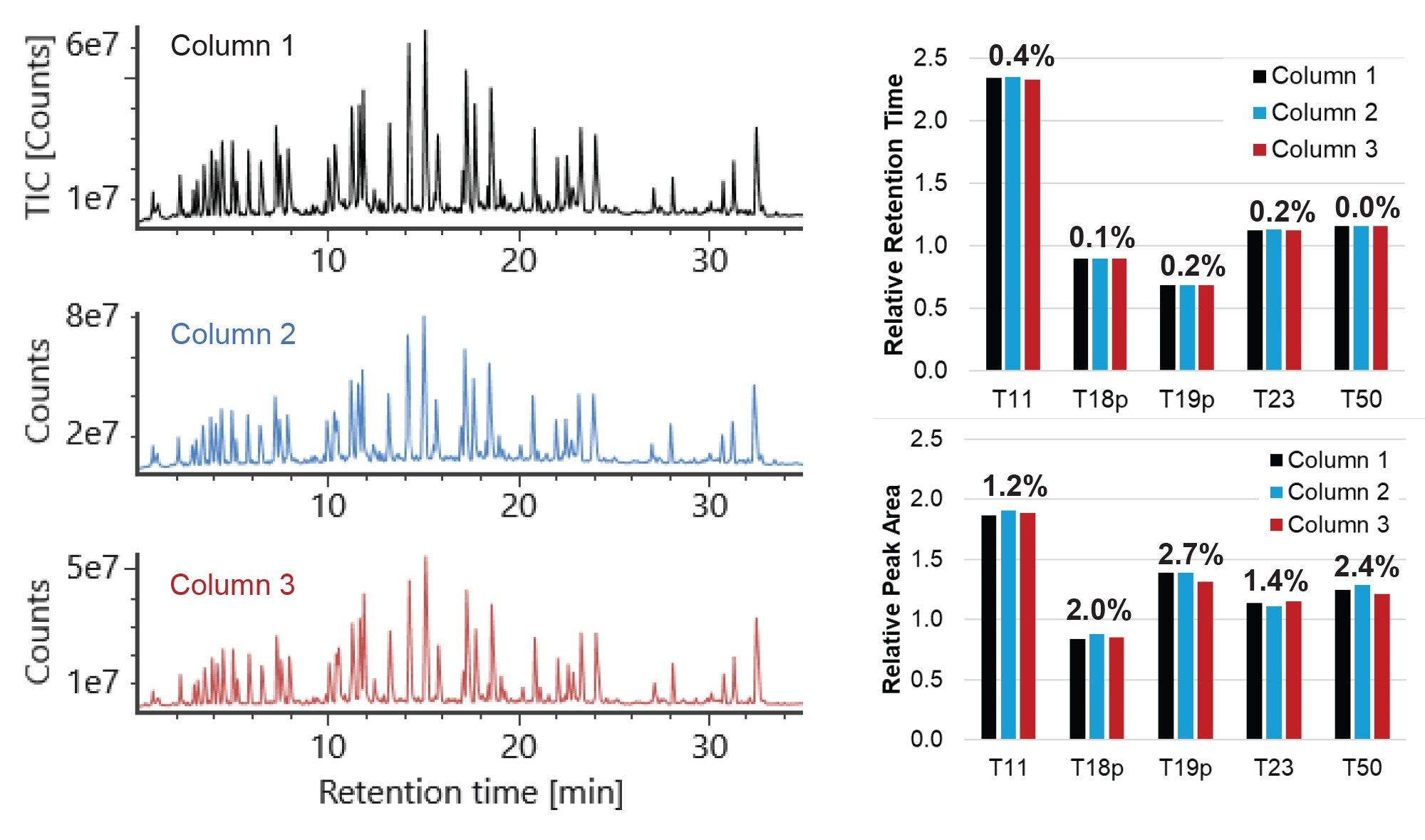
Figure 3 displays TICs of the MassPREP Enolase Digest with Phosphopeptides Mix on three BioResolve C18 RP 300 µm ID Columns. Excellent reproducibility is observed across the three columns. Using XIC data, relative peak areas and relative retention times were calculated against the T18 peptide. Relative retention time RSDs are less than 1% for each peptide and relative peak area RSDs are less than 5% for each peptide.
Conclusion
The results presented in this application note demonstrate that Waters BioResolve Peptide 300 µm ID Columns with MaxPeak Premier Technology deliver clear performance advantages over unmodified stainless-steel columns for capillary and low-microflow LC-MS proteomics analyses involving acidic and phosphopeptides. By leveraging MaxPeak HPS Technology, these columns effectively mitigate deleterious interactions between acidic peptides and column hardware, leading to improved recovery, superior peak shape, and reduced reliance on extensive column conditioning. Importantly, these benefits are achieved while maintaining excellent peak capacity coupled with improved signal intensity and column-to-column reproducibility. Collectively, these attributes make BioResolve Peptide 300 µm ID Columns a robust and reliable solution for routine proteomics workflows, particularly those focused on acidic peptides where sensitivity, reproducibility, and data quality are paramount.
References
- Bian, Y., Gao, C., Kuster, B. On the Potential of Micro-Flow LC-MS/MS in Proteomics. 2022, 19, 3, 153–164.
- Lennon, S.; et al. High-Throughput Microbore Ultrahigh-Performance Liquid Chromatography-Ion Mobility-Enabled-Mass Spectrometry-Based Proteomics Methodology for the Exploratory Analysis of Serum Samples from Large Cohort Studies. J. Proteome Res. 2021, 20, 3, 1705–1715.
- Zurawska, M.; Basik, M.; Aguilar-Mahecha, A.; Dadlez, M.; Domanski, D. A Micro-Flow, High-pH, Reversed-Phase Peptide Fractionation and Collection System for Targeted and In-Depth Proteomics of Low-Abundance Proteins in Limiting Samples. Methods, 2023, 11, 102306.
- Berthelette, K.; Collins, C.; Walter, T. H. Improving Sensitivity and Analytical Method Greenness using MaxPeak™ Premier 1.0 mm Internal Diameter Columns. Waters Application Note. 720009221. January, 2026.
- Hanna, C. M.; Koza, S. M.; Addepalli, B. Enhanced Recovery and Peak Shape of Acidic Peptides with BioResolve™ 1 mm ID Columns with MaxPeak™ Premier Technology. Waters Application Note. 720009231. February, 2026.
- Hanna, C. M.; Koza, S. M.; Addepalli, B. Benchmarking Resolution and Recovery of BioResolve™ 1 mm ID C18 RP Columns with MaxPeak™ Premier Technology. Waters Application Note. 720009274. March, 2026.
- Nguyen, J. M.; Rzewuski, S. C.; Lauber, M. A. Enhancing Phosphopeptide Quantitation Using ACQUITY Premier Peptide CSH C18 Columns. Waters Application Note. 720007211. March, 2021.
- Reed, C.; Hong, P.; Wong, N.; Birdsall, R. E. Improving Peptide Mapping Separations Containing Phosphopeptides Using MaxPeak™ Premier Column Technology on an ACQUITY™ Premier System. Waters Application Note. 720008136. December, 2023.
720009349, May 2026


