
Improving Analytical Greenness and Analyte Recovery of HPLC Analyses Using 3 mm ID MaxPeak™ Premier Columns
Kenneth Berthelette, Christopher Collins, Thomas H Walter
Waters Corporation, United States
Published on June 15, 2026

Abstract
Users of compendial HPLC methods can reduce solvent costs and environmental impacts without compromising data quality by adopting the use of smaller internal diameter (ID) columns. In this study, the results obtained using three columns packed with the same 2.5 µm stationary phase but differing in ID are compared using an Agilent 1260 Infinity II Bio-Inert LC System. The results of column performance testing showed that the 4.6 mm and 3.0 mm ID columns performed comparably, while a 2.1 mm ID column showed reduced efficiency due to the impact of extra-column volume. Calculations of solvent consumption and method greenness are discussed, using the analytical method greenness score (AMGS) calculator for the latter. Additionally, the 3 mm ID column was used to test a mixture containing betamethasone and betamethasone phosphate to assess the inertness of the MaxPeak Premier High-Performance Surface (HPS) hardware. Compared to a conventional stainless-steel column, the MaxPeak HPS Column allowed the phosphorylated compound to be detected.
Benefits
- Solvent consumption decreased by 56.4% using a 3.0 mm column compared to a 4.6 mm column, with comparable chromatographic performance
- AMGS decreased by 43.9% using a 3.0 mm column compared to a 4.6 mm column, indicating reduced environmental impact
- Improved detection of metal-sensitive analytes using a 3.0 mm MaxPeak Premier Column
Introduction
With recent advancements in liquid chromatography (LC) technology, along with increasing concern about the impact of analytical methods on the environment, there has been a shift towards more sustainable, or “green”, techniques and methodologies. In order to determine how “green” a method is, a tool was created to calculate the AMGS.1 This tool was created through collaboration among several pharmaceutical companies and is available for free on the American Chemistry Society website.2 This calculator takes several factors into consideration, including solvent consumption. Previously, AMGS scores were compared for different LC methods, particularly when moving from traditional HPLC columns with larger particle size stationary phases to UHPLC columns employing smaller particle sizes.3-5 While that work clearly showed a benefit for moving to UHPLC systems and columns, not every laboratory can make those changes due to a lack of system availability and budgetary constraints. HPLC systems remain common in many laboratories, especially in generic pharmaceutical manufacturing, which places practical limits on suitable column configurations. Although reducing environmental impact is important, data quality and accurate analytical results remain the top priorities.
For laboratories where HPLC systems are the only viable option, improvements in AMGS values can still be achieved. HPLC methods often use 4.6 mm internal diameter (ID) columns with particles ranging from 2.5–5 µm. This particle size range is compatible with many HPLC systems, which have lower pressure limits than their UHPLC counterparts. The ID of the columns used with HPLC systems are usually >3.0 mm as lower ID columns may suffer from the impact of the high extra-column volume of typical HPLC systems.6 This factor can limit improvements to HPLC methods but depending on the analysis, using 3.0 mm ID columns can achieve comparable LC results while also reducing solvent consumption and improving AMGS values.
In this application note, the performance of three columns packed with the same stationary phase is compared, a 2.5 µm charged surface hybrid (CSH™) C18. This stationary phase employs a full-coverage C18 bonded phase on a hybrid organic-inorganic particle. This particle is manufactured to have a slight positive charge at low pH, enabling improved peak shape for basic analytes by ionic repulsion as well as weak anion-exchange functionality.7 The columns were 50 mm length MaxPeak Premier Columns with 4.6, 3.0 or 2.1 mm ID. MaxPeak Premier Technology mitigates interactions between analytes and column hardware, thereby improving recovery and peak shape for metal-sensitive compounds.8 To compare the three columns, a three-component standard was analyzed to mimic a column performance test using isocratic mobile phase conditions. In addition to comparing analytical performance, as measured by USP plate count, AMGS values were calculated for each of the three methods. Lastly, a comparison of conventional stainless steel and MaxPeak Premier Column hardware was performed to assess the impact of the inert column on the recovery of a metal-sensitive compound, betamethasone phosphate.
Experimental
Sample Description
Betamethasone and betamethasone phosphate stock solutions were created at 1 mg/mL. A mixture was created containing 50 µg/mL each of the compounds with water as the diluent.
The Neutrals QC Reference material (p/n: 186006360) was purchased and placed on system for analysis.
LC Conditions
|
LC system: |
Agilent 1260 Infinity II Bio-Inert LC System configured with a multicolumn thermistat (MCT), and a Photo Diode Array (PDA) Detector |
|
Detection: |
UV @ 254 nm Quality Control Reference Material (QCRM) UV @ 240 nm (Betamethasone and betamethasone phosphate) |
|
Columns: |
XSelect™ Premier CSH C18 Column, 4.6 x 50 mm, 2.5 µm (p/n: 186009872) XSelect Premier CSH C18 Column, 3.0 x 50 mm, 2.5 µm(p/n: 186011851) XSelect CSH C18 Column, 3.0 x 50 mm, 2.5 µm (p/n: 186006105) XSelect Premier CSH C18 Column, 2.1 x 50 mm, 2.5 µm (p/n: 186009865) |
|
Column temperature: |
30 °C |
|
Sample temperature: |
10 °C |
|
Injection volume: |
Varied based on column ID and test. See figure captions |
|
Flow rate: |
2.34 mL/min (4.6 mm) 1.02 mL/min (3.0 mm) 0.5 mL/min (2.1 mm) |
|
Mobile phase A: |
Water with 0.1% formic acid |
|
Mobile phase B: |
Acetonitrile with 0.1% formic acid |
|
Mobile phase conditions (Neutrals QCRM): |
50:50 (A:B) mixed by system |
|
Mobile phase conditions (Betamethasone): |
35:65 (A:B) mixed by system |
Data Management
|
Chromatography software: |
Empower Chromatography Data System (CDS) |
Results and Discussion
Prior to the chromatographic testing, the system being used was characterized to determine its extra-column volume.6 Extra-column volume, sometimes called bandspreading or dispersion, can have an impact on chromatographic results. As such, it is important to measure extra-column volume especially when transferring methods between systems or when new column configurations are being considered. To test this, a zero-volume union was installed in the flow path instead of the column and a 0.5 mL/min flow rate of 50:50 acetonitrile:water was set. The next five replicate injections of a 0.16 mg/mL caffeine standard were made and peak widths at 4.4% peak height were recorded. The width, in minutes, was converted into a volume by multiplying by the flow rate. The system used for this work was determined to have an extra-column volume of 48 µL. It should be noted that different systems will have different extra-column volumes based on the configuration and tubing sizes used.
After system characterization, the three test columns were installed and used to analyze the QCRM in triplicate. The USP plate counts for naphthalene and acenaphthene were calculated. Figure 1 shows chromatograms for the QCRM analyzed on the three different columns using the same chromatographic system.
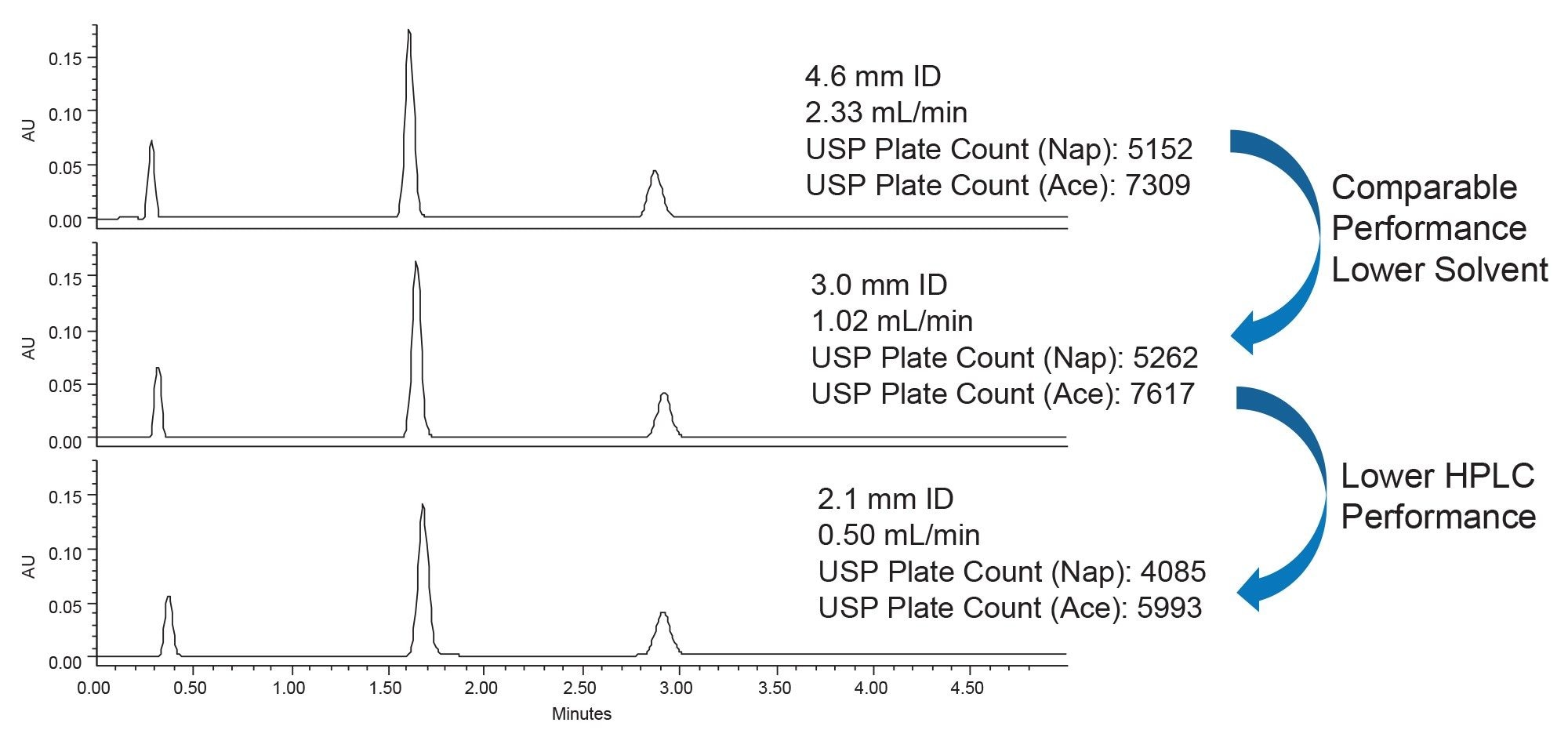
As shown, the 4.6 mm and 3.0 mm ID columns achieved comparable HPLC performance with similar average plate counts for both columns. As expected, some performance loss was observed when using the 2.1 mm ID column, due to a mismatch between the column internal diameter and the extra-column volume of the system. In this case, the mismatch leads to lower plate counts for both compounds, with a ~21% loss in efficiency for acenaphthene compared to the 3.0 mm ID column results. The use of 2.1 mm ID columns is best suited for UHPLC systems which have lower extra-column volumes.6
Next, the analytical greenness for the methods using three different ID columns were compared. First, a simple calculation of solvent savings was performed to measure the benefits of scaling the method. Table 1 shows the solvent needed per analysis of the QCRM across the three columns selected, and the percent decrease in solvent consumption when using the smaller ID columns compared to the 4.6 mm ID column.
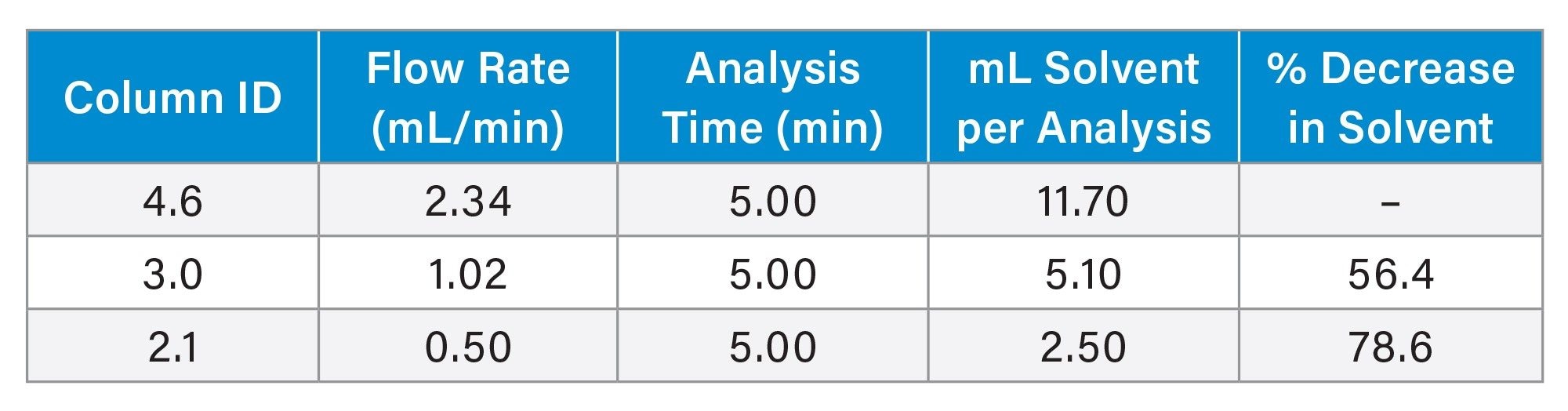
Large reductions in solvent consumption can be realized by using smaller internal diameter columns for this analysis. Moving to the 3.0 mm ID column resulted in a 56.4% reduction in solvent usage, having a significant and direct impact on the cost of analysis. Given that the 3.0 mm column produced comparable chromatographic performance to the 4.6 mm column, the reduced solvent consumption can be realized without compromising the scientific results. Further reduction in solvent usage can be seen by using 2.1 mm columns; however, as previously discussed, 2.1 mm ID columns are best suited for instruments with lower extra-column volumes.
With reductions in solvent usage also comes better AMGS. For the calculation of AMGS for the three methods, the following parameters were used. HPLC was selected as the technique, and the number of analytes of interest was set to two. To run a full analysis, a total of three injections were performed. The sample diluent was set to 50:50 acetonitrile:water as that is the solvent for the Neutrals QCRM. 1 mL of sample prep volume and 1 number of sample preps were used for the calculations. The sections marked standards, standard diluent, SST, and sensitivity were left blank. Table 2 shows the calculated AMGS values for the three methods.

As expected, the instrument energy score is the same across the three methods. This is because the instrument energy score only depends on the number of injections and the run time, which were the same for the three methods. However, the other two scores show significant differences. The Solvent Energy Score dropped from 32.78 to 14.80 just by reducing the ID of the column from 4.6 mm to 3.0 mm. Further reductions in AMGS values were realized moving to the 2.1 mm ID column; however, as noted previously, 2.1 mm columns don’t deliver the same performance on the HPLC system as the larger ID columns.
The 3.0 mm ID MaxPeak Premier Column was used for one final test as a part of this work. The inertness of the hardware was tested using a steroid phosphate, betamethasone phosphate. In previous experiments, this compound was shown to absorb almost completely on a stainless-steel column even when an inert LC system was used.9 Figure 2 shows the separation of betamethasone and betamethasone phosphate using a 3.0 mm ID stainless steel column and a 3.0 mm MaxPeak Premier Column packed with the same stationary phase.
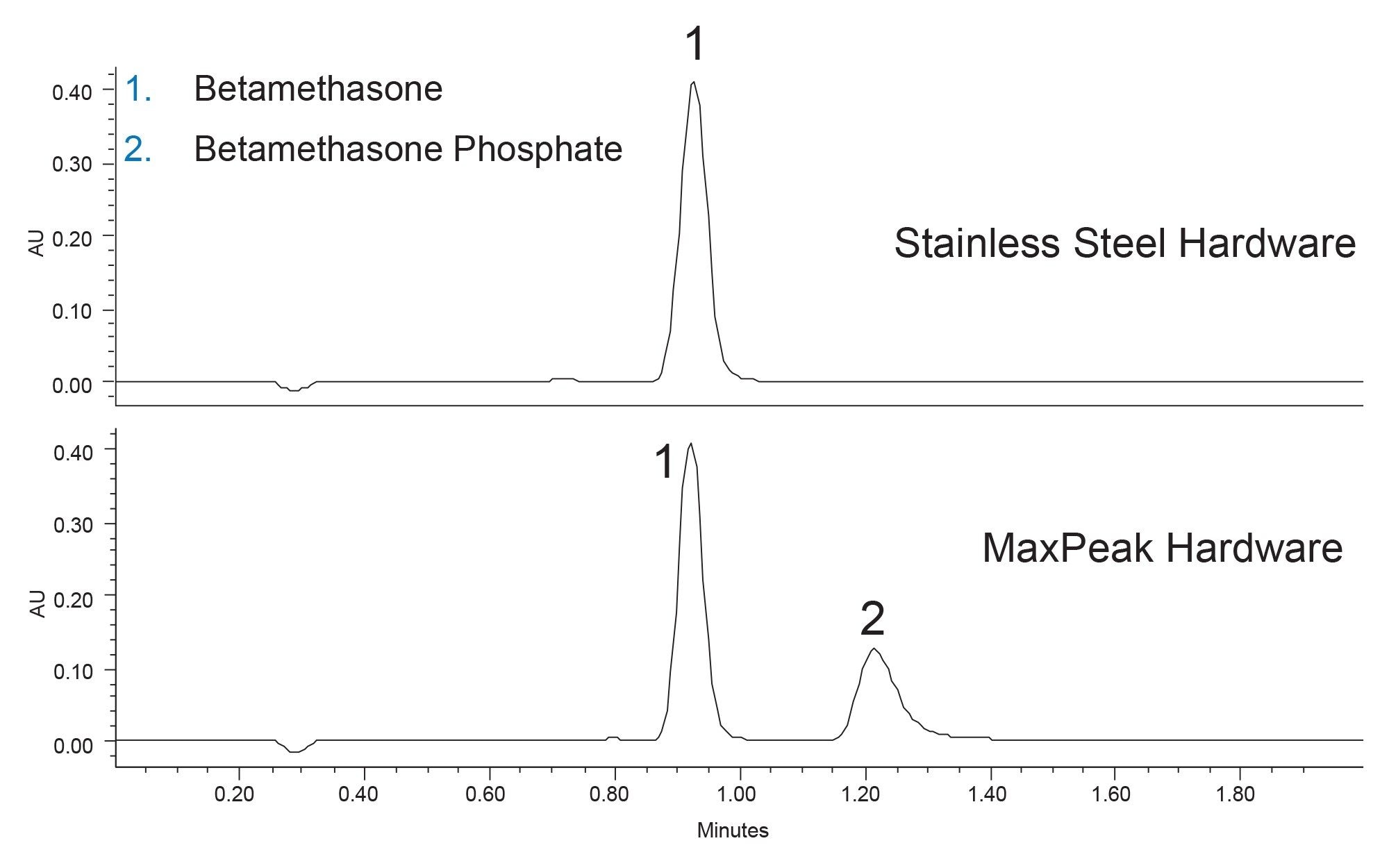
While the HPLC system used for this work is bio-inert, betamethasone phosphate adsorbs onto the stainless-steel column hardware and was virtually undetectable. Conversely, the use of the MaxPeak Premier Column showed both compounds with good signal intensity and peak shape. This data agrees with previously published work using MaxPeak Premier Columns to analyze these compounds.
Conclusion
While HPLC analyses typically employ 4.6 mm internal diameter columns to mitigate the effects of high system extra-column volume, reducing the column ID to 3.0 mm can produce comparable chromatographic results, while reducing solvent consumption by more than 50%. This reduces the cost and environmental impact of the analysis. To highlight the benefits of moving from 4.6 mm ID columns to 3.0 mm ID columns, the Neutrals QCRM was analyzed and chromatographic performance was compared. A 2.1 mm ID column was also tested to show why moving to smaller ID columns on a high extra-column volume HPLC system is not viable. In addition to chromatographic performance, solvent consumption and AMGS values were calculated for the three methods. Compared to the 4.6 mm ID column method, the method that used the 3 mm ID column showed a 56.4% solvent savings and a 43.9% smaller AMGS value, indicating reduced environmental impact.
Finally, a comparison was made between a stainless-steel column and a MaxPeak Premier Column for the analysis of betamethasone and betamethasone phosphate. The acidic betamethasone phosphate adsorbed on the stainless-steel column hardware and was not detected, while the same compound was easily detected using the MaxPeak Premier Column, which are inert and prevent the acidic analyte from interacting with the column hardware.
References
- Hicks, M.; et al. Making the Move Towards Modernized Greener Separations: Introduction of the Analytical Method Greenness Score (AMGS) Calculator. Green Chem. 21 (2019) 1816.
- ACS Green Chemistry Institute Pharmaceutical Roundtable Website. https://acsgcipr.org/amgs Accessed 22-April-2026.
- Berthelette, K.; Walter, T.H.; DeLoffi, M.; Kalwood, J.; Haynes, K. Creating Greener HPLC Methods as Measured by the AMGS Metric: A Case Study of Improving USP Monograph Methods. Waters Application Note. 720008281.
- Dlugasch, A.; Hong, P. Taking Advantage of 12k psi Pressure Capabilities for Modernizing USP Methods on the Alliance iS HPLC System. Waters Application Note. 720008973.
- Berthelette, K.; Walter, T.H.; Collins, C.; DeLoffi, M.;Haynes, K. Applying Analytical Method Greenness Scoring to the USP Monograph of Naproxen; Improving the Sustainability of Validated Methods by Modernizing to Newer Technology. Waters Application Note. 720008366.
- Hong, P.; McConville, P.R. Dwell Volume and Extra-Column Volume: What Are They and How Do They Impact Method Transfer? Waters white paper. 720005723.
- Iraneta, P.C.; Wyndham, K.D.; McCabe, D.R.; Walter, T.H. A Review of Waters Hybrid Particle Technology. Part 3. Charged Surface Hybrid (CSH) Technology and Its Use in Liquid Chromatography. Waters white paper. 720003929.
- Lauber, M.; et al. Low Adsorption LC Technology Based on MaxPeak High Performance Surfaces. Waters white paper. 720006930.
- Berthelette, K.; Collins, C.; Walter, T.H. Development of a LC-UV Method for Separating 12 Steroids using a Waters Acquity Biphenyl RP Column with MaxPeak Technology. Waters Application Note. 720009310.
720009361, June 2026


