
Liraglutide Native SEC-MALS Characterization Using Empower™ Chromatography Data System (CDS)
Udayabagya Halim
Waters Corporation, United States
Published on March 17, 2026

Abstract
Recent changes to FDA and EMA regulatory guidance specifically call for the identification and characterization of oligomers and higher-order structures (HOS). This application note demonstrates the use of native SEC-MALS, configured with a DAWN™ MALS Photometer and Optilab™ dRI Detector, for accurate molecular weight determination and identification of oligomeric species and higher-order structures. The method enables sensitive and precise characterization of peptides under native formulation conditions, with results generated directly in Empower™ Software. Empower Software provides a fully integrated workflow for chromatographic control, MALS and dRI or TUV signal processing, and automated calculation and reporting of oligomeric species.
Benefits
Non-destructive, calibration-free approach to determine absolute molecular weight.
Identification and quantification of oligomers and HOS, aligning with current regulatory guidance.
Accurate quantitation to avoid the bias introduced by UV detection for large particles.
Introduction
Recent regulatory updates are placing greater emphasis on the characterization of synthetic peptides, including rapidly expanding GLP-1 therapeutics. In July 2026, the FDA published 17 revised draft product-specific guidances for peptide products, identifying higher-order structure assessment as one of five key areas of recommendation. The EMA’s scientific guideline for synthetic peptides, effective June 1, 2026, likewise establishes specific expectations for the characterization, specifications, and analytical control of these products.1 Notably, the EMA states: “A specification parameter only denoted ‘high molecular weight impurities’ is not acceptable; the impurities should be specified (e.g. dimers, trimers, oligomers, aggregates) to indicate that the identities of the impurities are known.”2 Together, these developments highlight the growing need to identify and characterize aggregates, oligomers, and higher-order structures (HOS) as part of a comprehensive peptide characterization strategy.

Size exclusion chromatography (SEC) is widely used to assess peptide size distributions and oligomeric states. Native SEC preserves non-covalent interactions and molecular assemblies present under formulation-relevant conditions, making it particularly valuable for evaluating aggregation and higher-order structures. However, conventional SEC relies on calibration standards to estimate molecular weight, which introduce error when analyzing species with structures that differ from the standards.
Combining SEC with multi-angle light scattering (MALS) and differential refractive index (dRI) detection provides a calibration-standard-free approach for determining absolute molecular weight and distinguishing monomers, oligomers, and aggregates under native conditions. In this application note, native SEC-MALS configured with a DAWN™ MALS Photometer and Optilab™ dRI Detector enables sensitive and precise characterization of peptide species without disrupting their native state. The workflow is fully integrated into Empower™ Software for chromatographic control, MALS and dRI or TUV signal processing, and automated calculation and reporting of oligomeric species.
Experimental
Methods
|
Parameter |
Details |
|
System: |
Arc™ Premier HPLC System with quaternary solvent and sample manager |
|
Column: |
XBridge™ Premier Protein SEC Column, 250 Å pore size, 2.5 µm, 7.8 mm × 300 mm |
|
Mobile phase: |
10 mM Na2HPO4, pH 8.1 |
|
Flow rate: |
0.5 mL/min |
|
Detection: |
Arc Premier 2998 PDA UV Detector, DAWN MALS photometer, Optilab™ dRI Detector |
|
Software: |
Empower 3.10.0 CDS with advanced detector license option for MALS analysis |
|
dn/dc: |
0.185 mL/g for all samples under native conditions |
|
UV extinction coefficient: |
6990 M⁻¹ cm⁻¹ at 280 nm (1.86 (mg/mL)⁻¹ cm⁻¹) for liraglutide |
Accurate characterization of peptide oligomers and aggregates begins with careful selection of both the SEC column and detection strategy. Peptides are prone to forming oligomers, larger aggregates, and even fibrils that can exceed 20–50 nm in size.3,4 Under native conditions, columns with larger pore sizes are therefore required to effectively resolve oligomeric species, separate higher-order aggregates, and avoid size-exclusion effects.
In this study, an XBridge Premier Protein SEC Column with a 250 Å pore size was selected as to accommodate the higher-order oligomers present in liraglutide under native conditions. This pore size enables effective separation of oligomeric species while maintaining adequate recovery of large assemblies.
For concentration detection, the Optilab dRI Detector with dn/dc input of 0.1850 mL/g was used; traditional UV is another option for a concentration detector, but RI was used for two primary reasons. First, dRI detection provides flexibility across peptide development workflows, as it enables quantitation of peptides that lack aromatic residues and therefore exhibit weak or no UV absorbance. Second, prior work has shown that aged liraglutide drug product contains particulate species in the 20–30 nm size range that can interfere with UV-based concentration measurements.5 While UV detectors are commonly used for simple proteins and peptides, particles larger than ~20–30 nm can scatter light in addition to absorbing it, leading to overestimation of aggregate content and biased quantitation. The Optilab dRI Detector operates at a longer wavelength than alternative optical detectors and is less susceptible to light-scattering artifacts than UV detection, enabling more accurate determination of mass fractions.
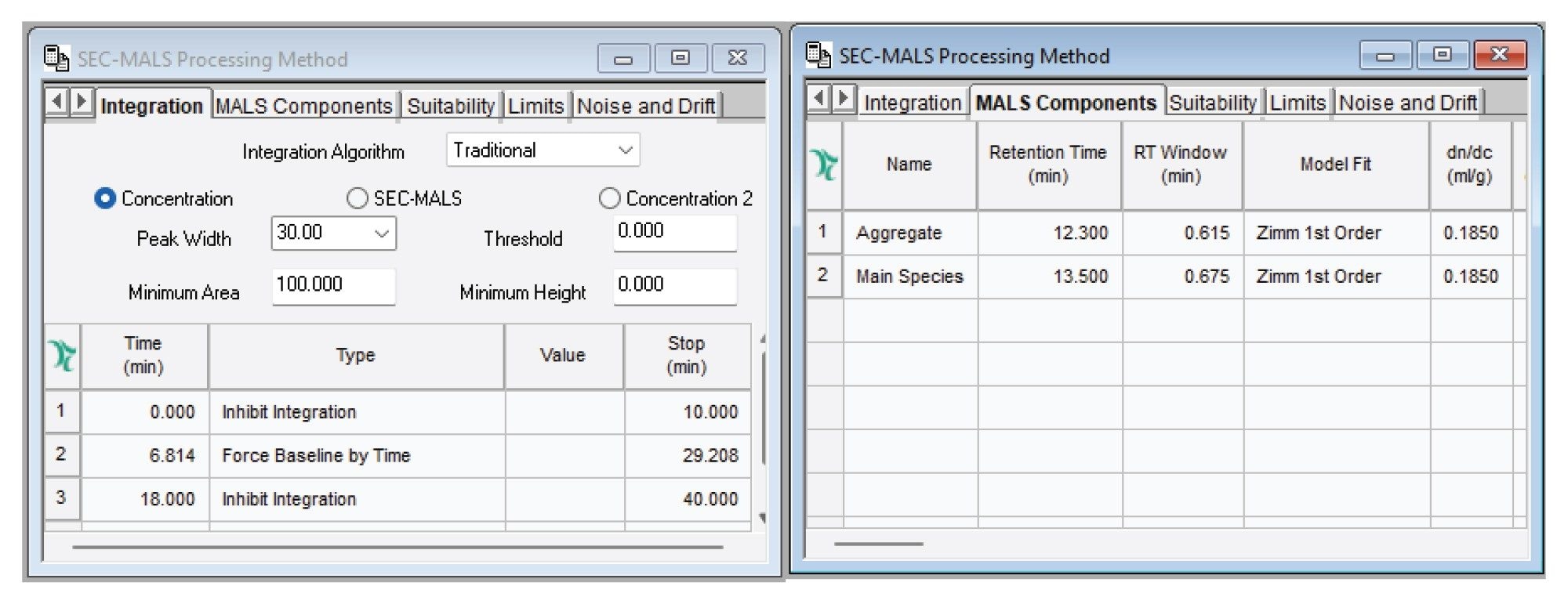
Data analysis was performed using Empower CDS 3.10.0 with the traditional algorithm for automatic peak detection and integration. This approach provides improved reproducibility of recovery and percentage mass calculations while simplifying method implementation, as it does not rely on fixed elution times and therefore reduces method development effort.
Although not part of this technical brief, the method for denaturing SEC-MALS analysis is described in a previously published application note.5 Whereas native SEC-MALS provides information on oligomerization and aggregation, denatured SEC-MALS using organic solvents separates GLP-1 RA molecules into individual monomers, providing information on covalently and more strongly bonded aggregates.
Results and Discussion
Native SEC-MALS analysis was performed on liraglutide drug substance (DS) at a concentration of 6 mg/mL under non-denaturing conditions. This concentration was selected to reflect the typical formulation of liraglutide drug product.5 The chromatogram exhibited two distinct peaks: a primary peak eluting at approximately 13 minutes and a secondary peak corresponding to higher-order oligomeric species.
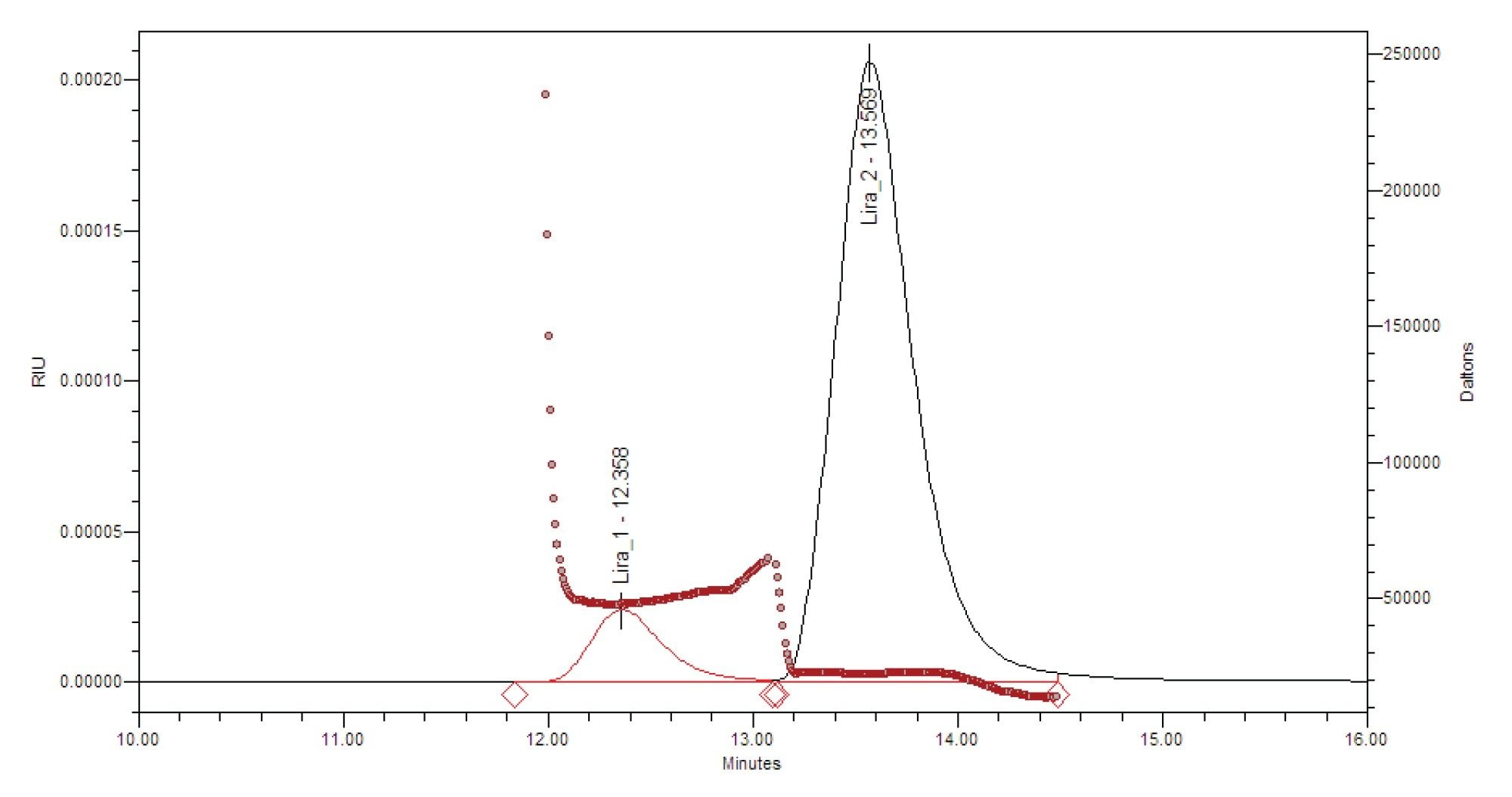
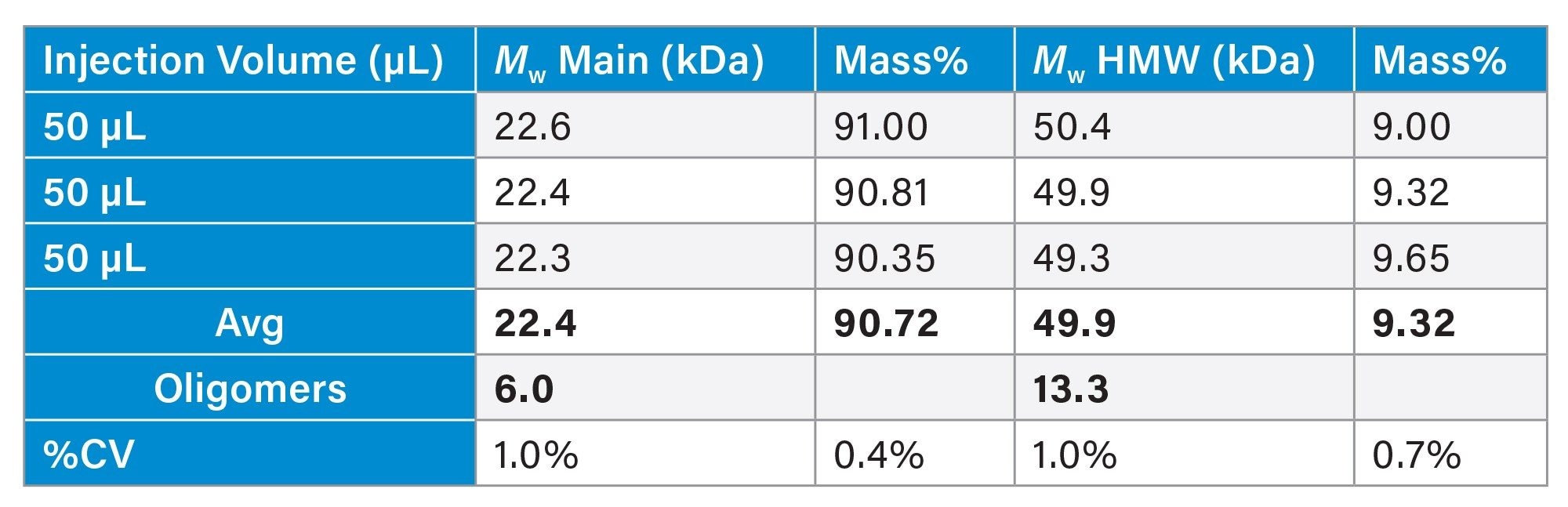
MALS analysis showed that the primary species accounted for 90.7% of the total mass, with a percent CV of 0.4%, and a weight-average molar mass (Mw) of 22.4 kDa with a %CV of 0.7% based on triplicate injections. This molar mass is consistent with a hexamer, given the theoretical monomer mass of 3.75 kDa. The secondary peak exhibited a molar mass of approximately 50 kDa, consistent with a 13-mer species. Identification of these oligomeric species was automatically calculated with Empower Software custom fields. No peak corresponding to the monomeric form was detected under these native conditions, which is in agreement with previously published reports.5,6
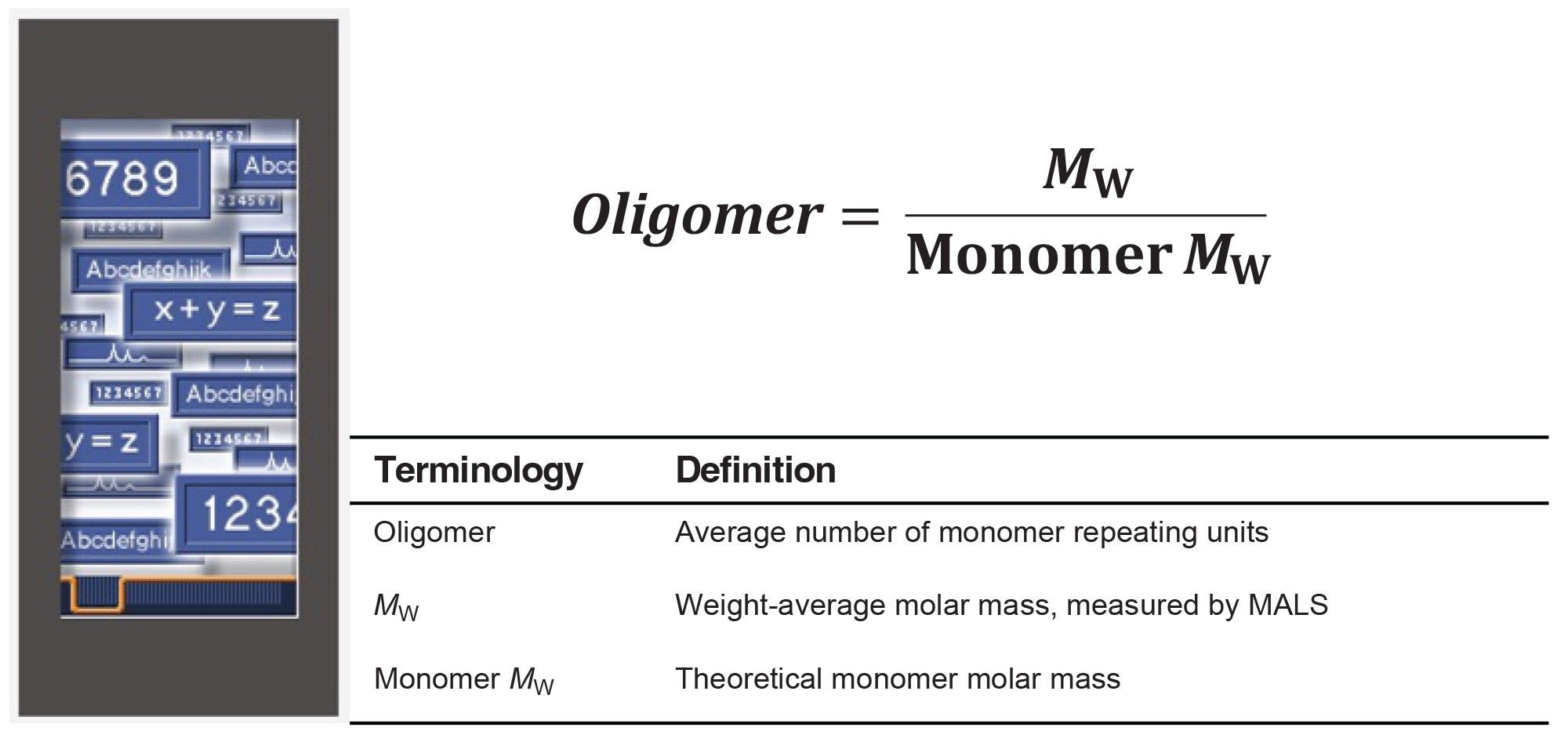
For liraglutide, the oligomeric state is determined by dividing the absolute molar mass measured by MALS by the known monomer molar mass. This calculation can be built directly into Empower™ Software using Custom Fields, enabling automated reporting of oligomer identity with greater consistency and traceability.
Conclusion
Native SEC-MALS provides a direct and reliable approach for identifying oligomeric species in peptide drug products under formulation-relevant conditions. By combining SEC separation with MALS-based absolute molecular weight determination, monomers can be distinguished from dimers, trimers, higher-order oligomers, and larger aggregates without relying on molecular weight calibration standards. The DAWN™ MALS Photometer and Optilab™ dRI Detector provide accurate molecular weight and concentration measurements, while Empower™ Software enables integrated data processing and automated identification and reporting of oligomeric species. This workflow provides a robust approach for the specific identification of high molecular weight species in support of current peptide regulatory expectations.
References
- U.S. Food and Drug Administration (FDA). FDA Publishes Revised Draft Product-Specific Guidances for Certain Generic Peptide Products. July 28, 2026. https://www.fda.gov/drugs/drug-alerts-and-statements/fda-publishes-revised-draft-product-specific-guidances-certain-generic-peptide-products.
- European Medicines Agency (EMA). Development and manufacture of synthetic peptides: scientific guideline. European Medicines Agency. https://www.ema.europa.eu/en/development-manufacture-synthetic-peptides-scientific-guideline.
- Brichtová, Eva Přáda, et al. "Glucagon-like peptide 1 aggregates into low-molecular-weight oligomers off-pathway to fibrillation." Biophysical journal 122.12 (2023): 2475-2488.
- Přáda Brichtová, Eva, et al. "Effect of Lipidation on the Structure, Oligomerization, and Aggregation of Glucagon-like Peptide 1." Bioconjugate Chemistry 36.3 (2025): 401-414.
- Zhang, Xujun, et al. “Identification of GLP-1 analog oligomeric states using SEC-MALS.” Application Note, Wyatt Technology Corporation
- Bothe, Jameson R., et al. "Peptide oligomerization memory effects and their impact on the physical stability of the GLP-1 agonist liraglutide." Molecular pharmaceutics 16.5 (2019): 2153-2161.
720009263, March 2026


