

For research use only. Not for use in diagnostic procedures.
- Main
-
For research use only. Not for use in diagnostic procedures.
Melissa Aiello, Kenneth Berthelette, Christopher Collins, Paul Rainville
Waters Corporation, United States
Published on November 18, 2026
For research use only. Not for use in diagnostic procedures.
A reversed-phase (RP) liquid chromatography (LC) method developed on a Waters ACQUITY™ I-Class UPLC™ System was scaled for an Arc™ HPLC System using a 3.5 µm XBridge™ Biphenyl Column. The use of the 3.5 µm particle size, appropriate column dimensions, and consultation of the Waters Columns Calculator were crucial to successful method scaling. Selectivity and resolution of 15 bisphenol analytes were conserved from the original method.
Scaling an analytical method between chromatographic systems is a common practice across testing laboratories. It is typically done to enable routine quality control testing, support cross-site transfer, and accommodate broader instrument availability across laboratories within an organization.1 When scaling a method, it is important to consider not only the system being used, but the column dimensions and particle size of the stationary phase.
Analytical methods developed on UPLC systems typically use 2.1 mm ID columns packed with < 2 µm particles. This allows for short run times without sacrificing separation efficiency. However, if UPLC columns are used on an HPLC system, this can lead to over pressuring and low resolution because these systems have lower pressure limits and greater system dispersion. Therefore, larger particle sizes are needed as well as larger column dimensions for compatibility with HPLC systems.
In this work, a 3.5 µm Waters XBridge Biphenyl RP Column with MaxPeak™ Premier Technology allowed seamless scaling from a Waters ACQUITY UPLC I-Class System to an Arc HPLC System. Separation selectivity and resolution were conserved across the methods. This method leverages the unique selectivity of the biphenyl stationary phase to separate the structurally similar bisphenols. It has been shown in previous work that pi-pi interactions between the biphenyl group and conjugated or aromatic analytes, particularly with methanol as the organic mobile phase, can provide different selectivity compared to a C18 stationary phase.2
Individual bisphenol standards were purchased from AccuStandard. Stocks of each standard were combined and diluted to 0.1 mg/mL in 75:25 (v/v) water and methanol. Solutions were stored at room temperature, protected from light.
|
LC System: |
Arc HPLC with Quaternary Solvent Manager (QSM), Flow-Through Needle (FTN-R), 2998 PDA Detector |
|
Detection: |
UV @ 220 nm |
|
Vials: |
TruView™ pH control Vial (p/n: 186005663CV) |
|
Column(s): |
Waters XBridge Biphenyl RP Column with MaxPeak Premier Technology 4.6 x 100 mm, 3.5 µm (p/n: 186011955) |
|
Column temperature: |
25 °C |
|
Injection volume: |
9.6 µL |
|
Flow rate: |
1.049 mL/min |
|
Mobile phase A: |
Water |
|
Mobile phase B: |
Methanol |
|
Gradient: |
See Column Calculator Below |
|
Chromatography software: |
Empower™ Software |
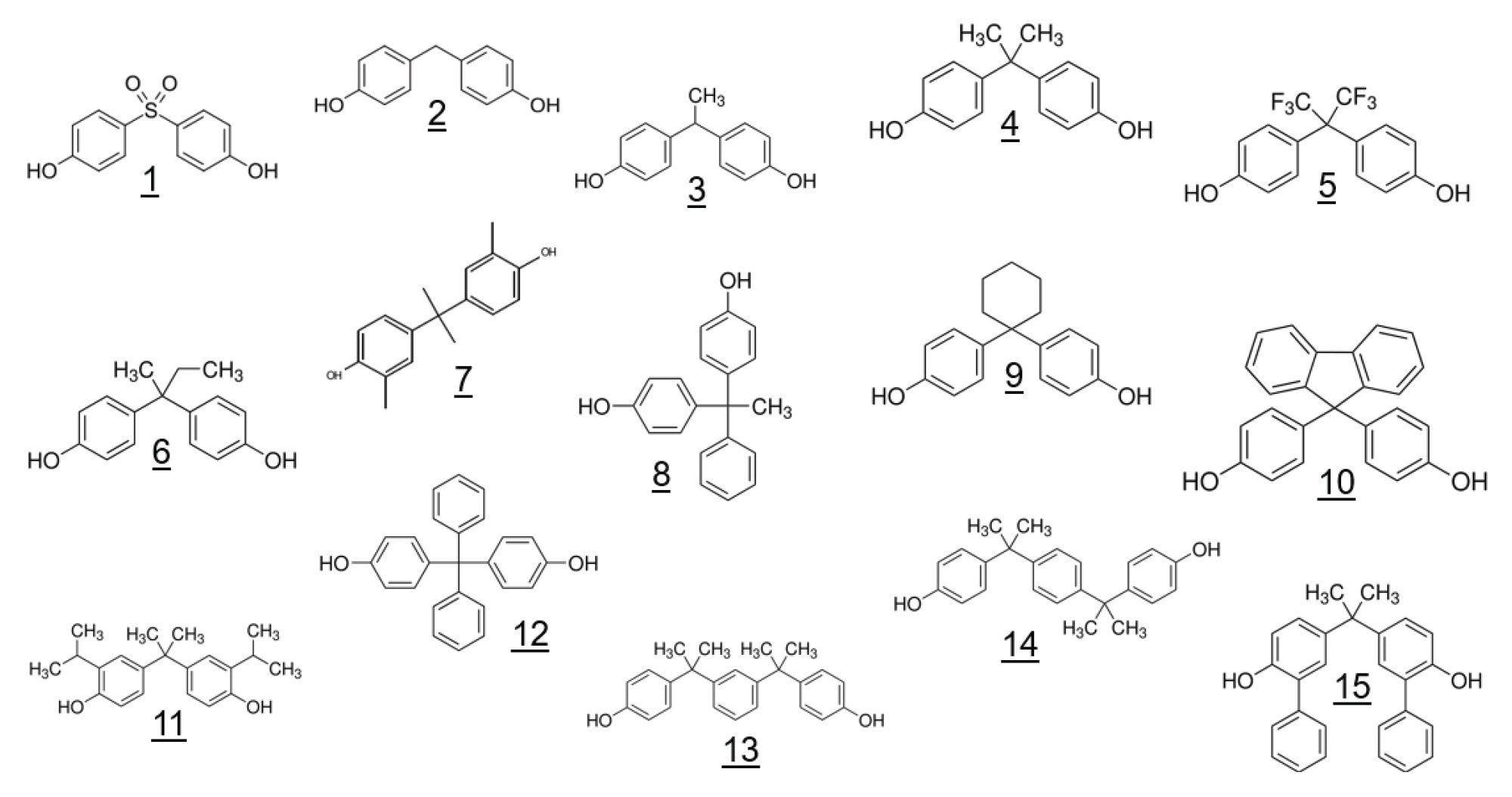
The method to be scaled for HPLC is described in Waters application note 720009250. Please refer to that work for more details on the development of the method. For this work, the same 15 bisphenols were analyzed. The structures are shown in Figure 1.
The first step in scaling is to evaluate the LC systems being used. This gives critical information on system dispersion and the appropriate column dimensions and particle size, all of which can impact chromatographic performance.3 For example, placing a 2.1 x 50 mm column with 1.7 µm particles on an HPLC system could cause over pressuring due to the lower system pressure limit. The higher system dispersion can decrease resolution and affect peak shape3, highlighting the importance of matching the correct column size to the system.
For the Arc HPLC System, 4.6 mm ID columns are generally used to minimize the effects of extra-column dispersion. To stay below the system pressure limit, a 3.5 µm XBridge Biphenyl RP Column was employed. To maintain the separation efficiency of the UPLC method, the column length was increased from 50 to 100 mm for the HPLC column. This gives a similar ratio of column length to particle size (L/dp) for the UPLC and HPLC columns.
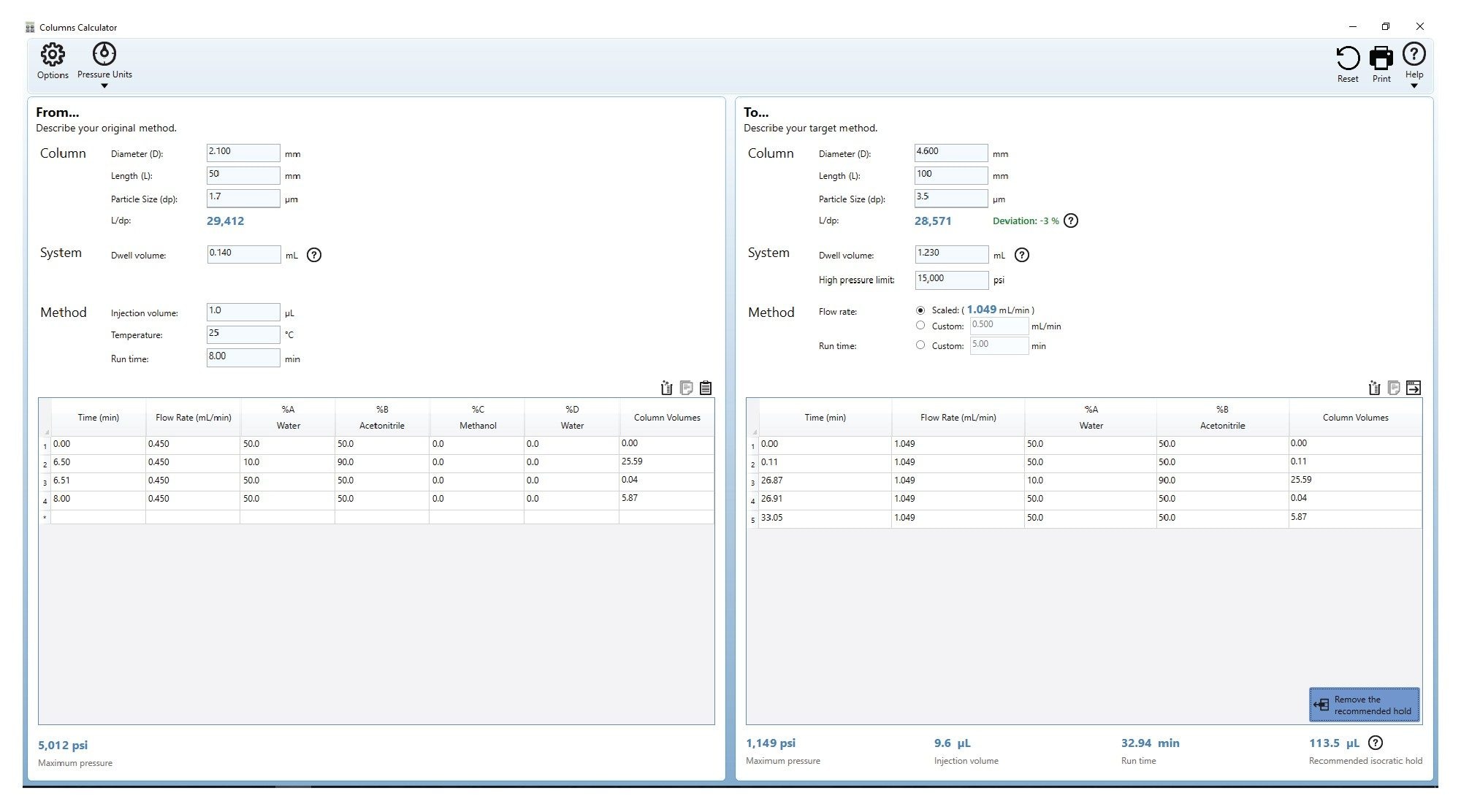
With the appropriate column chosen, the original method information was entered into the Waters Columns Calculator (Figure 2). The calculator returns the scaled method information (gradient, flow rate, and injection volume). It also calculates the L/dp ratios for both the original and scaled methods. Keeping this ratio constant maintains chromatographic efficiency, resolution, and separation power when transferring a method to a different column size or particle size.4 USP 621 guidelines state that the ratio must stay within -25% to +50% of the original method.5 Because the variation of the L/dp is 3%, it is appropriate to move forward with the new method conditions.
It is important to note that the system dwell volume for both instruments was measured and entered into the calculator. The system dwell volume is the volume of solvent required “for the change in a gradient to reach the column, or the volume difference between the point of mixing and the head of the column."4 Differences in dwell volumes can impact retention times across systems. By accounting for this parameter in the Columns Calculator, an appropriate post-injection delay or isocratic hold can be programmed into the scaled method. In this case, an isocratic hold of 50:50 water and methanol was established for 0.11 minutes.
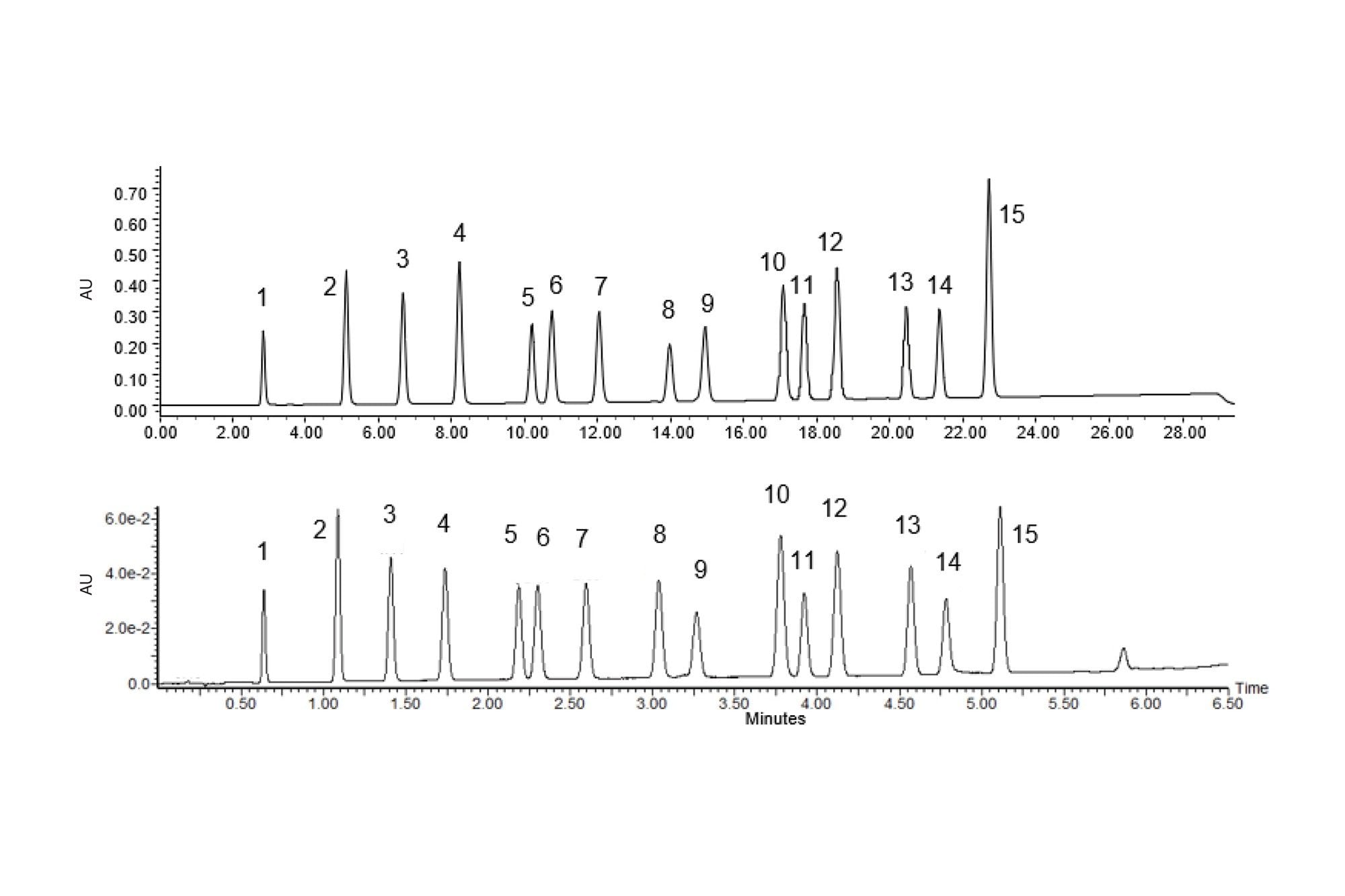
The chromatogram obtained using the scaled HPLC method is compared with the separation achieved using the UPLC method in Figure 3 below. The retention order was conserved and the analyte peaks line up nicely between the chromatograms. Note that the x-axes are different, reflecting the four-fold longer run time of the HPLC method. The critical resolution of bisphenol AF and bisphenol B was maintained (represented by peaks 5 and 6, respectively), demonstrating the successful scaling of the UPLC method to the Arc LC System.
The use of reliable and robust instrumentation along with the seamless scaling of analytical methods between systems is crucial for testing laboratories. Most analytical needs are not solved in a singular laboratory but as part of collaboration between colleagues in different departments or sites.
In this work, a UPLC method for the analysis of 15 bisphenols was scaled to HPLC using a 3.5 µm Waters XBridge Biphenyl RP Column. A walkthrough of the steps for successful method scaling using the Waters Columns Calculator was discussed. The impact of system dwell volume, system dispersion, and column dimensions and particle size were considered, producing a scaled method that maintains the chromatographic selectivity and resolution of the UPLC method.
Du, X.; DeLaney, K.; Birdsall, R.; Friedman, T. Method Scaling from ACQUITY Premier to Arc Premier System. Waters Application Note. 720007862. 2023.
Berthelette, K.; Collins, C.; Ross, E.; Walter, T. H. UPLC Separation of 15 Bisphenols Using a Waters ACQUITY Biphenyl RP Column with MaxPeak Premier Technology and UV Detection. Waters Application Note. 720009250. 2026.
Dlugasch, A. B.; Simeone, J.; McConville, P. R. Scaling USP Methods to Smaller Particle Columns on the Alliance HPLC System. Waters Application Note. 720006610. 2019.
Hong, P.; McConville, P. Dwell Volume and Extra-Column Volume: What Are They and How Do They Impact Method Transfer? Waters White Paper. 720005723. 2018.
United States Pharmacopeia. General chapter <621> chromatography. In: United States Pharmacopeia and National Formulary. Rockville, MD: United States Pharmacopeial Convention. https://online.uspnf.com. Accessed 23 September 2026.
720009641, November 2026


