

For research use only. Not for use in diagnostic procedures.
- Main
-
For research use only. Not for use in diagnostic procedures.
Gabrielle Zabala, Bonnie Alden, Thomas H. Walter, Weiqiang Gu, Daniel P. Walsh, Jim Cook
Waters Corporation, United States
Published on July 15, 2026
For research use only. Not for use in diagnostic procedures.
B vitamins are essential, water‑soluble nutrients involved in key metabolic and neurological functions. Accurate and reliable analytical methods are required for their determination in complex matrices. Reversed‑phase liquid chromatography (RPLC) is commonly used in these analyses. However, traditional hydrophobic stationary phases such as C18 are susceptible to pore dewetting when used with highly aqueous mobile phase conditions, potentially leading to reduced retention, poor reproducibility, and compromised performance for polar analytes. In this study, a Waters XBridge™ Biphenyl RP Column with MaxPeak™ Premier Technology was evaluated as an alternative stationary phase, demonstrating useful selectivity for B vitamins and compatibility with a 100% aqueous mobile phase. Furthermore, the use of MaxPeak Premier Technology increased the peak height for the phosphorylated vitamer pyridoxal 5’-phosphate by 36%, providing improved sensitivity and reproducibility compared to a stainless-steel column.
B vitamins are a group of essential, water‑soluble vitamins that play critical roles in cellular metabolism, energy production, and neurological function. These nutrients are not stored extensively in the body and are sensitive to environmental factors such as light, temperature, and pH.1 Accurate quantification of B vitamins in pharmaceutical, food, and biological samples is essential for ensuring product quality and supporting nutritional and clinical research. Analytical methods must therefore be both robust and sensitive to reliably measure these compounds, which often exist in complex matrices and at low concentrations.2
RPLC is one of the most utilized techniques for B vitamin analysis due to its versatility. However, traditional alkyl‑bonded stationary phases, such as C18 silica, can be susceptible to pore dewetting (also incorrectly known as phase-collapse) under highly aqueous mobile phase conditions.3 Pore dewetting occurs when the aqueous mobile phase is expelled from the pores of the hydrophobic stationary phase when the pressure drops below a critical point.3 This leads to a reversible loss of retention and poor reproducibility.3,4 This phenomenon is especially problematic when analyzing highly polar analytes like B vitamins, which often require mostly aqueous mobile phases to achieve adequate retention.
To address these limitations, specially designed stationary phases can be used for these analyzes such as intermediate-coverage C18 bonded phases like Atlantis™ T3 Column.5 Another option is to use a phenyl stationary phase which has also been shown to be compatible with 100% aqueous mobile phases.4 Here, an evaluation of the use of a biphenyl column for separating four B vitamins is described. Biphenyl columns provide useful selectivity that can enhance the separation of compounds possessing π electrons, such as B vitamins, compared to traditional C18 and phenyl stationary phases.6
Two sample mixtures were used for this evaluation. The first sample contained 10 µg/mL of uracil, and the sample diluent was 100% acetonitrile. The second sample contained 10 µg/mL of uracil, 32 µg/mL of nicotinic acid, 80 µg/mL of nicotinamide, 50 µg/mL of thiamine and 100 µg/mL of pyridoxal 5’-phosphate. The sample diluent used for the second sample was 10 mM ammonium acetate pH 4.6 (aq). The column was initially equilibrated in 100% acetonitrile for 30 minutes to fully wet the pores of the stationary phase. Following equilibration, three injections of the first sample were performed followed by a 15-minute equilibration with 50/50 v/v acetonitrile/water. Another 30-minute equilibration was then performed using 100% aqueous 10 mM ammonium acetate pH 4.6 before three initial injections of the second sample were performed. After the initial three injections, the column was maintained for 10 minutes with no flow. The final three injections for dewet analysis were performed after a 1.20-minute equilibration of 10 mM ammonium acetate pH 4.6 (aq). Each column was stored in 100% acetonitrile after evaluation.
|
System: |
ACQUITY™ UPLC™ H-Class System consisting of a Quaternary Solvent Manager (QSM) with a 100 μL mixer, a Sample Manager with Flow-Through Needle (SM-FTN) with a 15 μL needle, an ACQUITY Column Manager (CM-A) and an Auxiliary Column Manager (CM-Aux), and an ACQUITY UPLC PDA Detector installed with a 500 nL analytical flow cell. |
|
Data Management: |
Empower™ Chromatography Data System (CDS) |
|
Column size: |
2.1 x 50 mm |
|
Column temperature: |
30 °C |
|
Injection volume: |
1.0 µL |
|
Flow rate: |
0.2 mL/min |
|
Mobile phase: |
Line A – 10 mM ammonium acetate pH 4.6 (aq) Line B – 100% acetonitrile Line C – 100% water |
|
UV detection: |
250 nm |
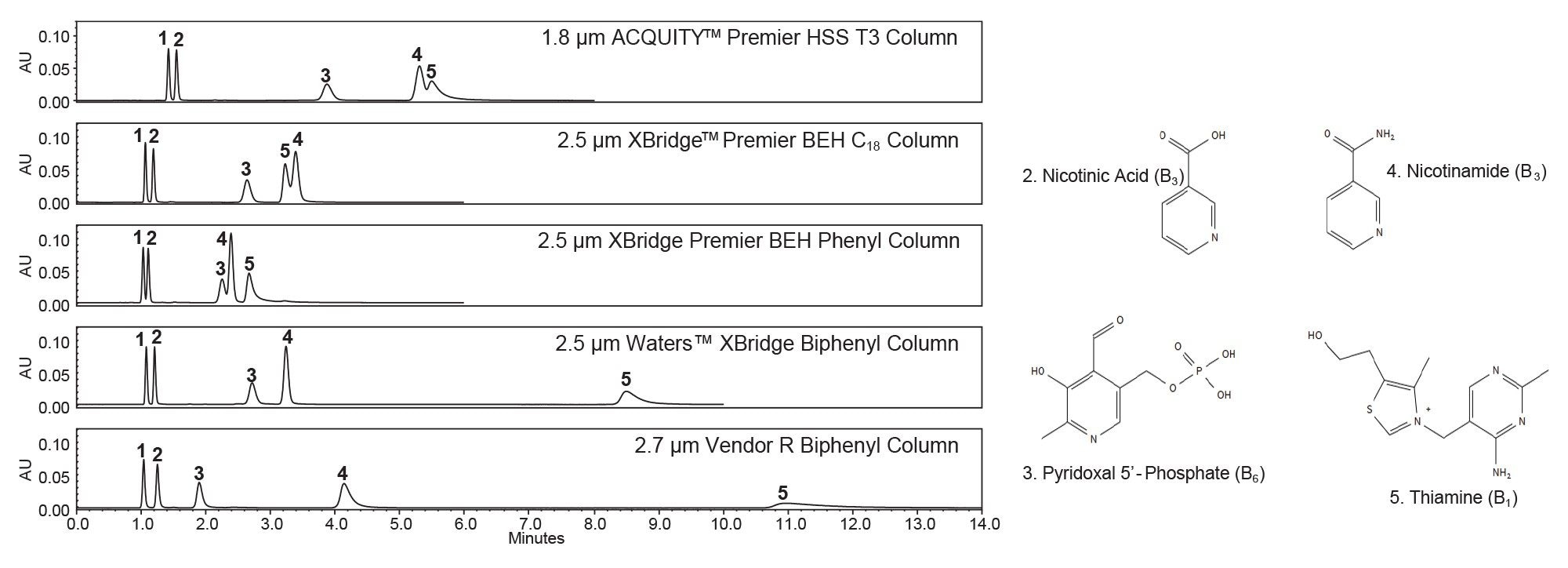
In Figure 1, the separations of four B‑vitamins using five different columns (an ACQUITY Premier HSS T3 Column, an XBridge Premier BEH™ C18 Column, an XBridge Premier BEH Phenyl Column, a Waters XBridge Biphenyl Column, and a biphenyl column from Vendor R) are shown. All columns were evaluated at 30 °C using 100% aqueous mobile phase containing 10 mM ammonium acetate (pH 4.6). Among the columns tested, only the Waters XBridge Biphenyl Column and the biphenyl column from vendor R achieved baseline separation of all four B‑vitamins under these conditions. Although the biphenyl column from Vendor R provided the longest overall retention for thiamine (peak 5), the peak shape for this analyte was poor, with a USP tailing factor of 2.55. In contrast, the Waters XBridge Biphenyl Column produced a thiamine peak with a lower USP tailing factor of 1.67, indicating improved peak symmetry. The shorter retention and lower tailing seen for the Waters XBridge Biphenyl Column is likely from lower silanol activity than seen in the silica-based biphenyl column from Vendor R. At pH 4.6, some residual silanols may be ionized leading to the formation of SiO- species on the surface of the stationary phases. Because thiamine is a cationic species under these conditions, its retention is strongly influenced by ionic interactions. A higher density of ionized silanols increases these interactions consequently producing increased retention and more pronounced peak tailing. The lower silanol activity seen in the Waters XBridge Biphenyl Column could be attributed to the bridged ethylene hybrid (BEH) particle in combination with Waters proprietary endcapping chemistry, both of which reduce the concentration of residual silanol sites on the stationary phase.
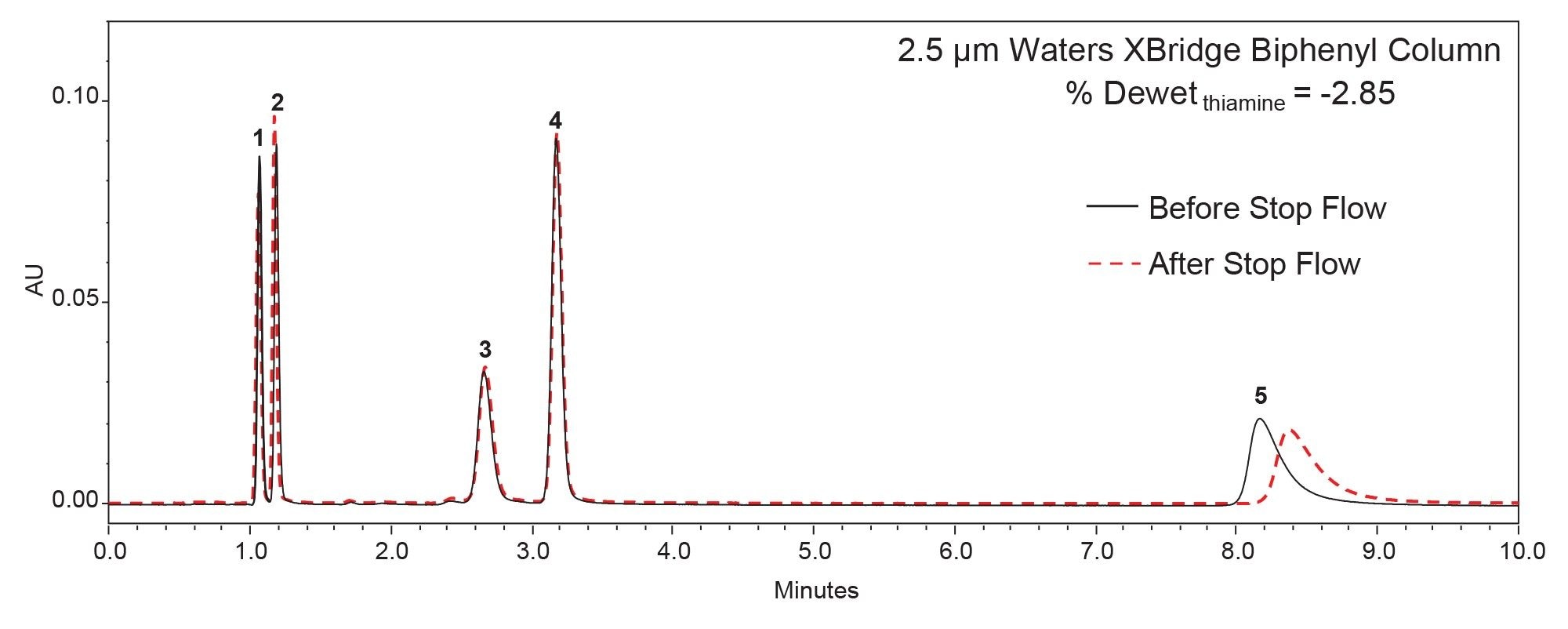
After the initial evaluation, the XBridge Biphenyl Column was subjected to a 10-minute stop-flow period. Following the flow stoppage, the column was equilibrated for 1.20 minutes with 100% aqueous 10 mM ammonium acetate (pH 4.6) before three final injections were performed. Figure 2 shows the results of the third injections before and after flow stoppage. The column did not show any pore dewetting, with a slight increase in retention time of thiamine observed. The 100% aqueous compatibility of the Waters XBridge Biphenyl Column stationary phase, coupled with its strong retention and selectivity for B‑vitamins, positions it as an attractive choice for separations of these compounds.
Many B vitamins exist in different forms known as vitamers.7 For example, vitamin B6 has six vitamers known as pyridoxine, pyridoxal, pyridoxamine, pyridoxamine 5’-phosphate (PMP), and pyridoxal 5’-phosphate (P5P).7,8 The phosphorylated vitamers of B6 are often found in dietary supplements. They are easily absorbed in the body where they are dephosphorylated and freely absorbed through passive diffusion.8 These dietary supplements require rigorous analytical evaluation with accurate quantification. However, phosphorylated compounds frequently exhibit undesirable interactions with the surfaces of stainless‑steel column hardware, leading to poor peak shape and reduced peak area.7,9 MaxPeak Premier Technology Columns address this challenge by incorporating a surface treatment that prevents direct contact between analytes and metal surfaces.9 This results higher peak responses (both area and height), improved peak symmetry and reduced injection-to-injection variability, thereby increasing the accuracy and reliability of LC‑based quantification.7,9
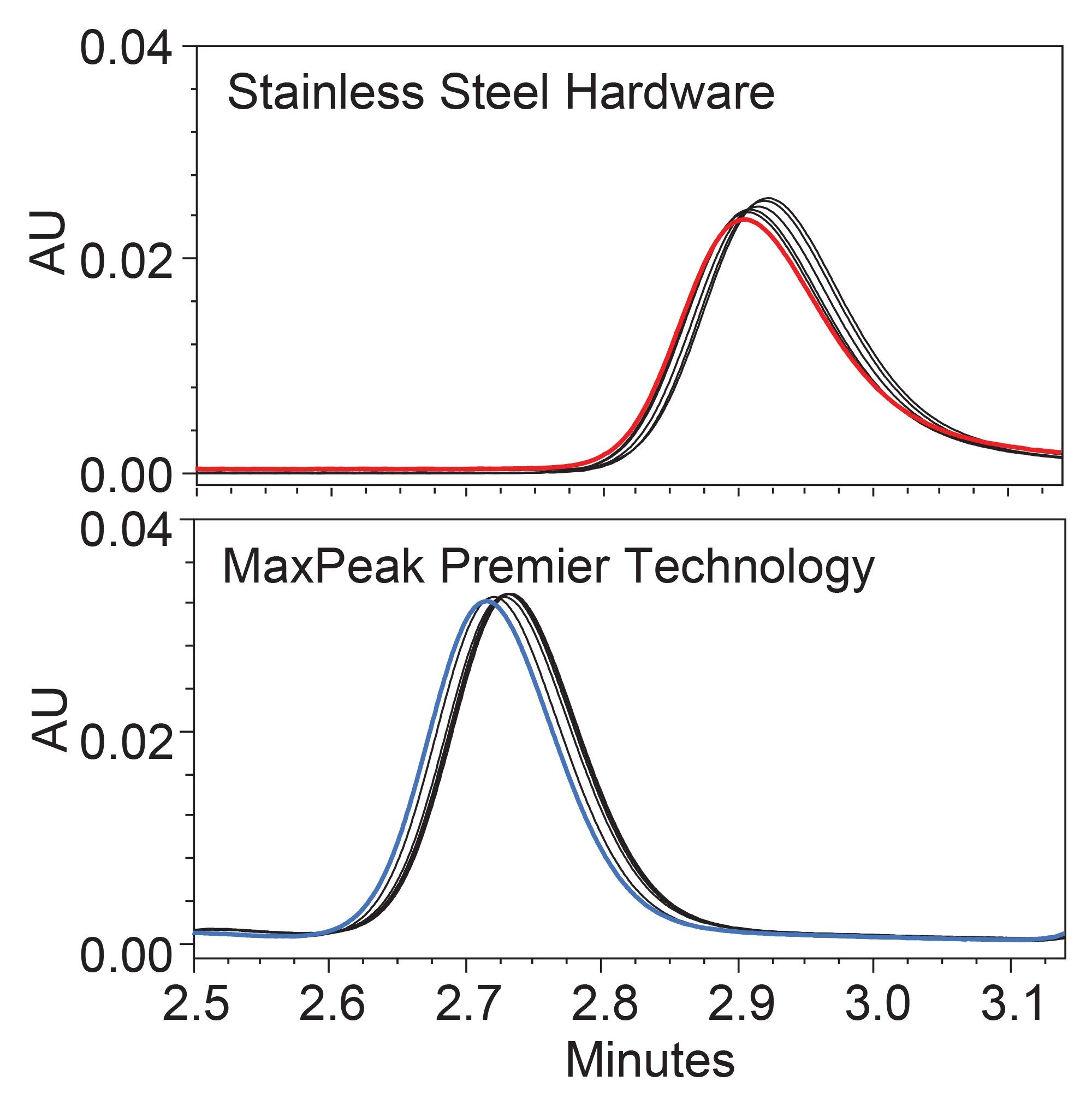
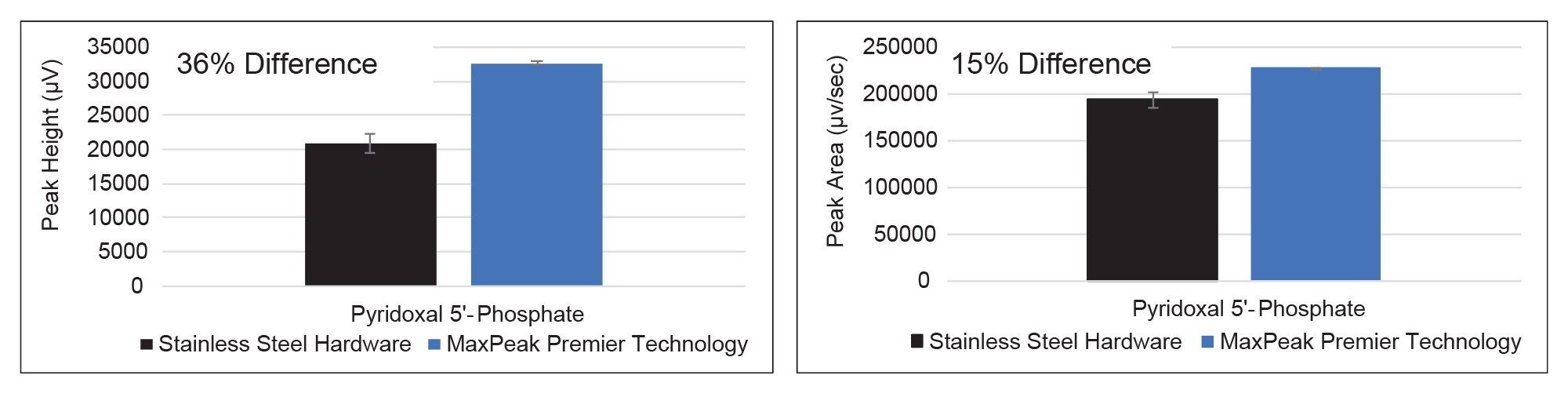
Figure 3 shows the differences in peak response observed for P5P when comparing MaxPeak Premier Technology hardware with conventional stainless‑steel column hardware. For each column type, chromatograms were overlaid for six consecutive injections. In the chromatograms obtained using the stainless‑steel column, the peak height increased progressively across the six injections as the surface became conditioned with the analyte. Additionally, the peak height for the stainless‑steel column is approximately 36% lower than that observed using the MaxPeak Premier Technology Column. Average peak area and peak height values for both hardware types were calculated and are summarized in Figure 4, along with their respective standard deviations. A 36% difference in peak height and a 15% difference in peak area were observed for P5P between the MaxPeak Premier Technology Column and the stainless‑steel column. The stainless‑steel column also exhibited higher standard deviations, likely reflecting the increasing peak response across the six injections. Collectively, these results demonstrate that MaxPeak Premier Technology provides superior performance for the analysis of phosphorylated compounds such as P5P, offering improved consistency and greater peak response.
This study demonstrated that the Waters XBridge Biphenyl RP Column with MaxPeak Premier Technology is useful for the separation of B vitamins. Compared to ACQUITY HSS T3, XBridge BEH C18 and XBridge Phenyl Columns, only the XBridge Biphenyl Column provided the successful baseline separation of the four B vitamins evaluated using the chosen mobile phase. The XBridge Biphenyl Column also provided good peak shapes and no dewetting after stop‑flow testing when using a 100% aqueous mobile phase. For the phosphorylated vitamers P5P, stainless‑steel hardware caused significant adsorption, whereas MaxPeak Premier Technology mitigated this interaction and produced markedly higher, more consistent peak height and area. Overall, the combination of biphenyl selectivity and inert MaxPeak Premier Technology hardware offered by Waters XBridge Biphenyl Columns provides a robust and reliable solution for separating B vitamins.
720009505, July 2026


