
Efficient and Traceable Aflatoxin Immunoaffinity Sample Cleanup with Extraction+™ Connected Device
Makda Araya, John Davenport, Chelsea Plummer, Tom Walter
Waters Corporation, United States
Published on July 31, 2026

Abstract
Aflatoxins are metabolites produced by Aspergillus fungi that persist through food processing and pose significant health risks due to their carcinogenicity and accumulation in fatty tissues. They are commonly found in agricultural commodities such as corn and peanuts, necessitating reliable analytical methods to ensure regulatory compliance. AOAC Official Method 991.31 utilizes immunoaffinity (IA) column cleanup for selective aflatoxin extraction. Waters VICAM™ Iimmunoaffinity AflaTest™ Columns effectively isolate aflatoxins B1, B2, G1, and G2 and are commonly used as a preparatory method for analytical fluorescence and LC-MS detection. Existing IA columns and mycotoxin isolation methods were utilized in an automated workflow, streamlining processes and reducing manual labor to support workflows in high-throughput laboratory settings.
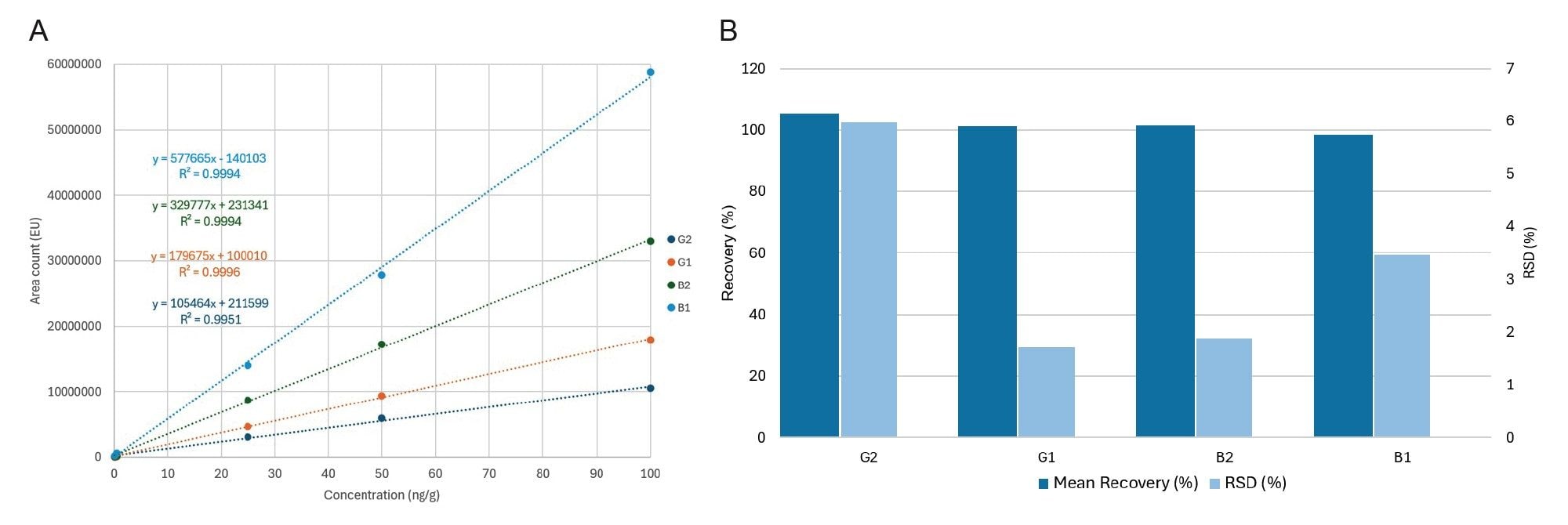
In this study, an automated workflow using the Waters VICAM AflaTest, Extraction+ Connected Device vacuum manifold, Pipette+™ Automated Pipetting and OneLab™ Software was developed to modernize aflatoxin sample preparation. Pressure gradients were optimized to maintain controlled flow rates and ensure consistent sample processing across challenging matrices. The method demonstrated excellent linearity (R² ≥ 0.995) and reproducibility (<10% RSD) over a range of 0.1–100 ng/g in corn, with high (95 – 110%) and precise (<6% RSD) recoveries for aflatoxins B1, B2, G1, and G2. These results show that the Extraction+ Connected Device provides a robust, efficient, and reproducible alternative to traditional positive pressure methods while maintaining the analytical performance of the AOAC protocol using Waters VICAM AflaTest. Integration of OneLab Software with LIMS and Empower™ Software with VICAM Iimmunoaffinity Columns enables full end-to-end traceability, automated data handling, and reduced manual intervention.
Benefits
- High-throughput capability: Extraction+ Connected Device processes up to 24 samples simultaneously in a compact footprint, reducing the processing time by 50% compared to manual sample preparation
- Increased reproducibility: Automated, programmable pressure gradients minimize operator-to-operator variability and maintain consistent AflaTest cartridge loading and elution
- Maintained AOAC-level selectivity: AflaTest immunoaffinity cleanup remains fully compliant with AOAC 991.31 performance expectations
- Robust performance: Controlled vacuum gradients prevent clogging and maintain flow even with viscous or particulate-rich food matrices
- Excellent analytical performance: Demonstrated linearity and precision for aflatoxins B1, B2, G1, and G2
- Full digital traceability: LIMS + OneLab + Empower Software integration ensures chain of custody, automated sample lists, and seamless data transfer with the AflaTest workflow
Introduction
Mycotoxins are toxic metabolites produced by Aspergillus, Fusarium, and Penicillium fungi that often contaminate crops, feed and grain, and can be introduced at all stages of the food supply chain, presenting health risks to humans and animals. Aflatoxins are among the most hazardous mycotoxins commonly found in commodities such as corn, peanuts, and grains, and are classified as Group 1 carcinogens, requiring reliable analytical monitoring to ensure regulatory compliance.
AOAC Official Method 991.31 describes the extraction of aflatoxins from corn, raw peanuts, and peanut butter using an immunoaffinity column. This highly selective and sensitive workflow is traditionally performed manually and requires careful control of column loading and elution rates (≤1 drop per second), making the process laborious and potentially susceptible to operator-to-operator variability. Traceable and programmable extraction enabled by advances in processing hardware improves robustness and reproducibility for aflatoxin testing. Regardless of how pressure is applied to drive elution, VICAM IA cartridges have proven to be highly selective and sensitive even without post column derivatization.2
In this study, immunoaffinity cleanup was performed using an Extraction+ Connected Device, which employs an automated vacuum pump. Pressure gradients were optimized across the three-step workflow to maintain a flow rate of less than one drop per second. Aflatoxins B1, B2, G1, and G2 spiked in corn were successfully isolated using the VICAM AflaTest Column over a concentration range of 0.1 to 100 ng/g and analyzed using UHPLC-FLR. Integration of the automated vacuum manifold with audit-trailed software enabled a fully traceable, turnkey workflow that is less hands-on, limiting manual variability while maintaining the selectivity of the AOAC method.
Experimental
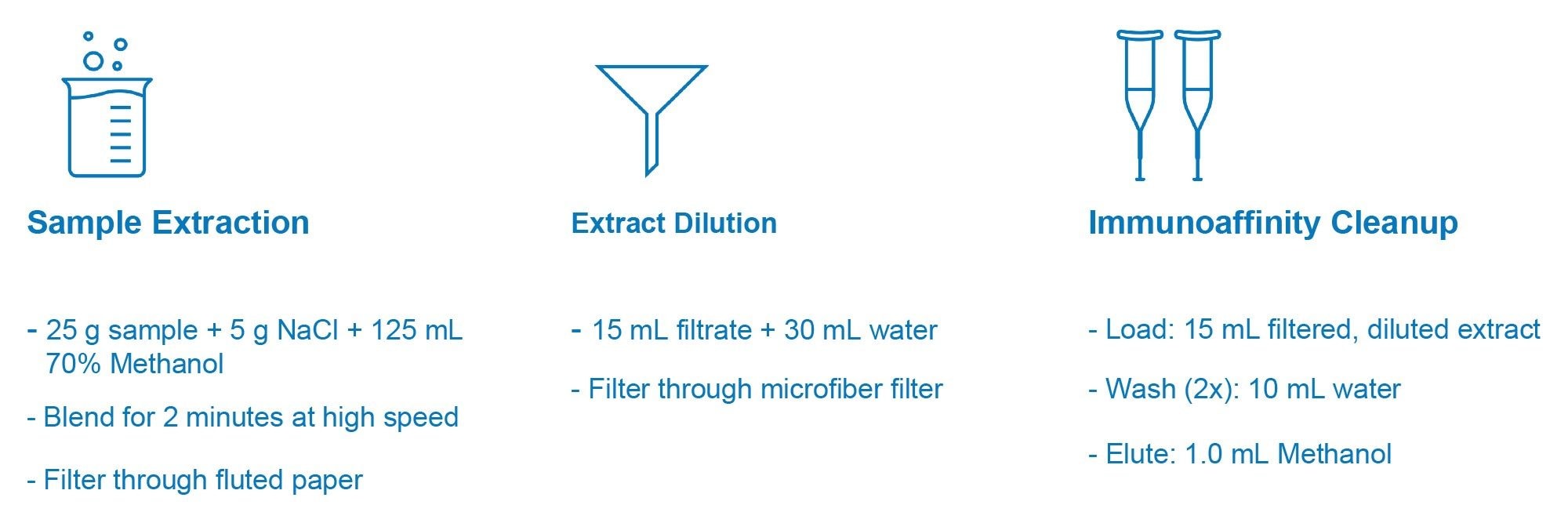
Following AOAC 991.31, 25 g of ground corn (Trilogy Reference Material, p/n: TR-A1000) was blended with 5 g NaCl and 125 mL 70% methanol at high speed for 2 minutes and gravity filtered through fluted filter paper (Waters VICAM, p/n: 31240, Milford, USA). 15 mL of filtrate was diluted with 30 mL water, mixed well and gravity filtered through a microfiber filter (Waters VICAM, p/n: 31955). 15 mL of the filtrate was then loaded on an AflaTest immunoaffinity IA cartridge (Waters VICAM, p/n: 205002642 (G1010)). In the three-step cleanup, 15 mL of the now twice-filtered sample was loaded, washed twice with 10 mL aliquots of water and eluted with 1.0 mL methanol. Eluates were diluted 1:1 with water and directly injected into an ACQUITY™ UPLC™ H-Class PLUS System paired with an ACQUITY UPLC FLR Detector. Corn samples were spiked with aflatoxin standards serially diluted from aflatoxins B1, B2, G1 and G2 stock mixture (Sigma, p/n: CRM46304). Neat, matrix-free standards in 50% methanol were prepared for recovery determination. The sample preparation procedure for AOAC 991.31 is summarized in Figure 1.
LC Conditions
|
System: |
ACQUITY H-Class Plus System with Flow-Through Needle (FTN) |
|
Column: |
ACQUITY UPLC HSS T3 Column, 1.8 µm, 2.1 x 100 mm (Waters, p/n : 186003539) |
|
Column temperature: |
40 °C |
|
Sample temperature: |
RT |
|
Mobile phase: |
Methanol/water 45/55 v/v |
|
Flow: |
0.350 mL/min |
|
Run time: |
6 minutes |
|
Injection volume: |
5 µL |
Detector Conditions
|
System: |
ACQUITY UHPLC FLR Detector |
|
Excitation: |
360 nm |
|
Emission: |
440 nm |
|
Data units: |
Emission |
|
Data rate: |
10 pts/sec |
|
PMT gain: |
1 |
|
Time constant: |
Normal |
|
Time: |
0.2 sec |
|
Autozero on injection start: |
Enabled |
|
Software: |
Empower Software (Ver. 3.6.1) |
Automation and Smart Devices
Pipette+ and Extraction+ Connected Devices driven by OneLab Software.
Results and Discussion
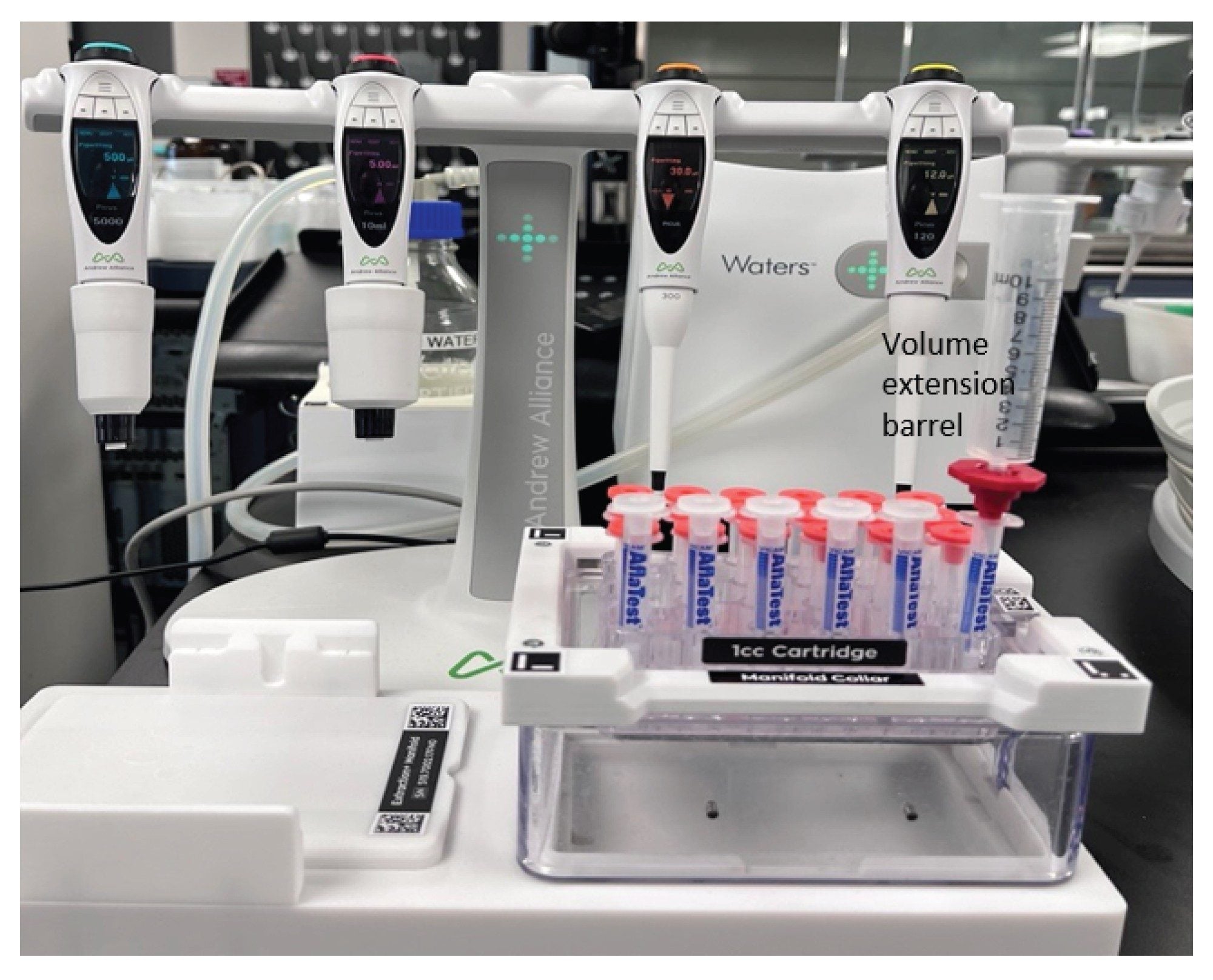
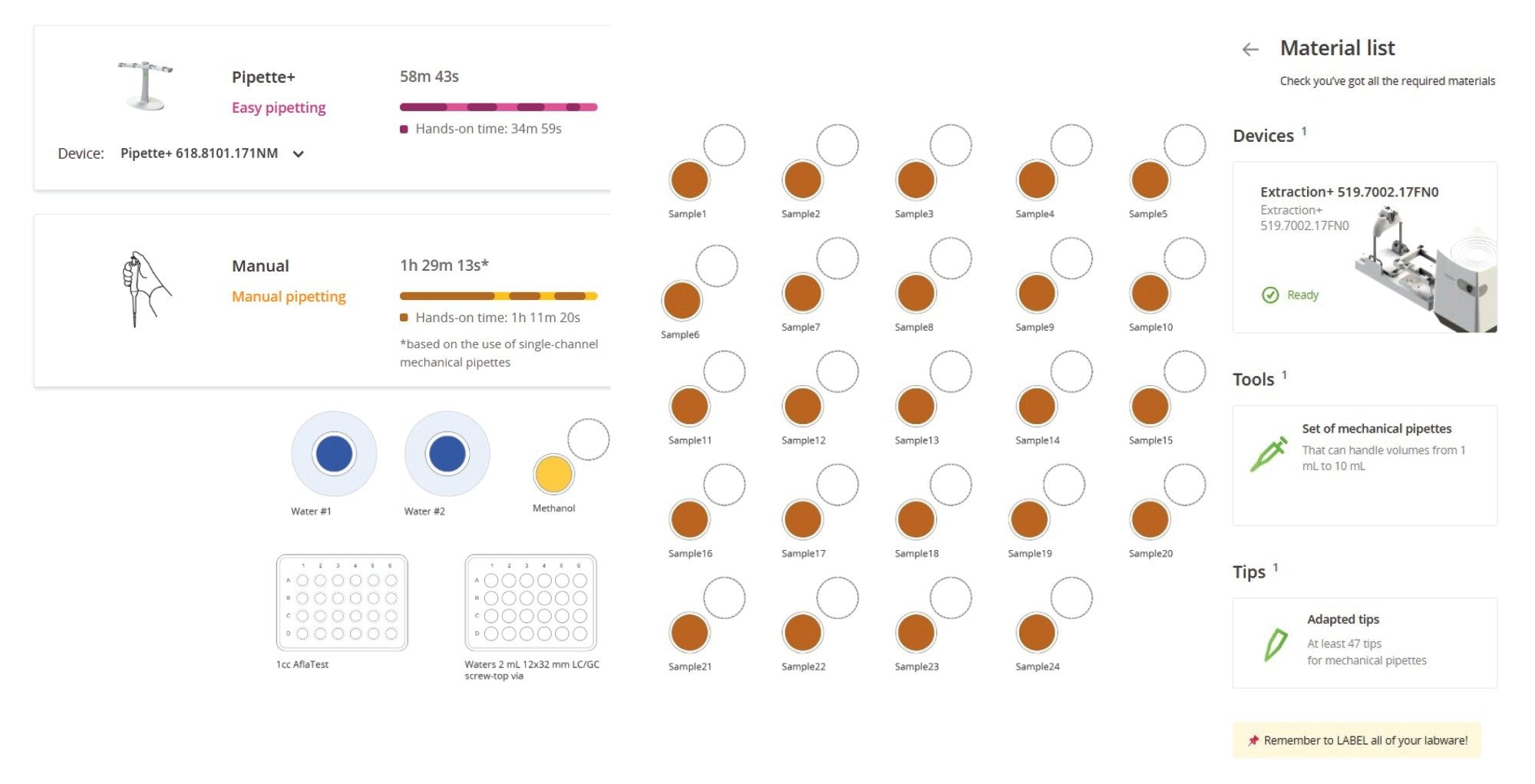
The Extraction+ Connected Device provides automation of immunoaffinity extraction that is beneficial for high-throughput laboratories, whether using semi-automated easy pipetting or fully manual pipetting. The work described here used easy pipetting with Extraction+ Connected Device. Figure 3 highlights time consumed for each workflow. While the manual approach takes ~90 minutes to process 24 samples, only ~60 minutes are consumed with the assisted pipetting workflow, cutting the operator hands-on time by ~30 minutes. Its compact design occupies minimal bench space while enabling consistent processing of up to 24 samples simultaneously (Figure 2). Pipetting aids already in the lab can be used for manual workflows, while the Pipette+ Easy Connected Device option utilizes connected Andrew Alliance™ mechanical pipettes. As shown in Figures 2 and 3, the system includes a collar with a cartridge adapter for loading cartridges, sealing caps for any unused positions, and a collection rack fitted with 2 mL vials for eluate collection during the elution step. Since the 1 cc AflaTest Cartridges come prefilled with storage buffer, a volume extension barrel with an adapter was used to allow the addition of 10 – 15 mL of sample during loading.
Flow through the sorbent bed can slow when fine food particulates become trapped, depending on the sample matrix. For viscous or particle-rich samples, applying positive pressure is especially effective because it pushes fluid through from above, minimizing flow irregularities that can lead to clogging. To evaluate whether the Extraction+ Connected Device can manage challenging matrices, three demanding cases were tested: an OchraTest green coffee sample, an OchraTest 2% Tween in PBS wash solution, and a DONtest wheat sample. In each instance, once the storage buffer was depleted, additional vacuum was required as more sample was introduced. A gradient of vacuum pressure was needed to load the sample and completely evacuate each cartridge. Because cartridge elution behavior can vary, pressure gradients were carefully optimized to avoid drying the sorbent bed while maintaining a controlled elution rate of less than one drop per second. The Extraction+ Connected Device has a powerful vacuum capable of reaching up to 1000 mbar absolute pressure. To process even the most challenging samples, only 20% of maximum capacity was required.
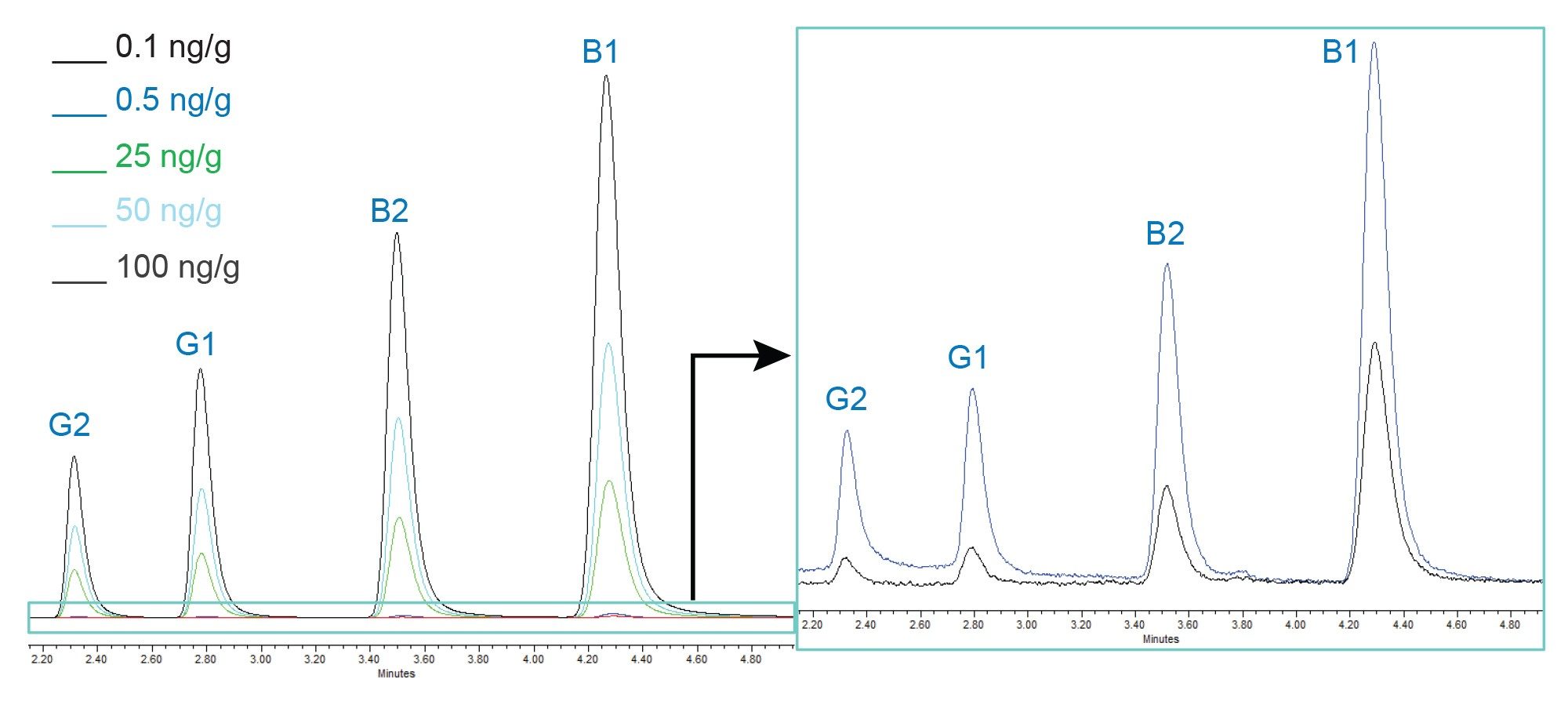
A OneLab Software workflow was developed and optimized for extracting aflatoxins from corn using 1 cc AflaTest Cartridges. Highlighted in Figure 4 (left) is an overlay of the five chromatograms for each of the concentration levels. A zoomed-in image of the lowest two concentrations is shown in the display to the right. The x-axis is kept constant while the y-axis is magnified to show the detection of the 0.1 and 0.5 ng/g chromatograms. Chromatograms are color coded for easy visualization: black, blue, green, turquoise and gray as 0.1, 0.5, 25, 50 and 100 ng/g, respectively. As shown in Figure 5, the method demonstrated excellent linearity (R² ≥ 0.995) and reproducibility (<10% RSD) for quantifying aflatoxins G2, G1, B2, and B1 across a range of 0.1 to 100 ng/g. Consistent with prior studies2 where AOAC Official Method 991.31 was performed using an Arc UHPLC configured with an XSelect™ HSS T3 Column, recoveries were both high (95–110%) and highly repeatable (<6% RSD) for all four analytes at all concentrations. These findings confirm that the Extraction+ Connected Device system can serve as an effective alternative to traditional positive pressure pumps.
Beyond improving efficiency through automation, OneLab Software integrates with LIMS and Empower Software to enable full end-to-end traceability for AflaTest sample preparation. Samples are first logged and assigned work orders in LIMS, after which OneLab Software manages and tracks the status of testing while maintaining a chain of custody. Information for the samples prepared is then seamlessly transferred into Empower Software and compiled into a sample set for analysis. Once testing is complete, Empower Software generates result reports that are automatically sent back to LIMS for final review and batch release. This connected workflow reduces manual intervention and helps prevent data entry errors by automatically generating sample lists during testing and results at the end. Additionally, CSV (Comma-Separated Values) file sample list uploads allow compatibility with systems outside of Empower Software.
Conclusion
This app note demonstrated that the AflaTest Column sample preparation method may be carried out using an Extraction+ Connected Device vacuum manifold with easy pipetting using Pipette+ Automated Pipetting. This reduces the need for manual intervention, reducing the amount of hands-on time by 50% and provides for high recoveries and excellent reproducibility. This was demonstrated for corn samples that were spiked with aflatoxins B1, B2, G1 and G2 at concentrations ranging from 0.1 - 100 ng/g. Using OneLab Software integrated with a LIMS and Empower Software further enhances efficiency by enabling seamless sample tracking, automated data transfer, and reduced risk of manual errors across the entire analytical process. Together, these benefits offer an attractive alternative to manual AflaTest Column sample preparation that should be particularly beneficial for labs that carry out many of these tests.
References
- AOAC, Aflatoxins in Corn, Raw Peanuts, and Peanut Butter, Immunoaffinity Column (AflaTest) Method 991.31, (2005). AOAC INTERNATIONAL.
- Sun, T.; Dreolin, N.; Hird, S.; Collette, N. Analysis of Aflatoxins in Corn and Peanuts Using Immunoaffinity Chromatography and the Arc™ HPLC System, (2023). Waters Application Note: 720007843.
- Benvenuti, M.E.; Alice, J.; Di, Gioia. Rapid Analysis of Aflatoxins without Derivatization Using Ultra Performance Liquid Chromatography and Fluorescence Detection, (2019), Waters Application Note: 720002644.
720009509, July 2026


