

Application Brief
This is an Application Brief and does not contain a detailed Experimental section.
Hua Yang, Steve Shiner
Waters Corporation, United States
Published on July 01, 2026
This is an Application Brief and does not contain a detailed Experimental section.
To demonstrate the use of BioResolve Peptide Phenyl-Hexyl+ and BioResolve Peptide C18+ reversed-phase (RP) Columns for separation of tirzepatide, a glucagon-like peptide-1 (GLP-1) receptor agonist, and its impurities.
GLP-1 therapeutics represent one of the fastest growing classes of biopharmaceuticals on the market. As these peptide-based drugs advance through development, manufacturing, and storage, it is critical to separate and characterize their impurities to ensure product safety, stability, and efficacy.
Structurally similar peptide impurities such as deamidation, isoasparate, single amino acid D- enantiomer and single amino acid substitution are particularly challenging to separate. This application brief shows that BioResolve Peptide Phenyl-Hexyl+ and BioResolve Peptide C18+ RP Columns can separate structurally similar impurities from tirzepatide, and that selectivity of these impurities can be modulated with appropriate selection of column chemistry.
Waters BioResolve Peptide Phenyl-Hexyl+ and BioResolve Peptide C18+ RP Columns are specifically tuned for the separation of larger peptides and their impurities. These columns incorporate superficially porous particles with an average pore size of 230 Å, providing improved accessibility and chromatographic efficiency for molecules such as GLP-1 receptor agonists and insulins. Additionally, a controlled level of positive charge is applied to the particle surface which has been proven to improve peak shape and loading capacity of basic analytes, especially when using formic acid modified mobile phases.1 Finally, the columns are built with MaxPeak™ Premier inert hardware designed to minimize non-specific adsorption (NSA) between the column hardware and the analytes, thereby improving recovery, consistency, and analytical robustness.2
BioResolve Peptide Phenyl-Hexyl+ and BioResolve Peptide C18+ RP Columns were used to separate a sample containing tirzepatide and seven known impurities (Figure 1). Both columns resolve D-Ser32 (Impurity 7) from the main peak, demonstrating that BioResolve Peptide RP Columns can be used to effectively separate challenging D-amino acid isomeric impurities of large peptides such as GLP-1s. Moreover, the elution order for the three deamidation species (Impurities 1, 2, and 3) is different on the two column chemistries (Phenyl-Hexyl+ vs. C18+). The Phenyl‑Hexyl Column resolves Impurity 3 from Impurities 1 and 2, whereas the C18+ Column resolves Impurity 2 from Impurities 1 and 3. These differences in elution behavior highlight the complementary selectivity provided by these two unique stationary phases.
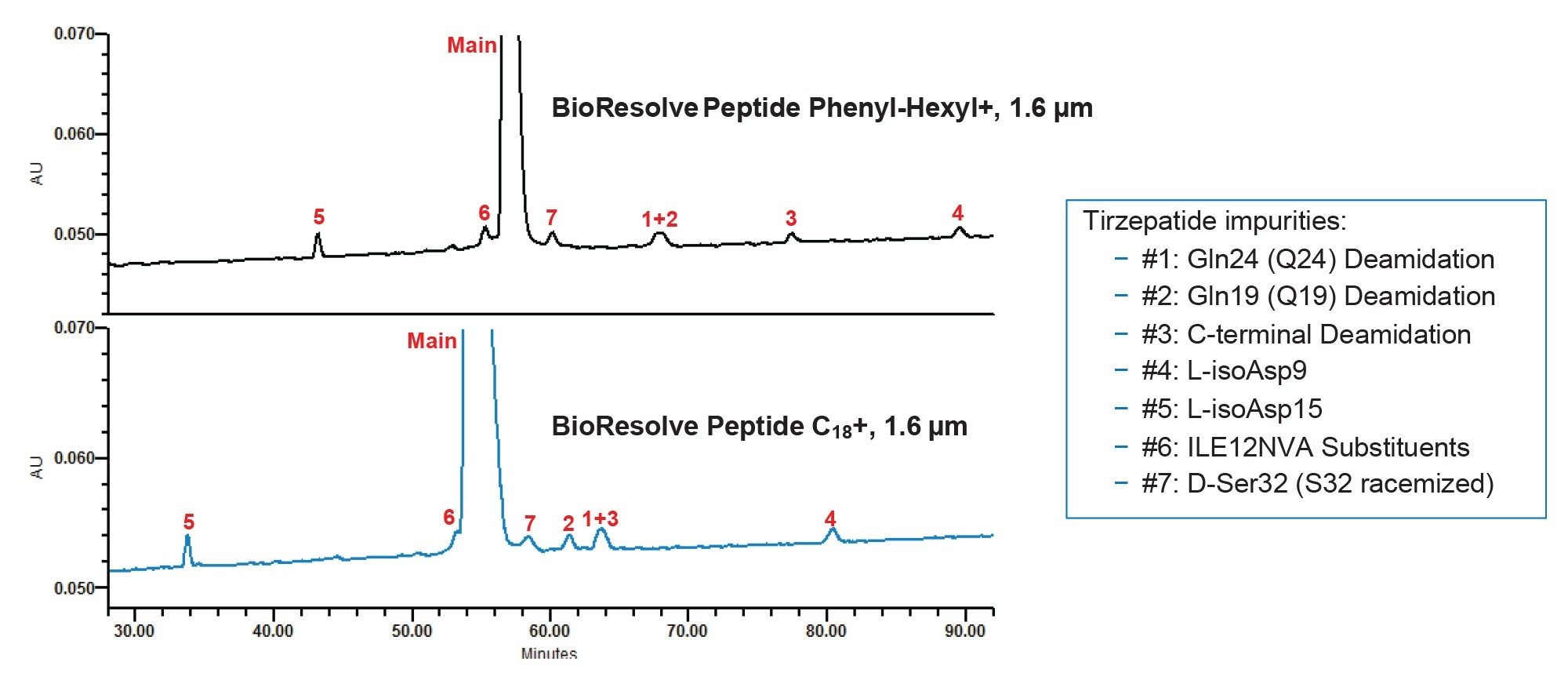
Even with a shallow gradient, separating some structurally similar impurities on the 2.1 x 150 mm columns remains difficult. Impurity 6 (Isoleucine→Norvaline) was not fully resolved from the main peak, and the three deamidation species were not baseline‑separated, underscoring the inherent challenge of resolving closely related peptide variants (Figure 1). Other approaches such as increasing column length can further improve resolution.
Figure 2 shows the separation of tirzepatide and its impurities on a 2.1 x 150 mm (top) and a 2.1 x 300 mm (bottom) BioResolve Peptide Phenyl-Hexyl+ 1.6 um Column. With the same run time, the 300 mm column can partially separate Impurity 1 and 2. A longer gradient time with a shallower gradient slope could be used to further improve resolution between Impurity 1 and 2. In addition, resolution of the two species eluting immediately before and after the main peak (Impurity 6 and 7) is improved on the 300 mm column compared to the 150 mm column. This suggests that longer columns may have more impact on the separation than running longer gradients on a shorter column, which has been observed in other separations.3
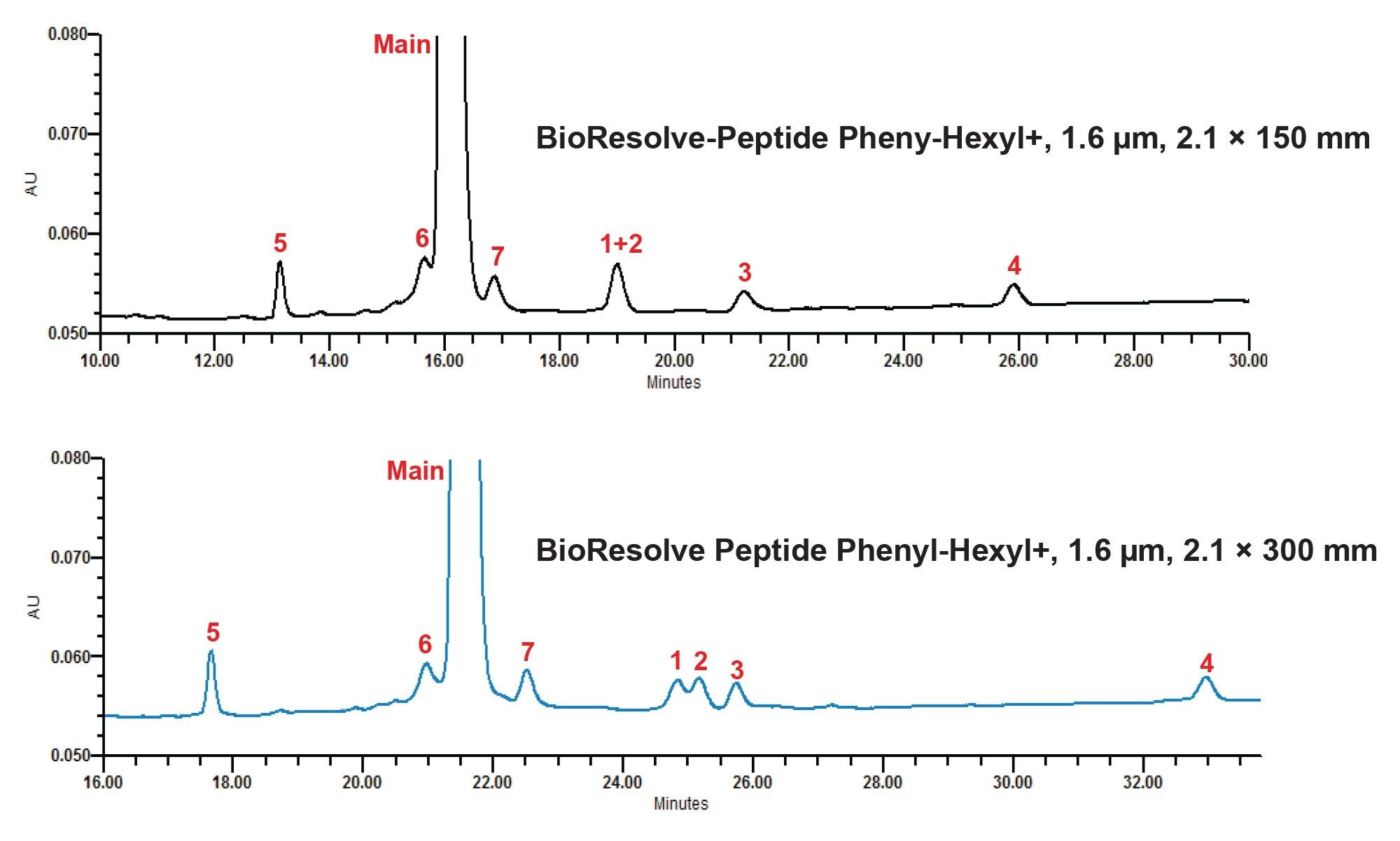
BioResolve Peptide Phenyl-Hexyl+ and BioResolve Peptide C18+ RP Columns are able to separate tirzepatide, a GLP-1 drug, from structurally similar impurities. The two different column chemistries (Phenyl-Hexyl+ and C18+) provide different selectivity, which can be useful depending on the separation needs. In addition, with the same run time, the 300 mm length column provides higher resolution than the 150 mm length column, even though the gradient slope is 2x steeper for the 300 mm length column.
720009465, July 2026


