

Application Brief
This is an Application Brief and does not contain a detailed Experimental section.
Ayeda Matar Al Hosania, PMN Rajeshb, Jesus Gomez-Maresb, Claudia Rathmannb, Nicole Baumgartenb
a Abu Dhabi Quality and Conformity Council, Abu Dhabi, UAE
b Waters Corporation, EMEA
Published on December 23, 2025
This is an Application Brief and does not contain a detailed Experimental section.
This application brief highlights an advanced analysis of per- and polyfluoroalkyl substances (PFAS) in bottled drinking water, helping ensure safe and affordable water for communities across the UAE. The method is aligned with the PFAS sum parameter listed in the EU Drinking Water Directive (EU DWD) 2020/2184.1 To allow high-throughput, a previously published PFAS method2 was reduced from 22 minutes run time to 15 minutes. Leveraging a streamlined dilute-and-shoot workflow, the ACQUITY UPLC I-Class Plus System combined with the Xevo TQ Absolute Mass Spectrometer delivers unmatched sensitivity. Together, they enable ultra-trace quantitation at parts-per-trillion (ppt; ng/L) levels, providing the precision and reliability needed to meet stringent regulatory standards and safeguard public health.3

PFAS employed in applications ranging from non‑stick coatings and surfactants to food packaging, fire‑fighting foams, and as polymerization aids for polytetrafluoroethylene (PTFE) and other fluoropolymers, exhibit remarkable chemical stability and environmental persistence. Most of these compounds are bioaccumulative and have been detected in human blood, underscoring their pervasive impact on both ecosystems and public health.4
Monitoring PFAS in drinking water is critical because they are widespread, resistant to natural breakdown, and linked to serious health risks, including cancer, immune dysfunction, and developmental issues. With thousands of distinct compounds, PFAS are widely used across consumer, commercial, and industrial applications. Their sheer diversity and widespread use complicate efforts to investigate and evaluate the potential risks they pose to human health and the environment.
This application brief outlines an adapted analytical methodology from the previously published application note by Waters2 for the determination of 27 PFAS compounds in alignment with the EU DWD to monitor bottled drinking water in the UAE. The approach employs a streamlined dilute-and-shoot technique, leveraging the exceptional sensitivity and performance of the ACQUITY UPLC I-Class System in combination with the Xevo TQ Absolute Mass Spectrometer. By eliminating labor-intensive preconcentration procedures, the likelihood of analyte loss or sample contamination is substantially reduced, while simultaneously enhancing sample throughput and analytical efficiency, thereby reducing overall costs.
With the number of analytes reduced to 27 PFAS compounds, the method could be further optimized, allowing the overall analysis time to be shortened from 22 minutes to 15 minutes. This reduction not only enhances high-throughput capacity but also facilitates more rapid and reliable monitoring of PFAS in drinking water.
To minimize sample preparation, conserve time, and mitigate the risk of contamination, a straightforward dilute-and-shoot strategy was employed. Bottled drinking water was diluted 1:1 with acidified methanol, vortex mixed, and subsequently transferred into polypropylene vials for direct injection of 50 µL of sample. Based on the previously published application note2 (p/n: 720008137), the overall run time of the LC method was reduced to 15 minutes, maintaining a good separation of all PFAS compounds (Figure 1).
The mass spectrometer parameters described in the application note were further optimized for this study. Under negative electrospray ionization mode, the capillary voltage was set to 0.5 kV. As no thermolabile PFAS compounds were included in the analytical panel, the source temperature was elevated from 110 °C to 130 °C, while the desolvation temperature was increased from 400 °C to 500 °C.
The acquisition was performed using MassLynx™ 4.2 Software, while data processing of 27 PFAS compounds was carried out in waters_connect™ for Quantitation Software. The exception focused review functionality facilitates a faster and more efficient evaluation of large datasets, streamlining the overall analytical workflow.
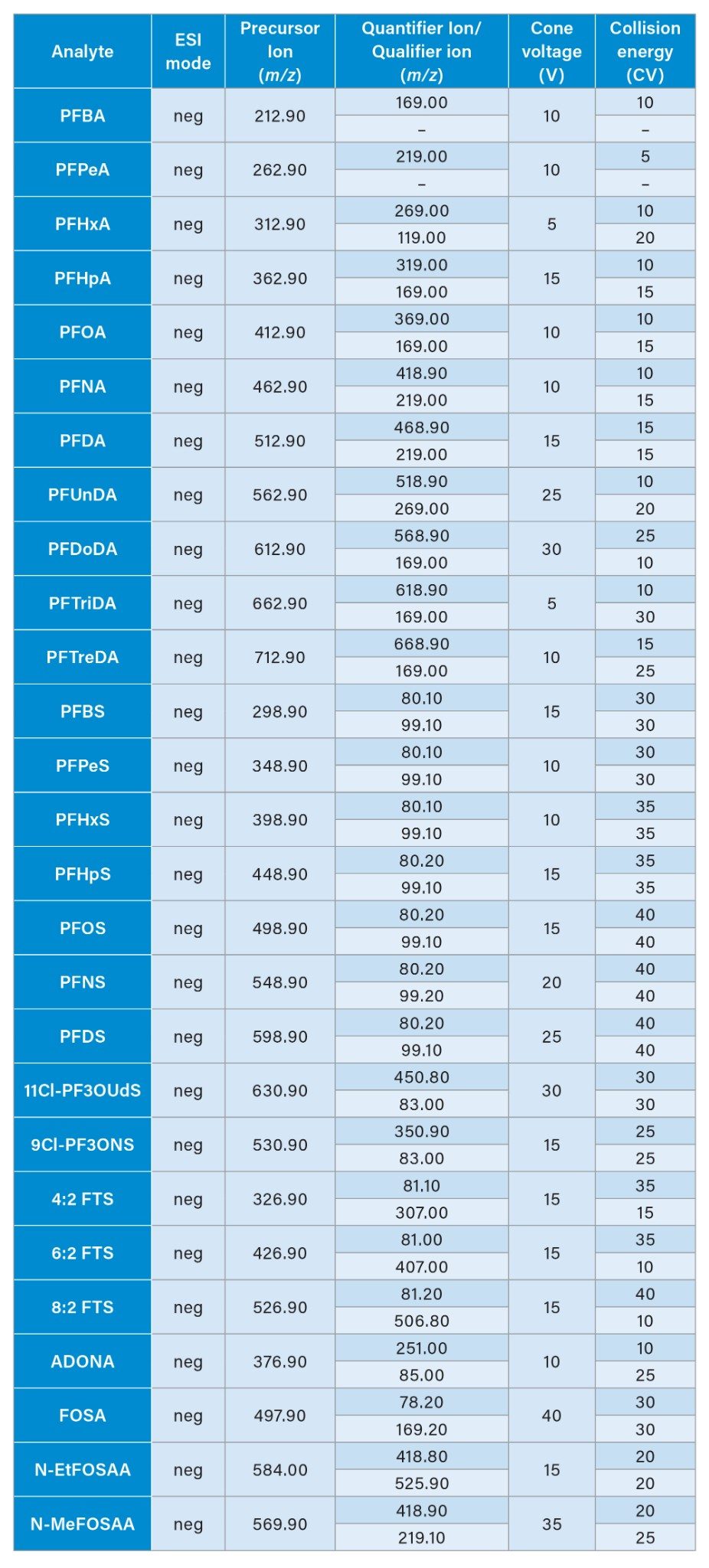
With the exceptional sensitivity of the Xevo TQ Absolute and the optimized mass spectrometer parameters, a limit of quantitation (LOQ) of 1 ng/L and calibration curves ranging from 1 to 250 ng/L were achieved for all 27 PFAS. All MRM conditions with cone and collision energies are listed in Table 1.
The optimized method demonstrated outstanding linearity and high reproducibility across the 27 selected PFAS compounds. As illustrated in Figure 1, chromatographic separation was achieved for all analytes, with elution times under 10 minutes.
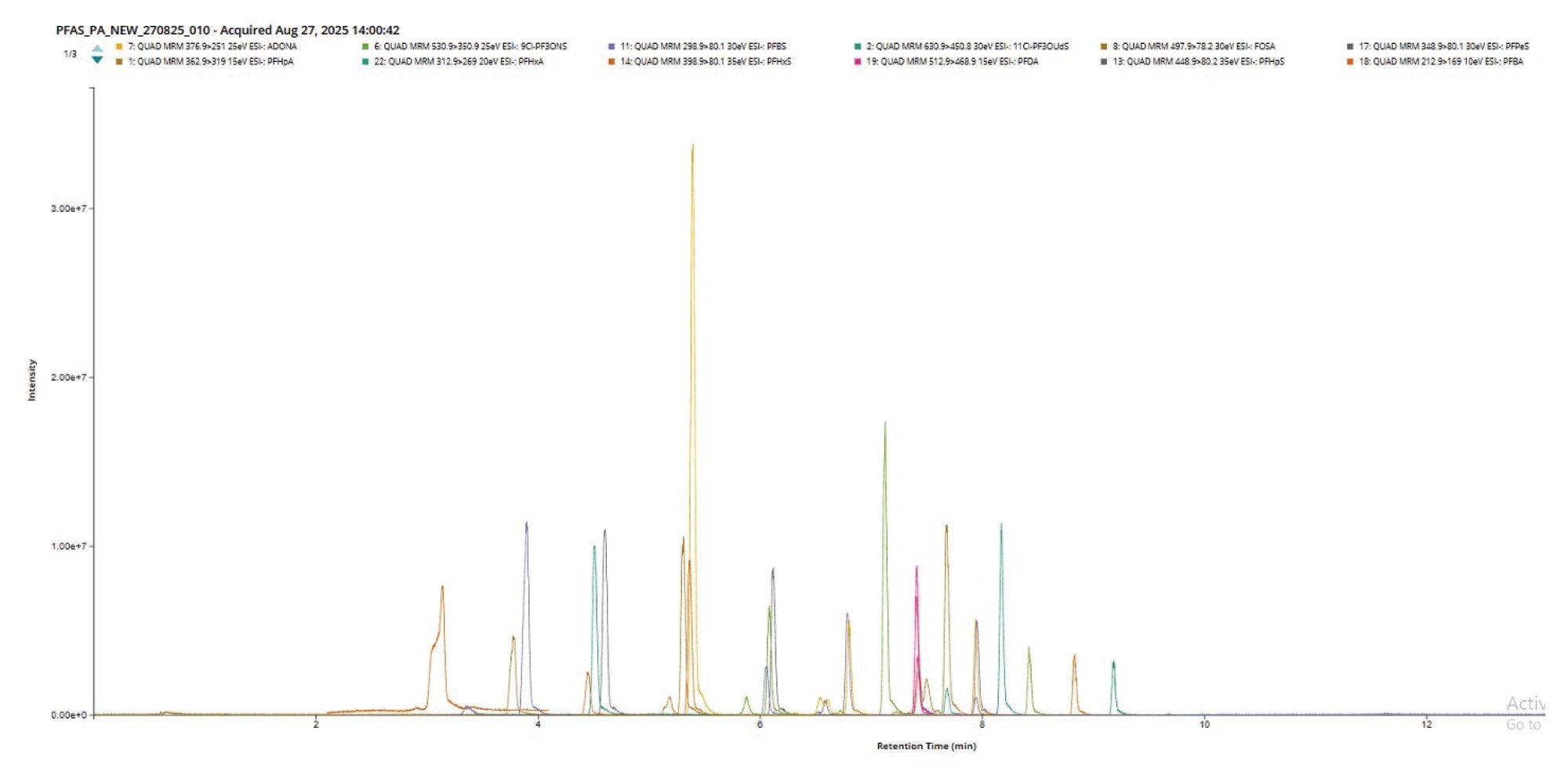
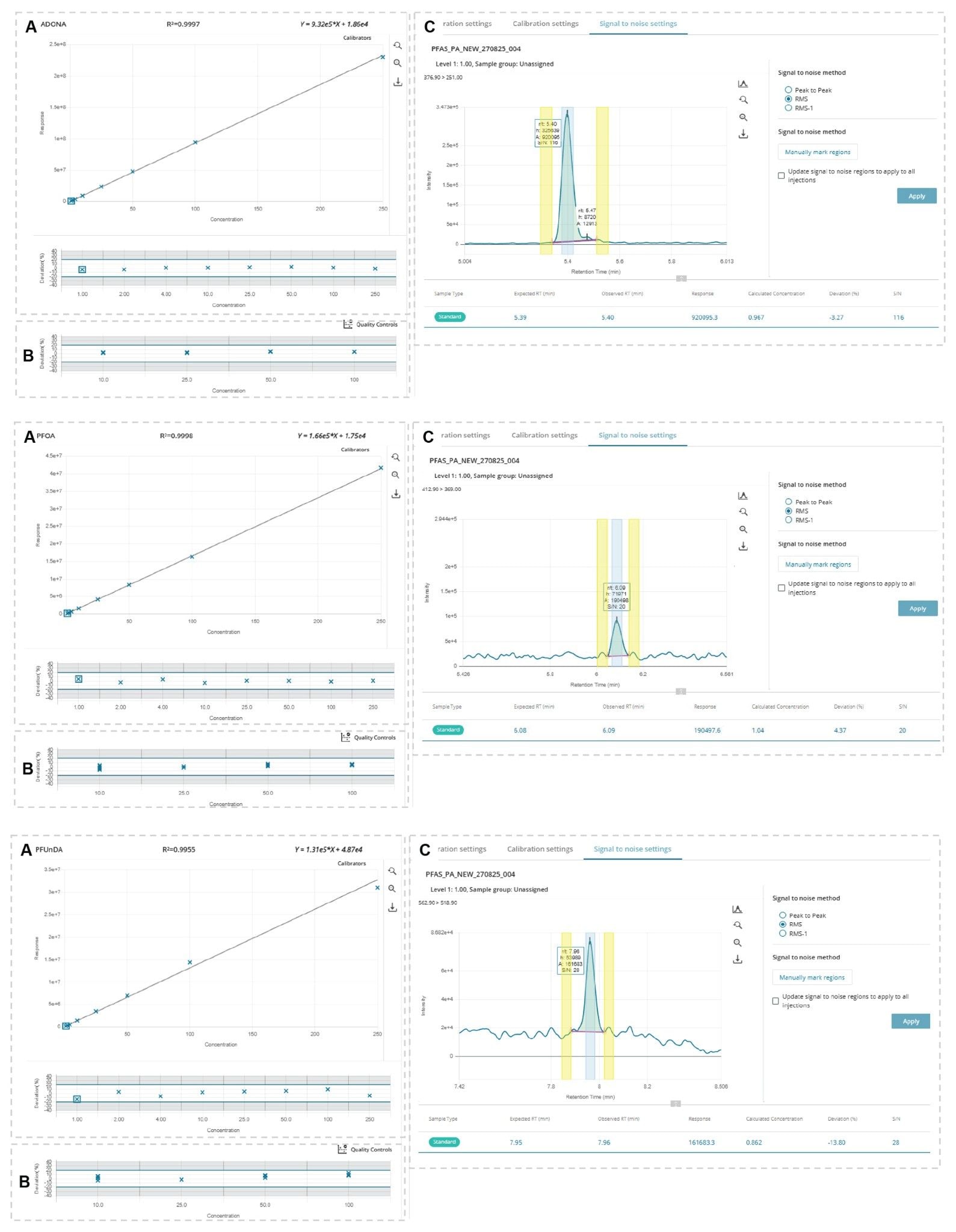
Figure 2 shows linear calibration curves for selected PFAS compounds, ranging from 1 to 250 ng/L, demonstrating both the sensitivity and dynamic range of the system. For each compound, the percentage deviation of each individual calibration standard is well within a 20% deviation range (Figure 2, A). All 11 drinking water samples tested with this approach showed no detectable PFAS contamination.
To assess reproducibility, three of these water samples were pooled and spiked at four different concentration levels (10, 20, 50, and 100 ng/L). Repeated injections demonstrated strong system reproducibility, with QC deviations remaining well within the 20% tolerance (Figure 2, B).
In addition, Figure 2 shows the calculated signal-to-noise ratios for the PFAS compounds at 1 ng/L (Figure 2, C), highlighting the method’s capability for ultra-trace quantitation.
The PFAS compounds displayed in Figure 2 were chosen to represent a range of classes, spanning well-known perfluorooctanoic acid (PFOA) to long‑chain perfluoroundecanoic acid (PFUnDA) species, as well as emerging PFAS 4,8-dioxa-3H-perfluorononanoic acid (ADONA).
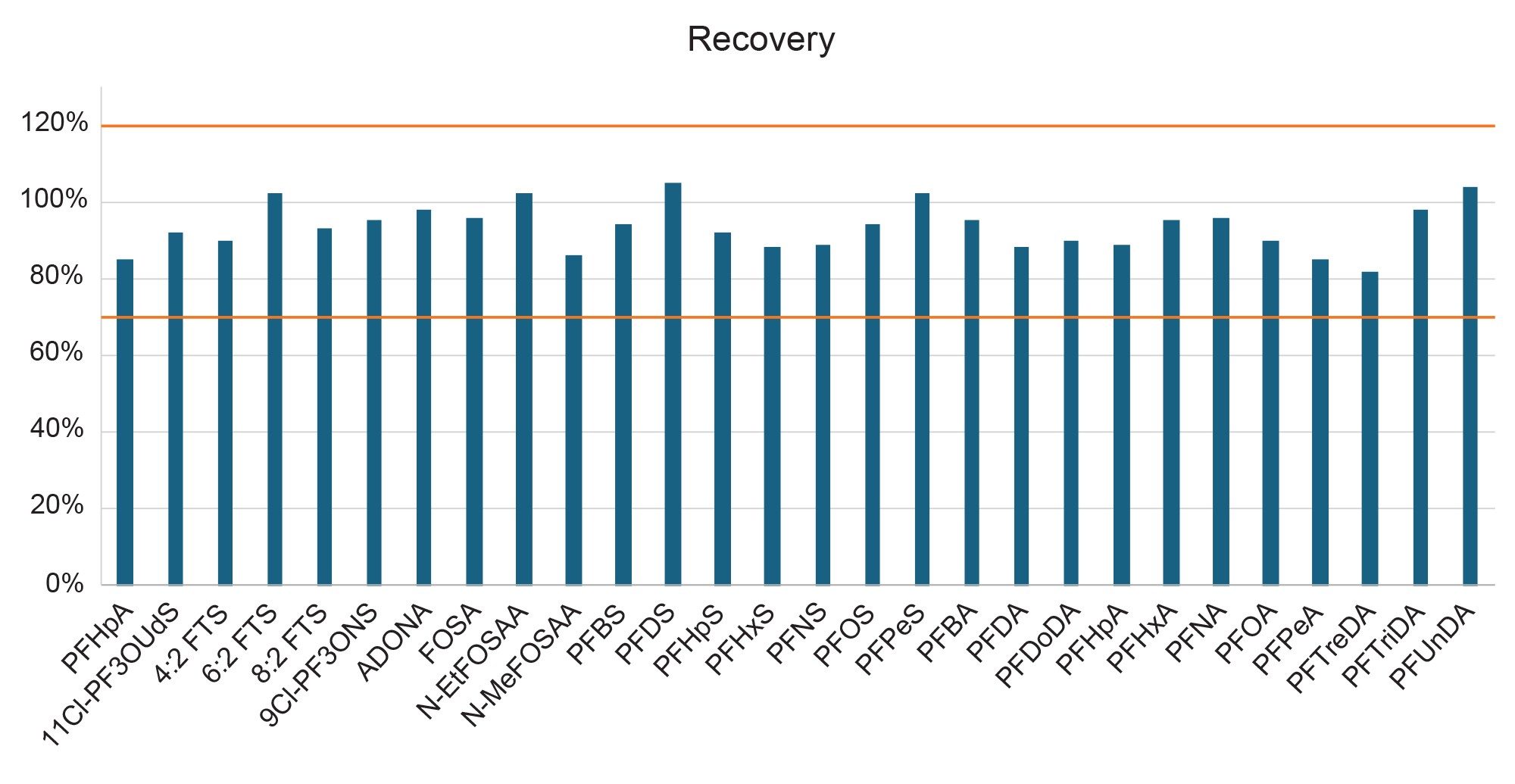
Recoveries of PFAS compounds in an exemplary matrix derived from 3 pooled drinking water samples were consistently within the tolerable range of 120 to 70%, ranging from 84% to 105% at the lowest quality control (QC) level of 10 ng/L. These results demonstrate the robustness and accuracy of the method even at trace concentrations, ensuring reliable quantification of PFAS in compliance with stringent analytical performance criteria.
This application brief presents an optimized LC-MS/MS method for the analysis of 27 PFAS compounds aligned with EU DWD regulations. The use of a straightforward dilute-and-shoot approach combined with a reduced LC runtime of 15 minutes enables rapid and convenient monitoring of PFAS at trace-level concentrations in drinking water in the UAE. The method delivers exceptional sensitivity with an LOQ of 1 ng/L and a broad dynamic range, demonstrating linearity from 1 to 250 ng/L for all 27 PFAS.
Quality control samples from pooled drinking water confirmed excellent reproducibility and recovery. All 11 bottled water samples analyzed with this method showed no PFAS contamination above the quantification limit which is set at regulatory requirements. Enhanced negative ion sensitivity of the Xevo TQ Absolute, together with optimized mobile phase composition and source parameters, ensure consistent performance at sub-ng/L detection limits throughout the study. These capabilities support high-throughput drinking water analysis, enabling timely and reliable monitoring to safeguard public health.
720009195, December 2025


