
A Fully Integrated Qual/Quan Solution from a Single Injection Using Standardized Sample Preparation and Chromatography with a Benchtop MRT Mass Spectrometer
Matthew E. Daly, Rowan Moore, Lee A. Gethings, Martin Palmer, Richard Lock, James I. Langridge
Waters Corporation, Wilmslow, United Kingdom
Published on June 01, 2026

Benefits
This application note demonstrates how a mixed mode LC–MS workflow can be used to:
- Combine qualitative discovery and targeted quantification within a single injection, eliminating the need for separate Qual/Quan analyses and reducing total analysis time and sample consumption.
- Deliver robust, reproducible quantitative performance using scheduled Time-of-flight multiple reaction monitoring (Tof MRM) acquisition, with stable responses maintained across extended analytical sequences.
- Maintain comprehensive qualitative coverage through concurrent data-independent acquisition (DIA), enabling confident protein identification alongside targeted measurements.
- Support high‑throughput and routine LC–MS operation through the integration of automated sample preparation, standardized Evosep™ chromatography, and fast multi‑reflecting TOF acquisition on a benchtop platform.
Introduction
Modern LC–MS laboratories are expected to deliver more actionable information from every injection. Researchers increasingly require both broad qualitative coverage to understand sample complexity and precise, reproducible quantification of selected targets. Historically, these objectives have been addressed using separate analytical methods or multiple injections, increasing instrument utilization, sample consumption, and workflow complexity.
As sample numbers grow and timelines shorten, the limitations of multi‑injection strategies become more pronounced. Additional injections introduce sources of analytical variability, extend total analysis time, and complicate long‑term studies that rely on high reproducibility across hundreds of measurements. In routine and high‑throughput environments, these factors can limit scalability and operational efficiency.
DIA has become an established approach for comprehensive qualitative analysis due to its systematic sampling of all detectable precursors and its inherent run‑to‑run reproducibility. DIA workflows support consistent protein identification and quantitative stability across large sample sets, making them well suited to exploratory and discovery‑focused applications. However, DIA alone is not always optimized for highly specific quantitative measurements required for targeted monitoring.
In contrast, targeted workflows based on multiple reaction monitoring (MRM) remain the gold standard for robust and precise quantification of predefined analytes in complex matrices. MRM assays provide high selectivity and excellent long‑term reproducibility, supporting quantitative consistency across extended analytical campaigns. Despite these strengths, targeted workflows typically provide limited contextual information beyond the monitored analytes.
Recent advances in mass spectrometer scan speed and acquisition efficiency now enable qualitative and quantitative acquisition strategies to be combined within a single LC–MS analysis. Mixed mode workflows reduce analytical overhead while retaining the benefits of both discovery‑level and targeted measurements. When coupled with standardized chromatography and automated sample preparation, these approaches support simplified workflows designed for routine, high‑throughput operation.
In this study, a single‑injection Qual/Quan workflow implemented on the Xevo™ MRT P10 Mass Spectrometer is demonstrated. The method combines DIA (MSe) with scheduled Tof MRM acquisition within a single run. Automated Evotip™ preparation using Andrew+™ Robotics and reproducible separations on the Evosep Eno System provide a consistent analytical front end, enabling a scalable LC–MS workflow that maximizes information content per injection.
Experimental
A peptide standard mixture was prepared from the tryptic digestion of four proteins combined at equimolar concentrations. The peptide mixture was subsequently spiked into a complex Escherichia coli tryptic digest to generate a representative background matrix suitable for evaluating both qualitative and quantitative LC–MS performance.
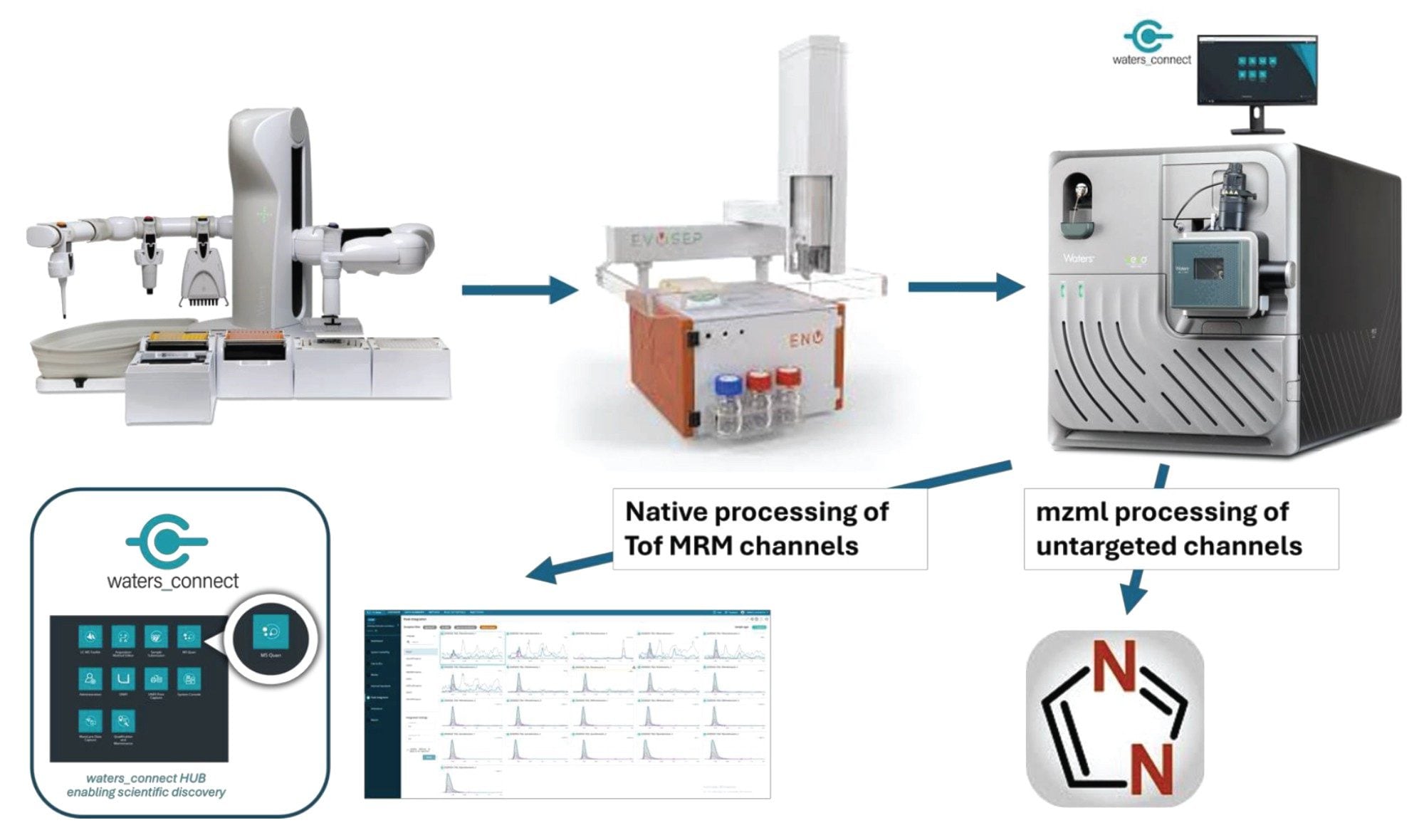
Samples were prepared and loaded onto Evotips using an Andrew+ Robot that offers automated liquid‑handling. Automated Evotip loading minimized variability associated with manual sample handling and ensured consistent sample cleanup, desalting, and loading prior to LC–MS analysis.
Chromatographic separations were performed using an Evosep Eno System operated with standardized Evosep methods. The 60 samples‑per‑day (SPD) method was employed, corresponding to a 24‑minute total cycle time, including gradient, washing, and equilibration steps.
The Evosep Eno System utilizes pre‑formed gradients and disposable trap‑based sample loading to deliver reproducible peptide separations with minimal overhead between injections. This standardized chromatographic approach supports high‑throughput operation while maintaining retention‑time stability suitable for scheduled targeted acquisition.
The LC eluate was analyzed using a Xevo™ MRT P10 Mass Spectrometer operated in a mixed mode acquisition configuration. Each analytical run combined:
- DIA, MSe for untargeted qualitative analysis
- Scheduled (Tof MRM) for targeted quantitative analysis
Targeted acquisition focused on ten predefined marker peptides, monitored using more than 30 Tof MRM transitions within the same injection. The fast multi‑reflecting TOF analyzer provided sufficient acquisition speed to support concurrent DIA and MRM data collection without extending chromatographic cycle time or compromising peak definition.
Targeted Tof MRM data were processed using the MS Quan Application within the waters_connect™ Software acquire and process workflow. This enabled automated data processing, batch‑level review, and consistent evaluation of quantitative performance across large injection sets.
Untargeted DIA data were converted to mzML format and processed using DIA‑NN for protein identification and qualitative assessment. Using independent processing paths for targeted and untargeted data ensured flexibility while maintaining compatibility with established proteomics workflows (Figure 1).
Results and Discussion
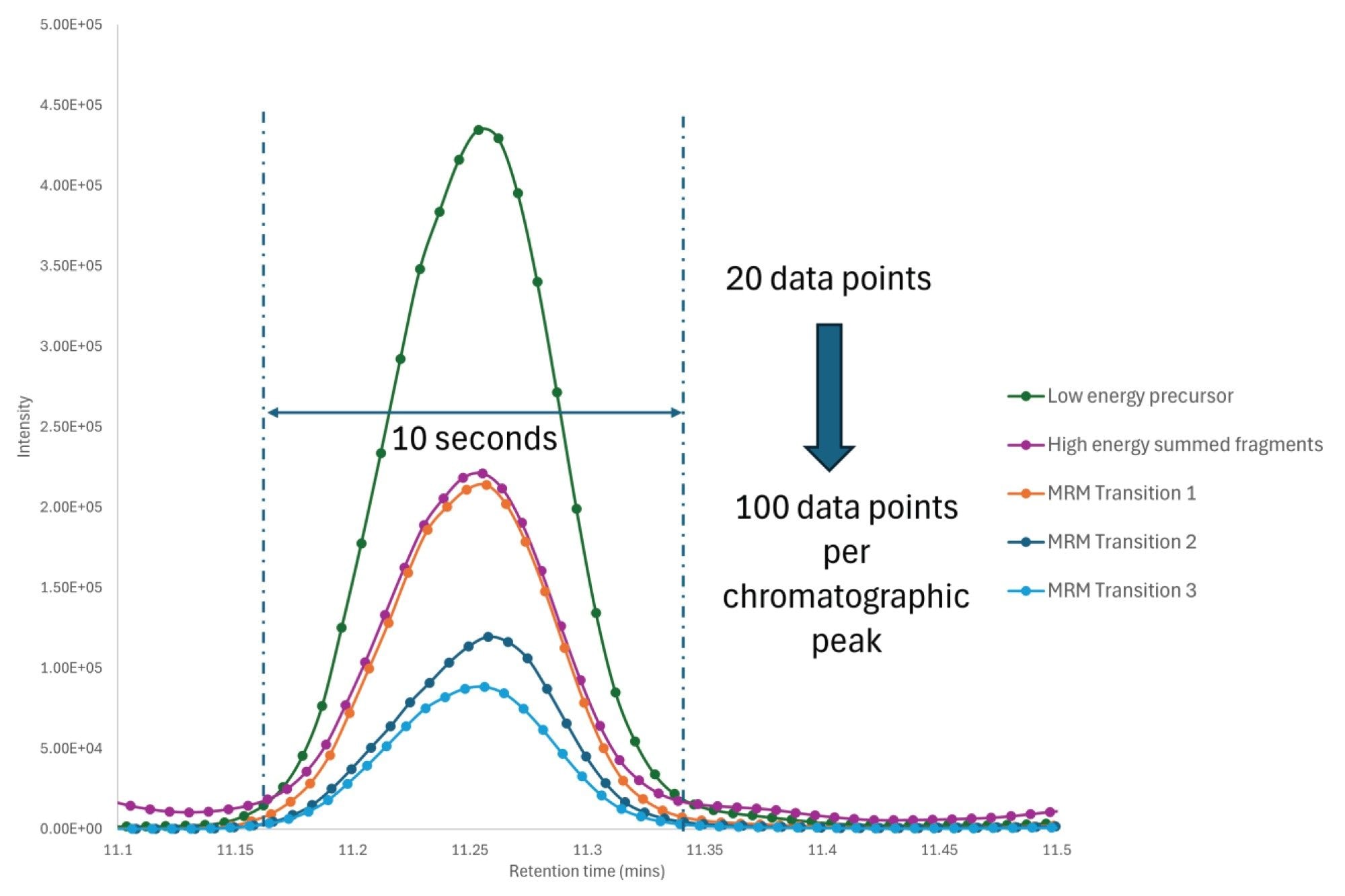
The mixed mode workflow enabled simultaneous untargeted and targeted acquisition within a single 24‑minute LC cycle. Fast multi‑reflecting TOF acquisition ensured sufficient sampling across both DIA and Tof MRM functions, maintaining accurate peak definition and integration even where acquisition events overlapped. This capability eliminates the need for separate qualitative and quantitative injections while preserving data quality for both experiment types (Figure 2).
Standardized chromatography using the Evosep Eno System delivered highly reproducible peptide separations. Using the 60 samples‑per‑day method, peptide retention times were maintained within ±2 seconds of the mean across repeated injections. This level of retention‑time stability is critical for scheduled targeted acquisition and reduces the need for frequent retention‑time adjustment in long analytical sequences.
Targeted quantification using scheduled Tof MRM demonstrated stable and reproducible responses across 300 consecutive injections. Automated Evotip loading using Andrew+ Robot minimized variability associated with manual sample handling and contributed to consistent peptide responses over time. The use of Tof MRM provided accurate mass confirmation while maintaining the selectivity and robustness required for quantitative analysis in complex matrices.
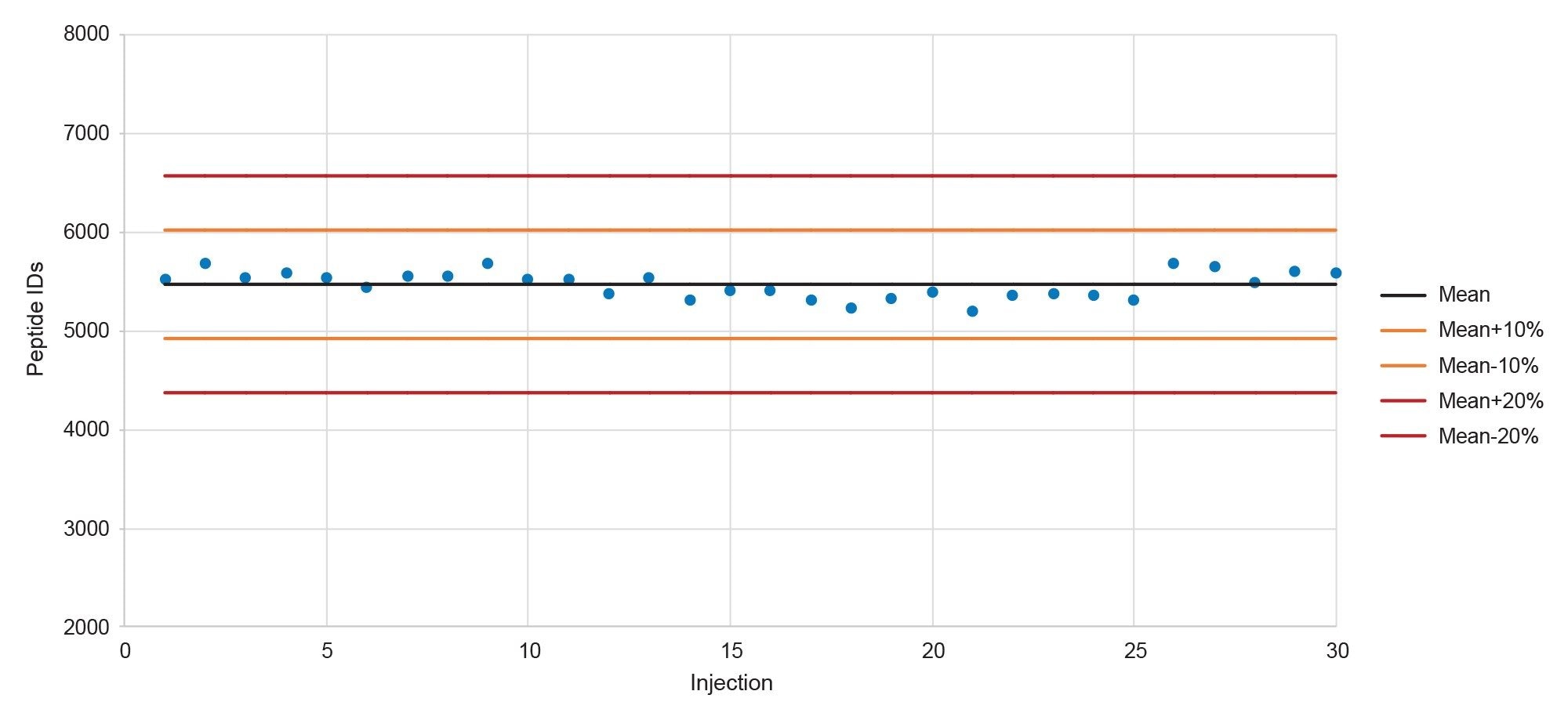
Untargeted DIA data were acquired concurrently without compromising qualitative performance. Consistent protein and peptide identifications were observed across all injections, confirming that comprehensive qualitative coverage was maintained alongside targeted quantification (Figure 3). This combined Qual/Quan approach enables both broad sample characterization and confident, reproducible quantification from a single injection.
Conclusion
This application note demonstrates that single‑injection mixed‑mode LC–MS workflows can replace traditional multi‑injection Qual/Quan strategies without compromising analytical performance. By combining DIA and Tof MRM acquisition on a Xevo MRT P10 Mass Spectrometer, laboratories can generate comprehensive qualitative insight and robust quantitative data from every analysis.
The integration of automated sample preparation, standardized Evosep chromatography, and fast MRT acquisition addresses key operational challenges faced by modern LC–MS laboratories. Reduced sample consumption, simplified method design, and improved long‑term reproducibility enable workflows that scale efficiently and perform reliably across extended analytical campaigns.
For laboratories conducting high‑throughput, routine, or longitudinal LC–MS studies, mixed mode acquisition on the Xevo MRT P10 Mass Spectrometer delivers a practical solution that maximizes information content per injection. This approach supports confident decision‑making while increasing laboratory efficiency and analytical consistency.
References
- Fröhlich, K.; et al. Data-Independent Acquisition: A Milestone and Prospect in Clinical Mass Spectrometry-Based Proteomics. Molecular & Cellular Proteomics. 2024 23(8), 100800.
- Li, J.; Smith, L. S.; Zhu, H.‑J. Data-independent acquisition (DIA): an emerging proteomics technology for analysis of drug-metabolizing enzymes and transporters. Drug Discovery Today: Technologies. 2021 39, 49–56.
- Liebler, D. C.; Zimmerman, L. J. Targeted quantitation of proteins by mass spectrometry. Biochemistry. 2013 52(22), 3797–3806.
- Mani, D. R., et al. Statistical characterization of multiple-reaction monitoring mass spectrometry (MRM-MS) assays for quantitative proteomics. BMC Bioinformatics. 2012 13(Suppl 16), S9.
- A standardized separation method with a throughput of 60 samples per day (Application Note AN‑008B). Evosep Biosystems. (2023).
- Bache, N.; et al. A Novel LC System Embeds Analytes in Pre-formed Gradients for Rapid, Ultra-robust Proteomics. Molecular & Cellular Proteomics. 2018 17(11), 2284–2296.
Featured Products
720009367, May 2026


