
Unique Selectivity of BioResolve Peptide C18+ and Phenyl‑Hexyl+ Columns for Separation of Deamidation Impurities of a GLP-1 Receptor Agonist
Hua Yang, Steve Shiner, Caitlin Hanna
Waters Corporation, United States
Published on October 08, 2026

Abstract
The BioResolve™ Peptide C18+ and BioResolve Peptide Phenyl-Hexyl+ reversed-phase (RP) Columns were compared to three columns from alternative vendors for the separation of tirzepatide, a glucagon-like peptide-1 (GLP-1) therapeutic, from its impurities. Unique selectivity of two deamidation impurities was observed on the BioResolve Columns, resulting in superior separation of the two species relative to the alternative columns.
Benefits
- The BioResolve Peptide C18+ and Phenyl-Hexyl+ Columns exhibited unique selectivity compared to competing columns in separating two deamidated impurities of tirzepatide
- The superior selectivity of the BioResolve cClumns enable effective separation of the two deamidated impurities even under high-throughput conditions with short gradients and high flow rates, where competing columns are more prone to impurity co-elution
Introduction
Deamidation of proteins and peptides can occur during production and storage, converting an amide functional group to a carboxylic acid. At neutral pH, this change introduces a negative charge that alters the structure of the biopharmaceuticals, impacting their chemical and biological properties. Because deamidation can significantly compromise drug purity, stability, and shelf life, separating and characterizing these specific impurities is essential to ensure therapeutic safety and efficacy.¹
GLP-1 therapeutics are among the fastest growing biopharmaceuticals on the market. Waters BioResolve Peptide C18+ and Phenyl-Hexyl+ RP Columns, designed specifically for analytes like insulins and GLP-1 receptor agonists, feature superficially porous particles with an average pore size of 230 Å, allowing improved accessibility and efficiency for larger peptides. A controlled positive surface charge enhances peak shape and loading capacity for basic analytes, particularly with formic acid mobile phases.2 Furthermore, integrated MaxPeak™ Premier Columns hardware minimizes non-specific adsorption (NSA), ensuring superior recovery, consistency, and robustness.3
It has been shown that Waters BioResolve Peptide C18+ and Phenyl-Hexyl+ RP Columns provide complementary selectivity in resolving structurally similar GLP-1 peptide variants.4 In this application note, the unique selectivity of these reversed phase columns resulting in superior separation of two deamidation impurities of tirzepatide compared to columns from alternative vendors are described.
Experimental
Sample Preparation
Tirzepatide was reconstituted in modified DPBS to make a 2 mg/mL solution. Tirzepatide impurities were spiked into the tirzepatide sample to achieve a final concentration of 0.02 mg/mL.
LC Conditions
|
LC system: |
ACQUITY™ Premier UPLC™ System with Quaternary Solvent Manager (QSM), Sample Manager FTN, Column Heater and TUV Detector |
|
Columns: |
Prototype BioResolve Peptide C18+ Column, 2.7 µm, 2.1 x 150 mm BioResolve Peptide Phenyl-Hexyl+ Column, 2.7 µm, 2.1 x 150 mm (p/n: 186011730) |
|
Column temperature: |
50 °C |
|
Sample temperature: |
6 °C |
|
Injection volume: |
0.5 µL |
|
Mobile phase A: |
0.1% formic acid in water |
|
Mobile phase B: |
0.1% formic acid in acetonitrile |
|
Detection λ: |
214 nm |
|
Sample vials: |
Polypropylene 12 x 32 mm Screw Neck Vial with Cap and Preslit PTFE/Silicone Septum, 300 µL Volume |
Gradient Table
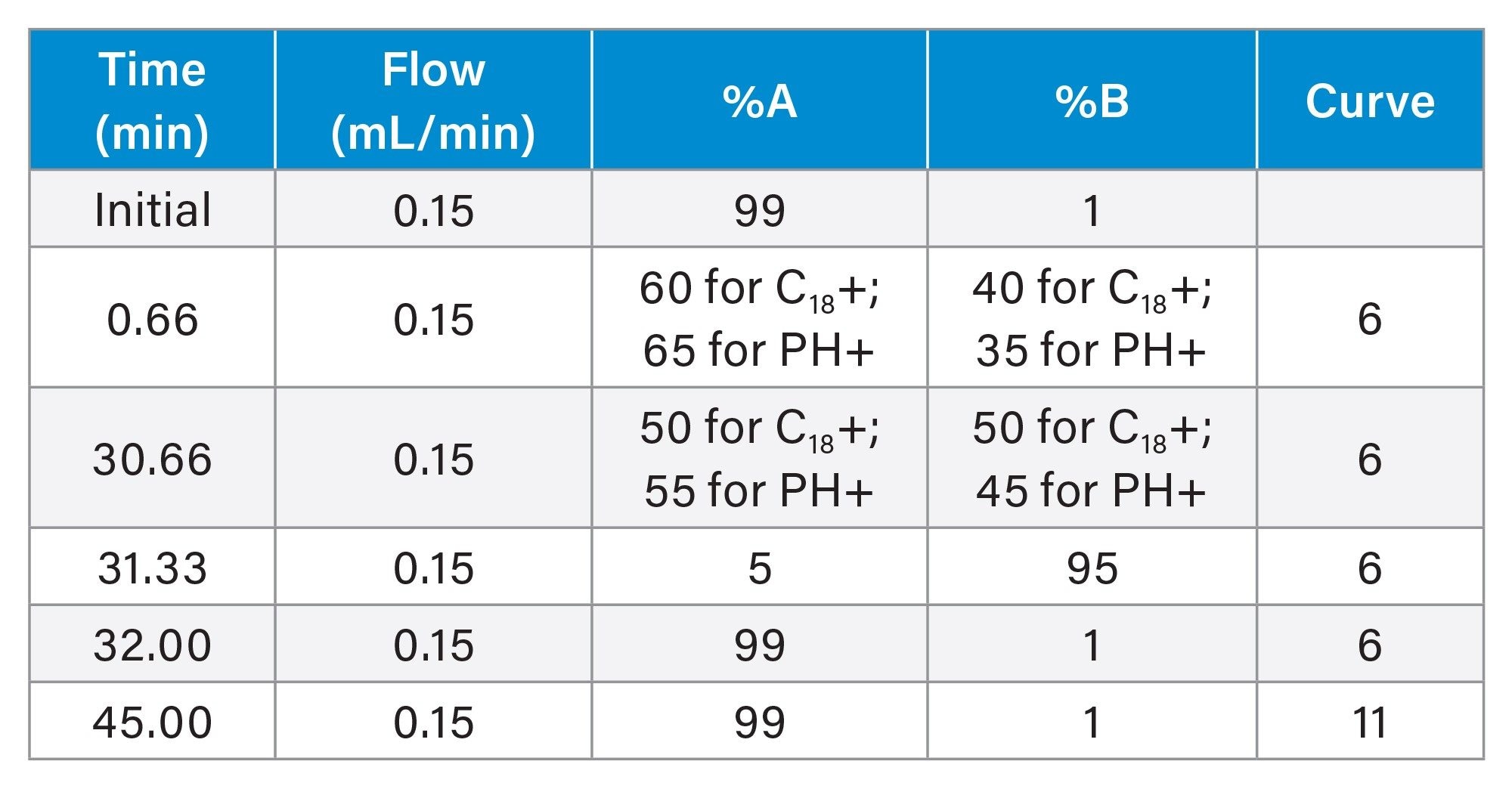
30-Minute Gradient
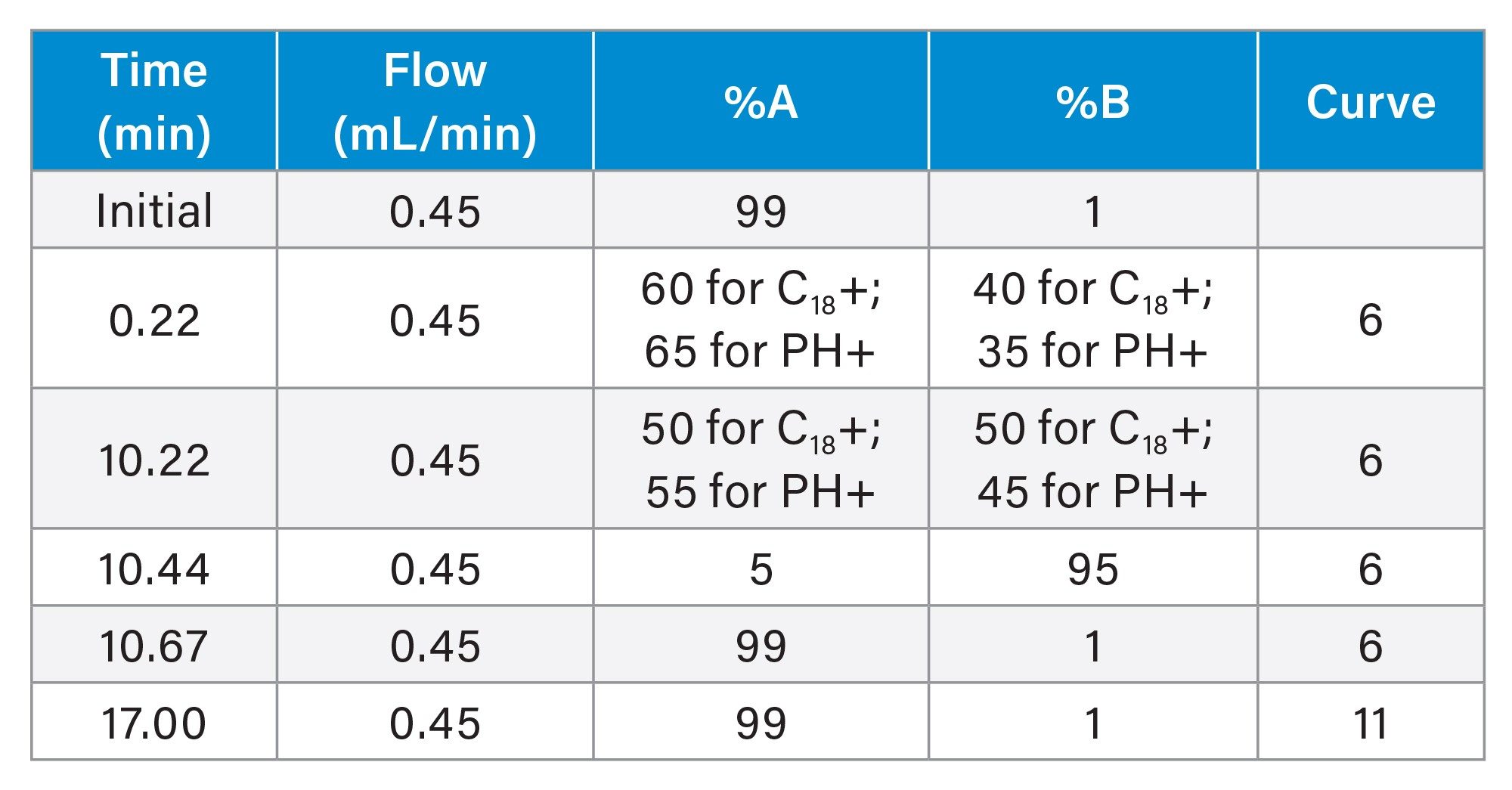
10-Minute Gradient
Results and Discussion
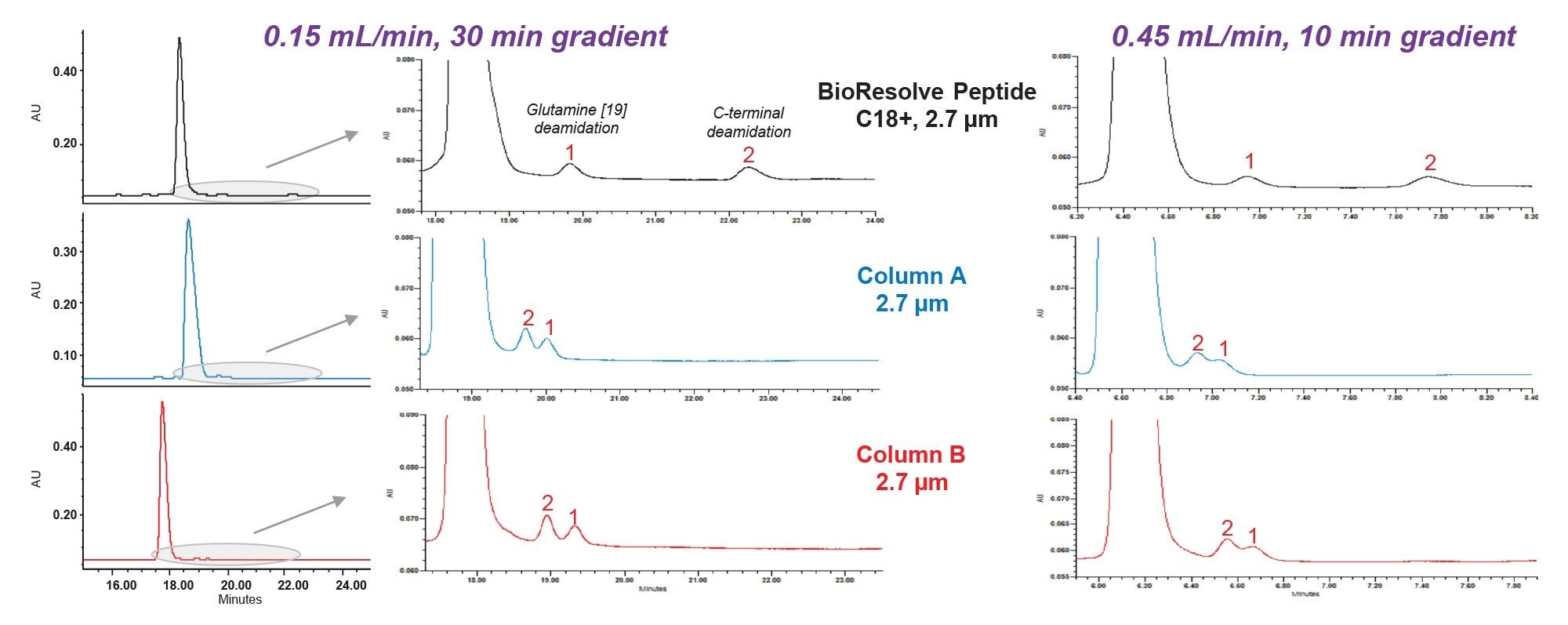
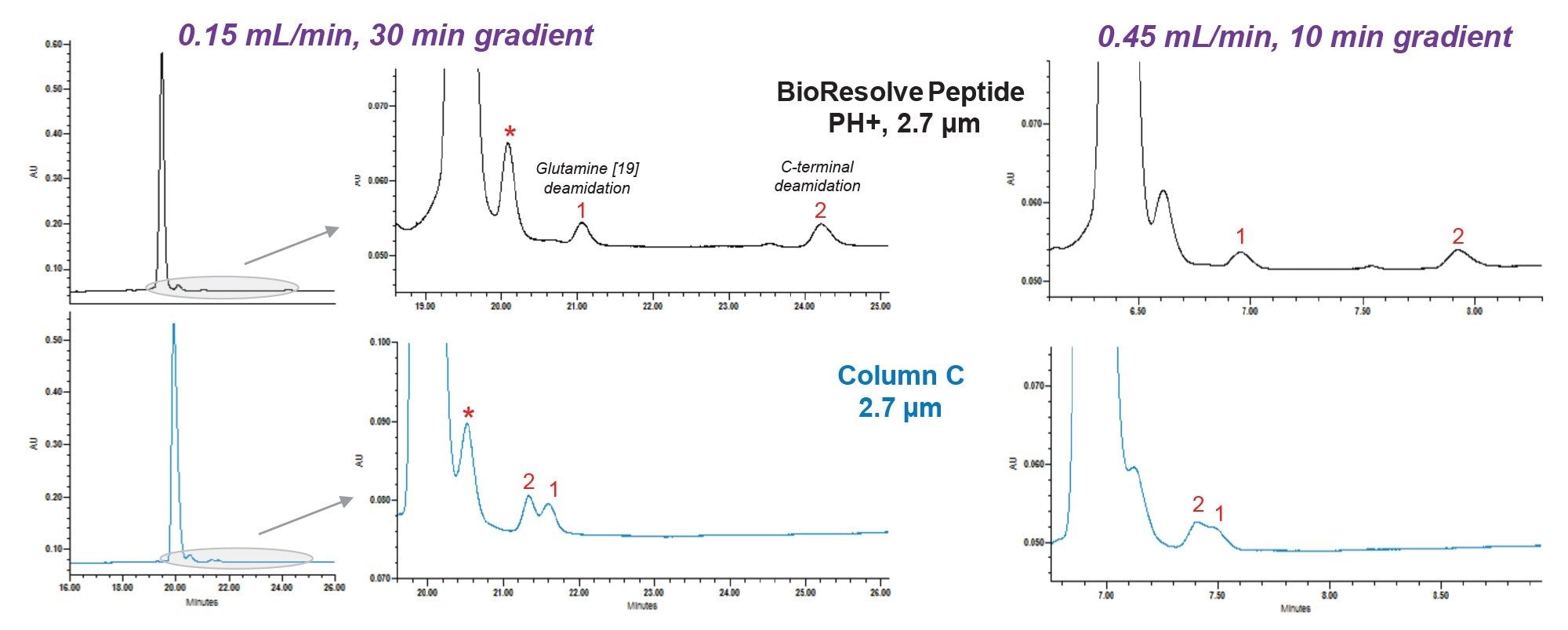
A sample containing unmodified tirzepatide, Glutamine 19 deamidated tirzepatide (Impurity 1), and C-terminal deamidated tirzepatide (Impurity 2) was separated on Waters BioResolve Peptide C18+ and Phenyl-Hexyl+ Columns and three columns from other manufacturers. All evaluated columns feature 2.7 µm superficially porous particles with positive surface charges. Figure 1 displays the chromatographic separations for C18 Columns, while Figure 2 illustrates the performance of Phenyl-Hexyl Columns.
The unique selectivity of the BioResolve Peptide C18+ Column is highlighted in Figure 1. On the BioResolve Column, Impurity 1 eluted before Impurity 2 whereas other columns (Column A and Column B) display the opposite elution order under the same gradient conditions. Additionally, the BioResolve Column delivered superior, baseline-resolved separation of the two deamidated impurities, which the other columns fail to achieve. This unique selectivity offers a distinct analytical advantage under high-throughput conditions featuring short gradient times and high flow rates. As shown on the right side of Figure 1, the BioResolve Column displays high resolution of tirzepatide's two deamidated impurities. Column A and Column B, on the other hand, suffer from co-elution of these two species under the same conditions.
As demonstrated in Figure 2, the BioResolve Peptide Phenyl-Hexyl+ Column also displays an inverted elution order for the two deamidated impurities compared to the phenyl-hexyl column from an alternative vendor (Column C). Additionally, the BioResolve Peptide Phenyl-Hexyl+ Column achieves baseline-resolved separation of these species that is maintained under high-throughput conditions, unlike Column C. While the C18+ and Phenyl-Hexyl+ Columns display comparable selectivity for the two deamidated impurities, they offer complementary selectivity for other species. Specifically, an unknown impurity (marked with an asterisk in Figure 2) is resolved from the main peak on the Phenyl-Hexyl+ Column, whereas this unknown impurity co-elutes with the main peak on the C18+ Column (Figure 1).
The fundamental resolution equation shown below outlines how three core parameters govern chromatographic separation: efficiency (N), selectivity (α), and retentivity (k). The chromatographic examples detailed in this application note clearly demonstrate that selectivity is the primary driving force for optimizing and improving resolution.
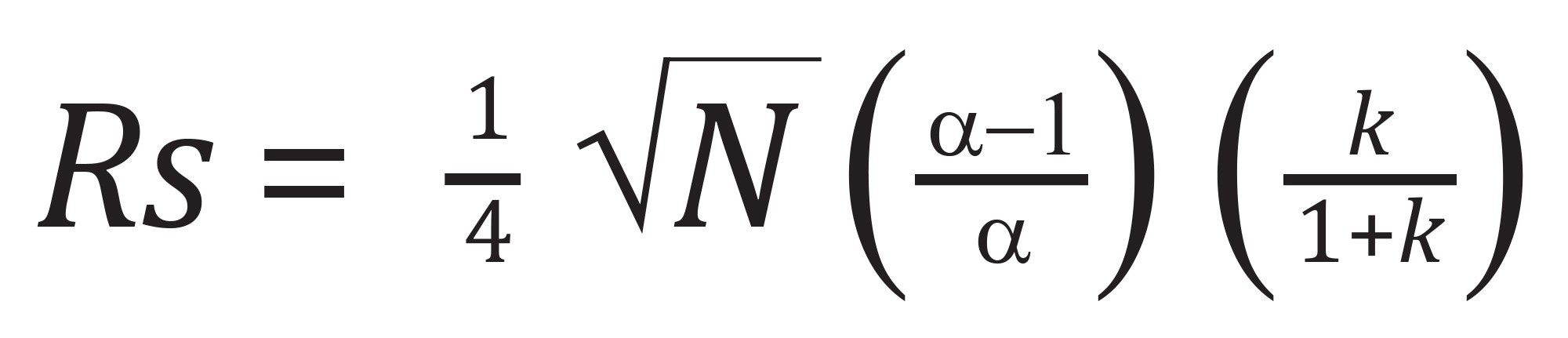
In a previous study, the elution order of the two deamidated tirzepatide impurities reversed when switching between formic acid and trifluoroacetic acid (TFA) mobile phases on the BioResolve Peptide Phenyl-Hexyl+ Column.5 This change in elution order was driven by substantially different selectivity of the C-terminally deamidated species under the two mobile phase conditions. The differing selectivity observed in this application note between the BioResolve Columns and columns from other vendors likely arises from differences in stationary phase properties such as ligand density, surface charge, and average pore size. Further investigations are needed to clarify the underlying mechanism.
Conclusion
BioResolve Peptide C18+ and Phenyl-Hexyl+ Columns offer unique selectivity, featuring a reversed elution order in separating two of the deamidated impurities of tirzepatide, compared to columns from alternative vendors. In addition, the BioResolve Columns provide superior, baseline-resolved separation of the two impurities, which leads to maintained high-resolution performance even under high-throughput conditions.
References
- Adav, S.S. Advances in the Study of Protein Deamidation: Unveiling its Influence on Aging, Disease Progression, Forensics and Therapeutic Efficacy. Proteomes 2025, Vol. 13 (2), Page 24.
- Lauber, M.A.; Koza, S.M.; Fountain, K.J. Increasing Peak Capacity in Reversed-Phase Peptide Separations with Charged Surface Hybrid (CSH) C18 Columns. Waters Application Note. 720004568, 2013.
- Improving Chromatographic Separations of Biopharmaceuticals with MaxPeak High Performance Surfaces (HPS) Technology. Waters eBook. 720008110, 2024.
- Yang, H.; Shiner, S. Separation of a GLP-1 Receptor Agonist and Structurally Similar Impurities Using BioResolve Peptide Phenyl‑Hexyl+ and C18+ Columns. Waters Application Note. 720009465, 2026.
- Koza, S.M.; Shiner, S.J. Lauber, M.A. Reversed-Phase LC-MS Analysis of Low Abundance Impurities in a GLP-1a Therapeutic Using a Charged Surface 230 Å Superficially Porous Phenyl-Hexyl Column. Waters Application Note. 720009507, 2026.
Featured Products
720009602, October 2026