
Multipass Ion Mobility Separation of GLP-1 Receptor Agonist Impurities Using the SELECT SERIES™ Cyclic™ IMS
Mariana Fioramontea, Alexandre F. Gomesb, Ignatius J. Kassb, Fabio Barrosc, Renata Biffic, Isadora M. Oliveirac
aWaters Technologies do Brasil, Barueri, SP, Brazil
bWaters Corporation, United States
cGrupo EMS, Sao Paulo, SP, Brazil
Published on August 03, 2026

Abstract
In this work, Cyclic Ion Mobility Mass Spectrometry was employed to separate, detect, and quantitate selected D- impurities of glucagon-like peptide 1 receptor agonist (GLP-1 RA) semaglutide that are otherwise difficult to differentiate using ultra performance liquid chromatography (UPLC™). The multipass cyclic IM capabilities of the Cyclic Ion Mobility Separation (IMS) bring enhanced mobility separation capabilities that are orthogonal to the LC separation and allow better characterization of complex impurity profiles such as those seen for GLP-1 therapeutics.
Benefits
- Resolve challenging semaglutide impurity isomers that are difficult to distinguish by LC-MS alone
- Achieve baseline separation of highly similar isomers using multipass ion mobility and advanced IMSn experiments
- Enable confident impurity identification and characterization for complex formulation samples
Introduction
The use of GLP-1 RA as therapeutics for type 2 diabetes and obesity have gained significant attention, resulting in unprecedented demand. As a result, there is an increased pressure on manufacturers for continuous improvement of their production processes to ensure efficiency, safety, and meet growing demands of an already enormous market.
One of the most challenging aspects in the development and production of GLP-1 RAs is in the characterization of impurities. While the typical impurity profile, along with pertinent regulations, is dependent on the manufacturing process (biotechnology or synthetic), what remains constant is the difficulty in separating possible impurities. Many of these are single amino acid configuration substitutions (L to D) on a peptide with 30 amino acid residues or more (which are often already modified with long fatty acid chains), which can require lengthy LC gradients and specialized mobile phases to achieve separation. Even then, in some cases, there is co-elution of impurities, which further complicates characterization and calls for orthogonal separation methods.
In this work, cyclic ion mobility with scalable resolution was evaluated as an orthogonal separation technique and as means to further elucidate impurity profiles on a typical GLP-1 agonist API (semaglutide).
Experimental
Sample Description
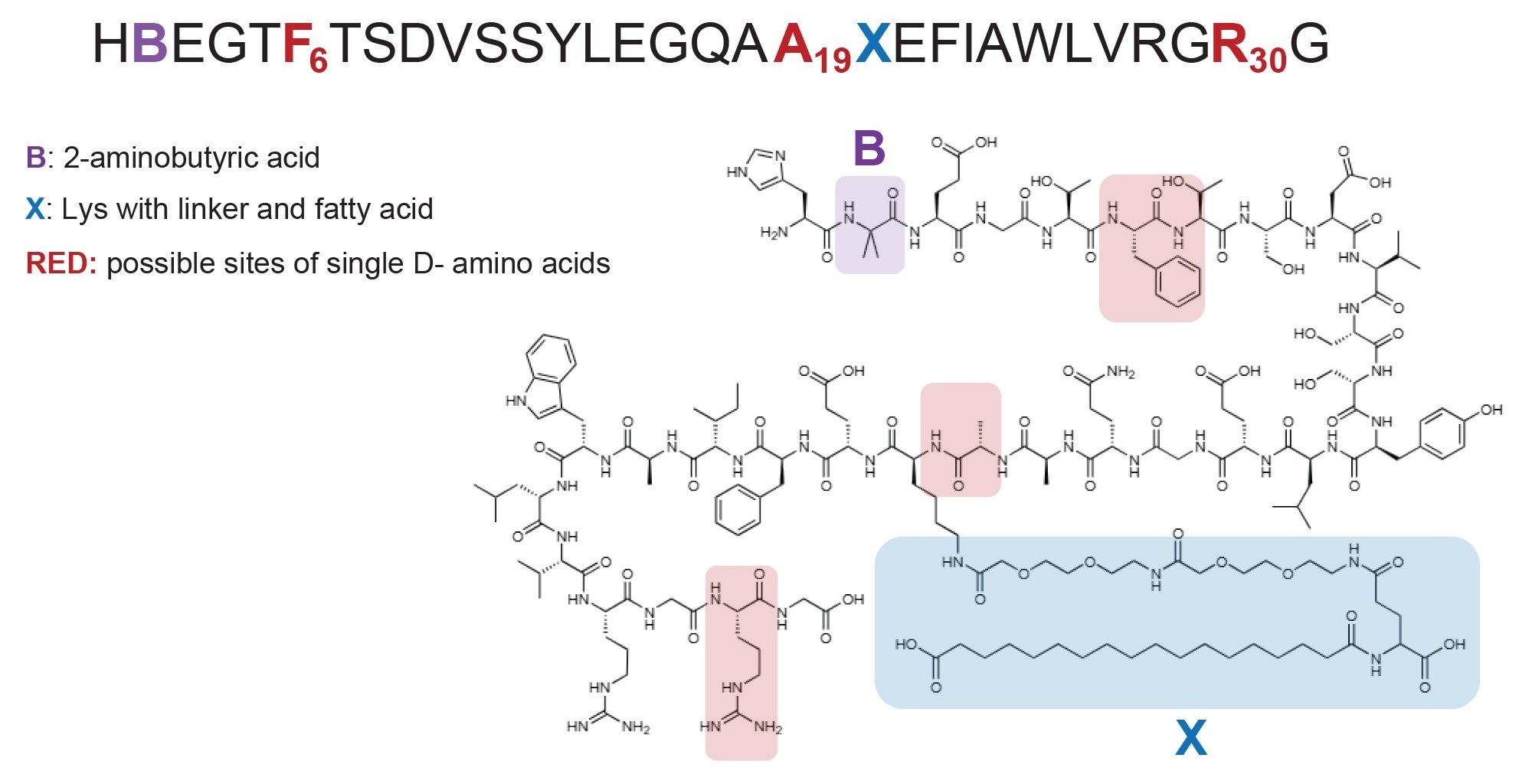
Standards of semaglutide API (all L- amino acids), along with D-Phe6, D-Ala19, and D-Arg30 impurities were obtained synthetically and previously characterized. These specific impurities were chosen because, while there’s LC separation between them and the API, all three impurities co-elute using the 60-minute method developed for this assay and are very hard to resolve from one another utilizing LC alone. Figure 1 illustrates the structure of semaglutide and these impurities.
Direct infusion experiments were used to optimize Cyclic IMS. Peptides were solubilized in ultrapure water to 1 mg/mL (~243 µM), then diluted to 1 µM in water/acetonitrile with 0.1% formic acid. For LC-IM-MS analysis, peptides were solubilized in 100 mM Tris HCl pH 7.5 to 1 mg/mL (~243 µM), then diluted to 0.1 mg/mL (~24.3 µM) and transferred to QuanRecovery™ Vials for injection.
Method Conditions
LC separations were carried out on an ACQUITY™ Premier UPLC System with an Quaternary Solvent Manager (QSM), using a ternary 60-minute gradient of water, acetonitrile, and methanol with 0.1% trifluoroacetic acid (TFA), each on an ACQUITY Premier CSH™ C18 Column 2.1 × 150 mm, 1.7 µm held at 60 °C.
MS Conditions
|
MS system: |
SELECT SERIES Cyclic IMS |
|
Ionization mode: |
ESI+ |
|
Acquisition range: |
m/z 50 – 2000 |
|
Capillary voltage: |
2.50 kV |
|
Cone voltage: |
40 |
|
Quad profile: |
600 (25/25) / 700 (25/25) / 800 |
All other remaining Cyclic IMS settings were installation defaults.
Data Management
|
Chromatography software: |
MassLynx™ Software |
|
MS software: |
MassLynx Software |
|
Informatics: |
DriftScope™ Software |
Results and Discussion
To investigate the mobility separation of the target impurity isomers, diluted (1 µM) solutions of the API and each impurity were first analyzed by direct infusion or as a mixture containing all three impurities. Direct infusion of standards is typically the preferred approach, as it enables optimization of mobility separations and advanced ion mobility experiments under a stable analyte signal. Features such as the pass calculator can help streamline method development and mobility optimization, providing an effective alternative when standards are not available.
Both API and D- impurities were observed mainly as [M+3H]3+ species at m/z 1372, with some [M+4H]4+ present as well at m/z 1029. Both charge states were investigated for IM separations, but much better results were observed for the [M+4H]4+ ions so the discussion will focus on them.
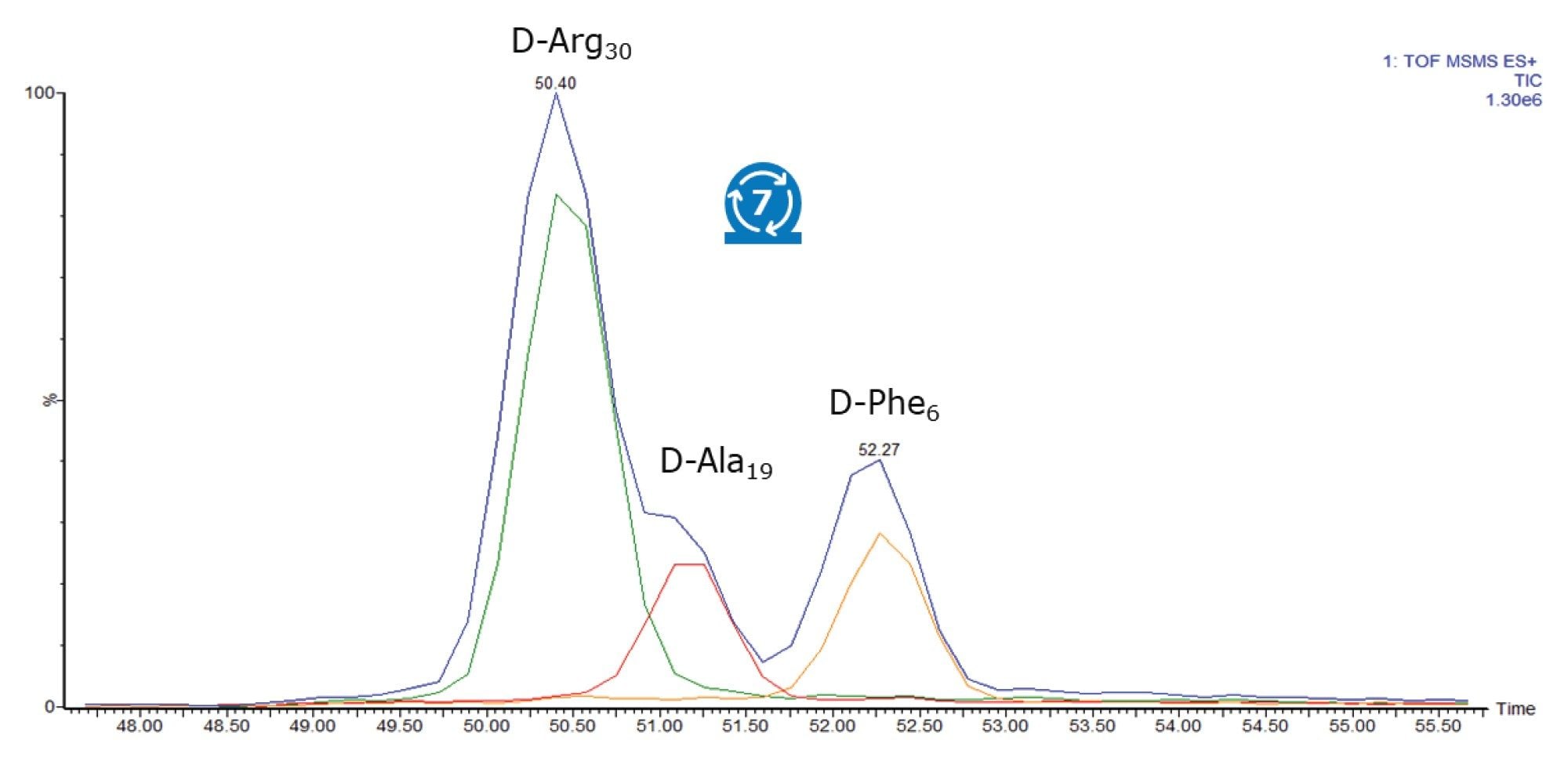
For an equimolar mixture of D-Phe6, D-Ala19, and D-Arg30 impurities, a multipass experiment with seven passes generated a distribution (Figure 2) containing two unresolved peaks (50.40/51.42 ms) and an almost fully resolved peak (52.27 ms). Analysis of the isolated impurities confirmed the identity of the first two unresolved peaks as D-Arg30 (50.40 ms) and D-Ala19 (51.42 ms), with D-Phe6 at 52.27 ms.
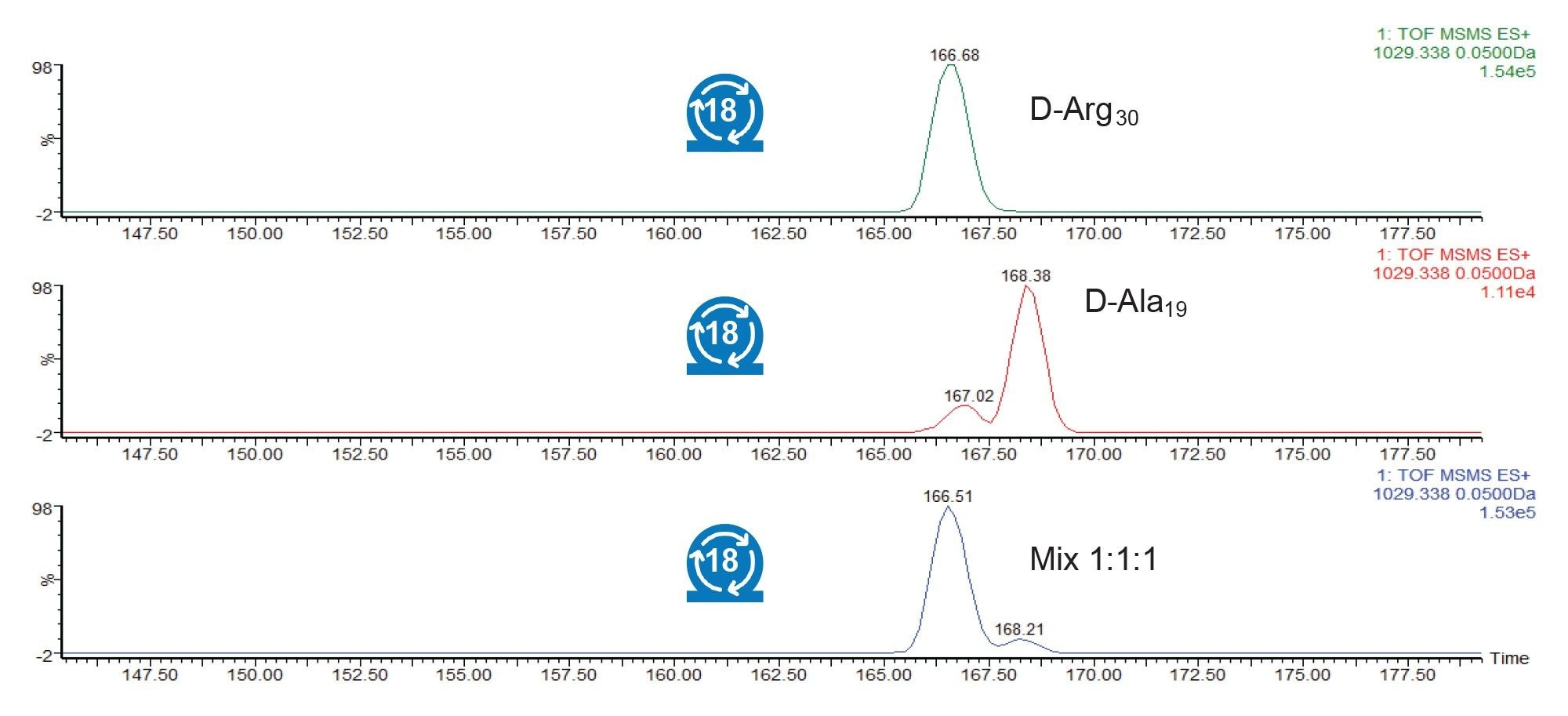
Increasing the number of passes beyond seven didn’t improve the separation of the unresolved isomers (data not shown). To achieve greater separation and distinguish the two unresolved peaks, a slicing IMSn experiment was performed. Following an initial seven-pass separation, the mobility region containing the first two peaks was isolated and stored in the pre-array before the mobility racetrack. After the remaining ions were ejected, the selected ion population was reinjected and subjected to additional multipass ion mobility separation. This targeted approach enabled baseline separation of the D-Arg30 and D-Ala19 isomers after a further 18 passes (Figure 3). This illustrates the power of IMSn and flexibility of the Cyclic IMS.
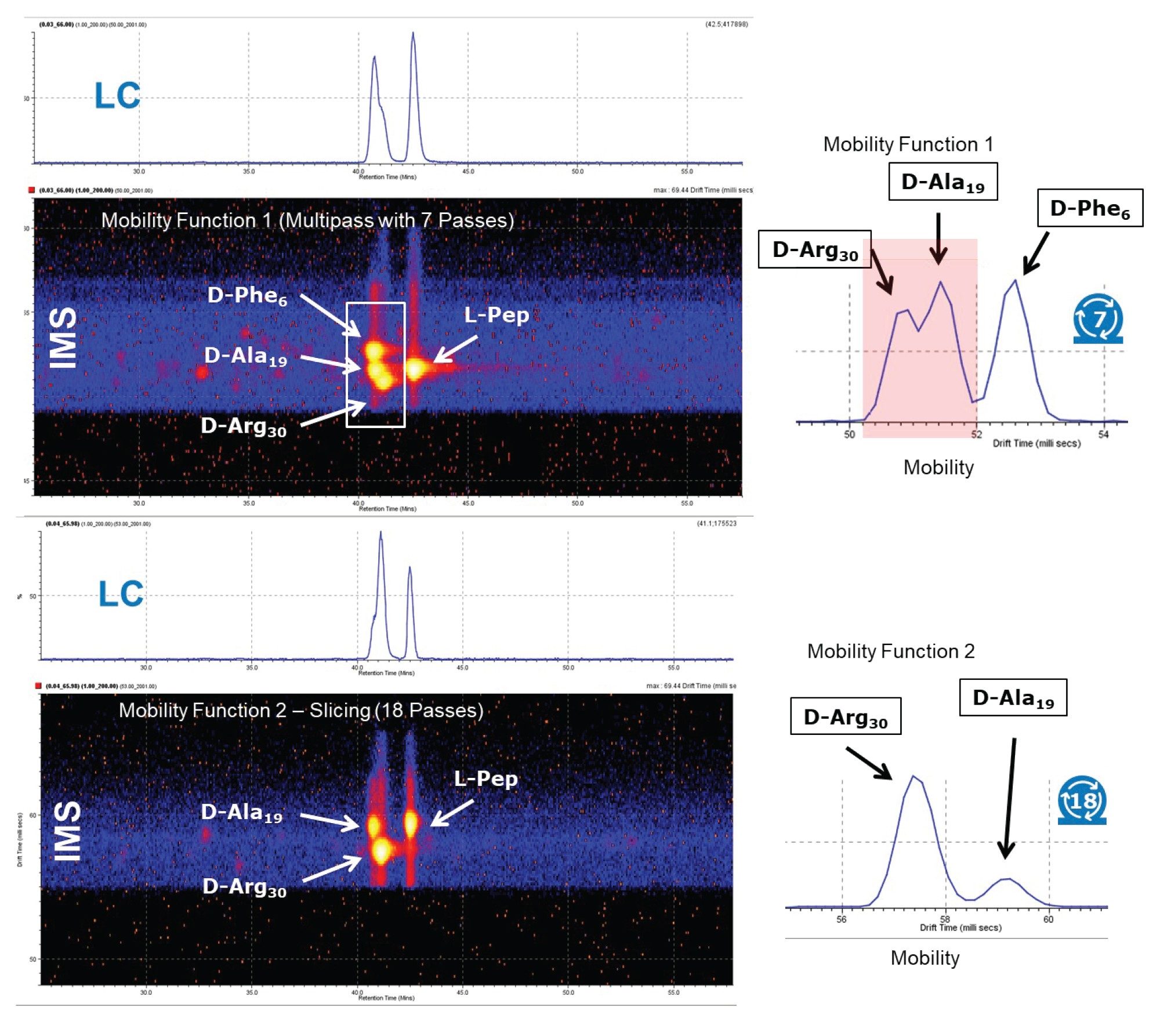
Having demonstrated separation of all three impurity isomers by infusion, the workflow was transferred to LC-IM/MS to show that the same mobility methods can be applied to more complex analyzes required for samples representative of real formulations. A MS method was created for the Cyclic IMS containing two functions: a seven-pass function to resolve D-Phe6, and a slicing/18-pass function to resolve the D-Arg30 and D-Ala19 isomers. To better visualize data, the DriftScope Software was used to extract the mobility chromatogram for a single LC peak containing all three impurities at around 42 minutes. The results closely reproduced what was observed for direct infusion (Figure 4), confirming that same performance is obtained with an LC-IM/MS experiment.
Conclusion
The SELECT SERIES Cyclic IMS enabled the separation and identification of single D-amino acid substitution impurities of semaglutide that are highly similar in structure and difficult to distinguish using LC-MS alone. By combining multipass ion mobility with slicing IMSn experiments, baseline-resolved mobility peaks were obtained for all three isomers, providing a robust approach for confident impurity characterization in complex formulation samples.
720009521, August 2026