
Enabling Deep Proteome Coverage at Ultra-High-Throughput Using Stepped-quadrupole DIA (SONAR Pulse) on the Xevo™ MRT P10 Benchtop Multi-reflecting TOF Mass Spectrometer
Matthew E. Daly, Lee A. Gethings, Richard Lock, Jason Wildgoose, James I. Langridge
Waters Corporation, Wilmslow, United Kingdom
Published on June 01, 2026

Abstract
Here, an ultra-high-throughput proteomics workflow using SONAR Pulse Acquisition Mode is demonstrated, using a stepped-quadrupole on the Xevo MRT P10 Mass Spectrometer. By combining narrow, sequential isolation windows with high MS/MS acquisition speed, short cycle times, and high TOF duty cycle, the method provides improved precursor specificity while maintaining sensitivity and proteome depth with rapid LC gradients. Using K562 cell line tryptic digests, the workflow delivered deep and scalable proteome coverage across high-throughput conditions, with preserved resolving power and mass accuracy- supporting confident identification and robust quantification in complex data independent analysis (DIA) datasets.
Benefits
This application note demonstrates how SONAR Pulse acquisition mode, using a stepped-quadrupole DIA approach, enabled by the Xevo MRT P10 Mass Spectrometer can be used to:
- Maintain deep proteome coverage on rapid, high-throughput gradients by acquiring information-rich MS/MS spectra at very high scan rates.
- Improve precursor specificity in fast DIA by using narrow, stepped quadrupole isolation windows with an acquisition duty cycle of 1 second.
- Enable high-throughput without trading away depth or specificity due to improvements in MS/MS sensitivity, scan speed, and duty cycle on a benchtop quadrupole multi-reflecting TOF.
Introduction
DIA is widely used for reproducible proteome-wide identification and quantification, but fast DIA on rapid LC gradients remains constrained by a three-way trade-off between proteome depth, analytical throughput, and precursor specificity. When chromatographic gradients are shortened to increase throughput, the time available per MS/MS event is compressed, fragment-ion signal reduces, and spectral complexity can rise (especially if isolation windows must be widened to preserve analytical duty cycle and quantitative coverage). These effects reduce identification rates, confidence and can degrade quantitative accuracy in complex samples.
In high-throughput DIA, the primary bottleneck is not spectral deconvolution but MS/MS sensitivity: the ability to repeatedly generate information-rich fragment spectra in only a few milliseconds while maintaining a fast cycle time to enable sufficient sampling across narrow chromatographic peaks.
The Xevo MRT P10 Mass Spectrometer platform addresses this constraint through high acquisition-rate operation, supporting a high duty cycle even at very fast >100Hz scan rates. The Xevo MRT P10 Mass Spectrometer incorporates specific improvements intended to increase MS/MS duty cycle and sensitivity, without sacrificing acquisition speed. Together, these capabilities enable SONAR Pulse Acquisition Mode that uses many narrow quadrupole isolation windows per cycle, improving both specificity and throughput while maintaining depth.
Experimental
Samples
K562 human cell lysate (Promega™) tryptic digest was used as the benchmark sample throughout this study to evaluate proteome depth under high-throughput DIA conditions. This sample was selected because it provides a complex and well-characterized human proteome background, making it suitable for assessing identification performance across short gradient methods.
Chromatography
High-throughput separations were performed using an Evosep™ Eno system with short, standardized gradients (e.g., 60 samples-per-day and faster methods). For extended separations, an ACQUITY™ UPLC™ M-Class System was used with longer gradients (e.g., 8–24 samples-per-day equivalents) to explore the depth/throughput relationship across gradient lengths.
Mass Spectrometry
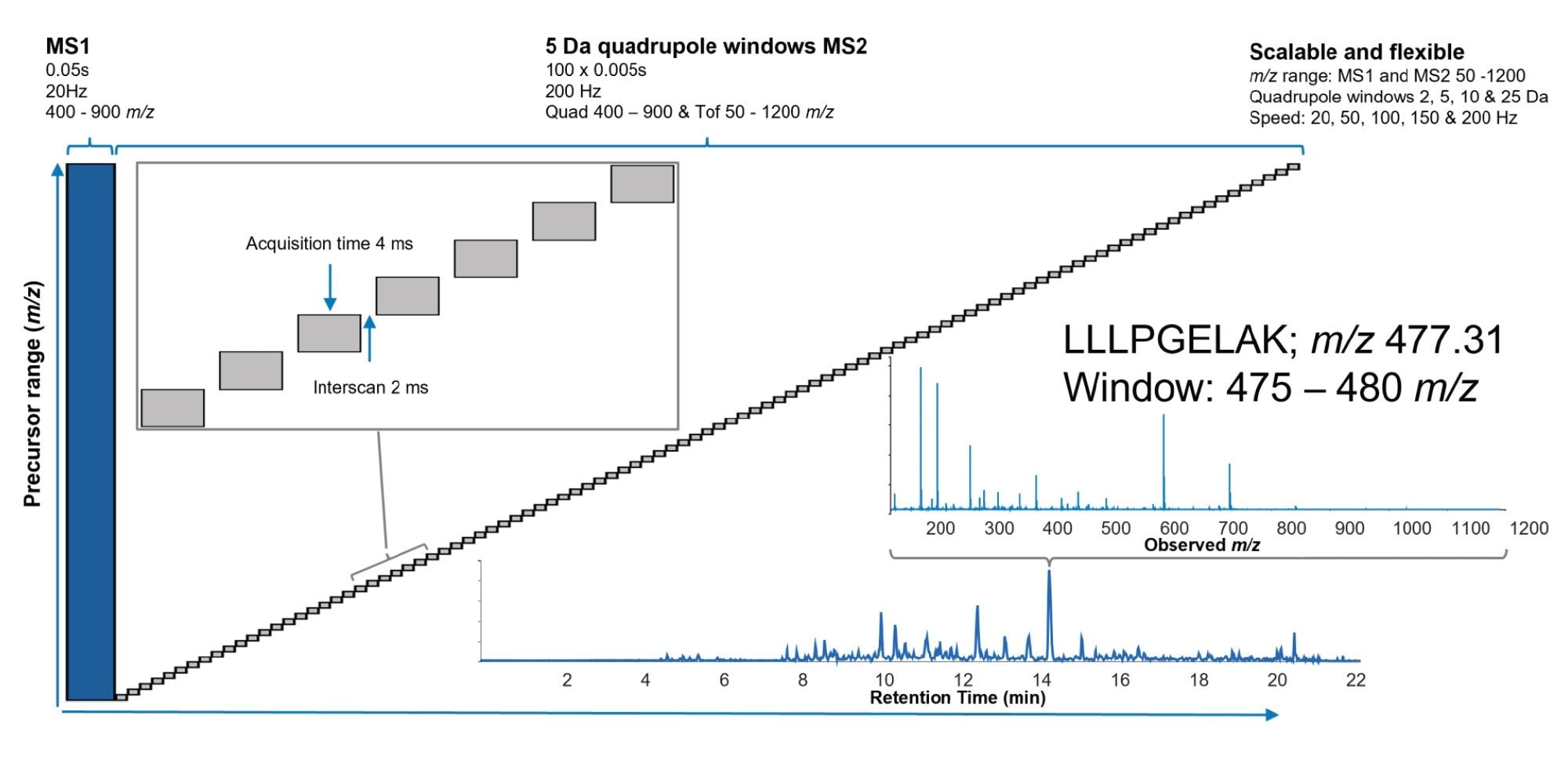
Analyses were performed on the Xevo MRT P10 Mass Spectrometer operated using SONAR Pulse Acquisition Method, a stepped-quadrupole DIA approach. A representative SONAR Pulse cycle comprised a short MS1 scan followed by 100 MS/MS spectra acquired at high acquisition rate. In the example method used, MS1 was acquired for 50 msecs for m/z 400–900, followed by MS2 acquired at 100 Hz using 5 Da quadrupole isolation windows stepped sequentially across 400–900 m/z. The TOF MS2 data was acquired with a m/z range of 50–1200. The total cycle time was ~1.05 s, enabled by the rapid MS/MS acquisition rate (Figure 1).
Data Processing
DIA data were processed using waters_connect™ Software to automatically generate mzML files. These were subsequently used with in custom pipelines with all data searched using DIA-NN2 with the following parameters:
- Library search (custom spectral library)
- Carbamidomethylation of C (fixed)
- Oxidation of M (variable)
- FDR 1%
- All other settings as default
Results and Discussion
Stepped-quadrupole DIA (SONAR Pulse) at Ultra-High-Throughput
The SONAR Pulse acquisition mode improves the traditional DIA trade-off by combining narrow, stepped isolation windows (improved precursor specificity) with short cycle times (adequate peak sampling) on short gradients (high-throughput). A representative method uses a survey MS1 scan followed by 100 MS/MS spectra per cycle (e.g., 5 Da windows stepped across 400–900 m/z with TOF detection over 50–1200 m/z), delivering an overall cycle time of ~1.05 s (Figure 1).
Maintaining MS/MS Sensitivity at High Acquisition Speed
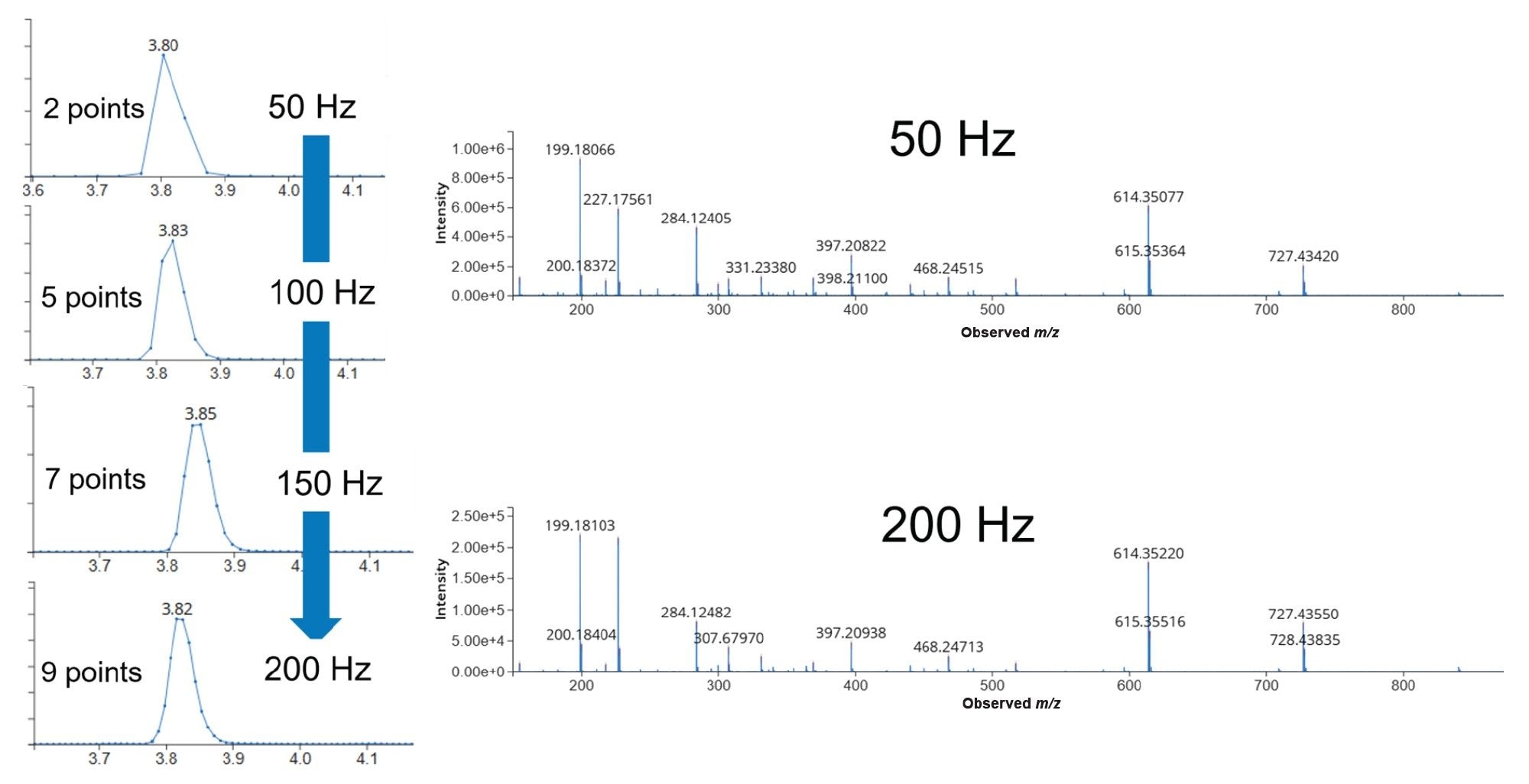
In DIA methods, fragment ion signal can drop rapidly as MS/MS acquisition times shorten. Xevo MRT2 supports high duty cycle operation at very fast >100Hz acquisition rates by minimizing interscan delay and synchronizing ion exit from the gas cell with the pusher of the TOF (wideband EDC), which help maximize ion utilization and therefore MS/MS sensitivity at speed. With the Xevo MRT P10 Mass Spectrometer performance uplift, information-rich MS/MS spectra can be acquired at high scan rates, enabling narrow or stepped quadrupole windowing (more windows per cycle) without sacrificing fragment spectra quality across narrow chromatographic peaks (Figure 2).
High Resolution and Mass Accuracy at Speed
High-throughput DIA only remains selective if mass resolution and mass accuracy are preserved as acquisition speed increases. The Xevo MRT P10 Mass Spectrometer maintains high resolving power at high MS/MS rates (up to 100,000 FWHM), supporting confident fragment-ion assignment and reducing the impact of spectral interference. Excellent mass accuracy at speed further strengthens identification confidence, and quantitative robustness, particularly in complex DIA spectra acquired from narrow, stepped isolation windows.
High Proteome Rapid on Short Gradients (K562)
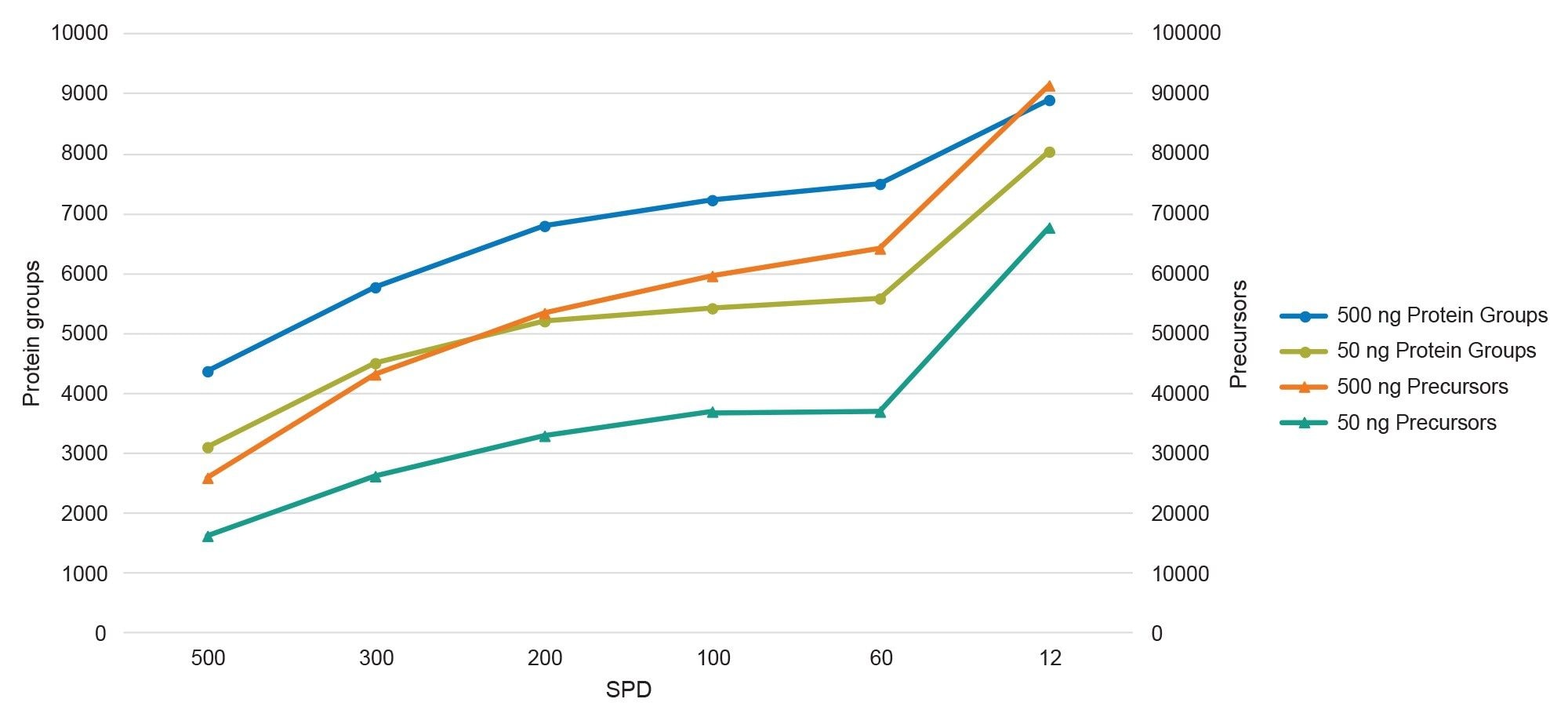
Proteome depth was evaluated using K562 digests on high-throughput gradients (up to 500SPD). Across the tested gradient lengths, comprehensive protein identification was maintained and scaled predictably with separation time. In the dataset shown, protein identifications increased for 500 ng loading from ~4,500 (500SPD) reaching ~9,000 on the longest chromatography tested condition (12). Performance was consistent for the lower loading of 50 ng, with ~3,200 (500SPD), and ~8,000 (12SPD). These results indicate that coverage can be sustained in a true high-throughput regime when MS/MS sensitivity, scan speed, and duty cycle are sufficient to support multiple narrow windows per DIA cycle (Figure 3).
Conclusion
This application note describes a high-throughput proteomics workflow enabled by SONAR Pulse on the Xevo MRT P10 benchtop multi‑reflecting time-of-flight mass spectrometer. The combination of rapid MS/MS acquisition rates, high duty cycle, and enhanced sensitivity permits short DIA cycle times without compromising fragment ion sensitivity. This, in turn, enables the use of multiple narrow, stepped quadrupole isolation windows per cycle, improving precursor selectivity and analytical specificity.
Using K562 digests on short, standardized gradients, comprehensive proteome coverage was maintained in a true high-throughput regime, with depth scaling predictably as gradient length was adjusted. Importantly, high resolving power was preserved at high MS/MS speed (up to 100,000 FWHM), together with excellent mass accuracy, supporting confident identification and robust quantification of peptides in complex DIA spectra. Together, these results demonstrate that proteome coverage need not be adversely compromised to achieve high-throughput on a benchtop quadrupole multi-reflecting TOF system.
References
- Demichev V, Messner CB, Vernardis SI, Lilley KS, Ralser M. DIA-NN: neural networks and interference correction enable deep proteome coverage in high throughput. Nat Methods. 2020 Jan;17(1):41-44. doi: 10.1038/s41592-019-0638-x. Epub 2019 Nov 25. PMID: 31768060; PMCID: PMC6949130.
- Verenchikov AN, Wildgoose J, Kirillov SN, Vorobyev AV, Makarov VV, Gethings LA, Tonge RP, Daly ME, Johnson WJ, Langridge JI. A Novel Compact Multi-Reflecting Time-of-Flight Mass Spectrometer. J Am Soc Mass Spectrom. 2026 Mar 4;37(3):601-611. doi: 10.1021/jasms.5c00321. Epub 2026 Jan 26. PMID: 41587471; PMCID: PMC12964538.
Featured Products
720009356, June 2026


