• Applikationsbericht

The Analysis of Coccidiostatic Agents in Feed Using the ACQUITY UPLC I-Class and Xevo TQ-S

The Analysis of Coccidiostatic Agents in Feed Using the ACQUITY UPLC I-Class and Xevo TQ-S

  • Nathalie Gillard
  • Gilles Pierret
  • Philippe Delahaut
  • Marijn Van Hulle
  • Centre d’Economie Rurale
  • Waters Corporation
Animal feed closeup

Abstract

This application note describes a fast, accurate, and robust UPLC/MS-MS method using the  ACQUITY UPLC I-Class System with Xevo TQ-S for the detection of 11 coccidiostatic agents in feed down to 0.25% carryover levels. The Xevo TQ-S is a highly sensitive tandem quadrupole instrument with fast positive/negative ion switching capabilities able to deal with challenging matrices.

Benefits

A fast, robust, accurate, and sensitive method for 11 coccidiostats in feed samples was developed on an ACQUITY UPLC I-Class System with Xevo TQ-S.

  • Compared to the original HPLC/MS-MS method the feed sample extracts can be further diluted by a factor of 50, using only half of the injection volume.
  • Runtime reduced from 16 min. (HPLC/MS-MS) to eight min. (UPLC/MS-MS).
  • RADAR provides the necessary qualitative information about possible matrix effects and is therefore a valuable tool during method development

Introduction

Coccidiosis is a parasitic disease of the intestinal tract of animals caused by coccidian protozoa. The disease spreads from one animal to another by contact with infected feces or ingestion of infected tissue. Diarrhea, which may become bloody in severe cases, is the primary symptom. Most animals infected with coccidia are asymptomatic; however, young or immuno-compromised animals may suffer severe symptoms, including death. Among domestic animals, industrially bred poultry and rabbits are particularly prone to this disease.

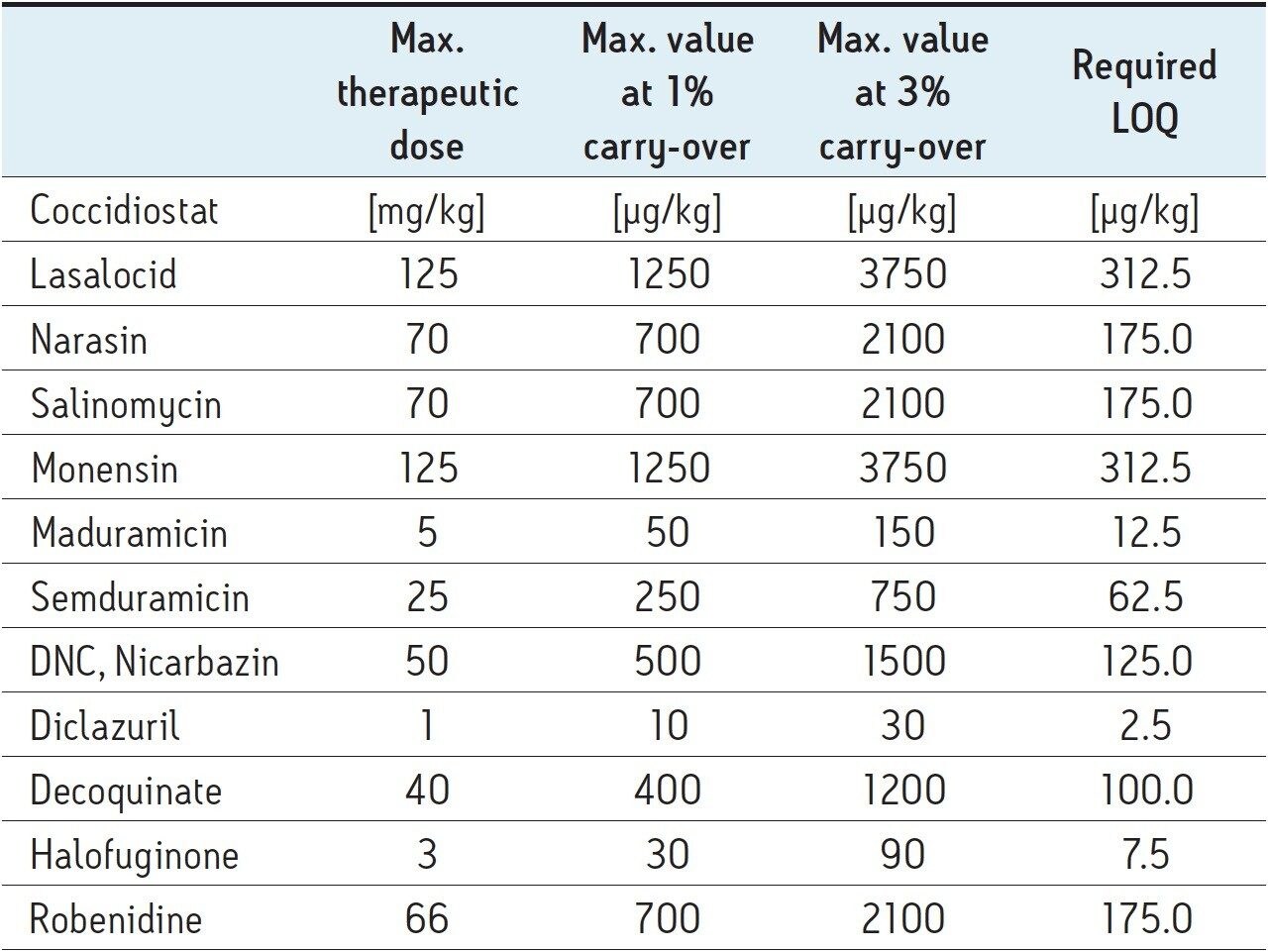
Today 11 coccidiostatic agents are authorized as feed additives in accordance with EU Regulation 2003/1831/EC. Other regulations specify which agents can be used for specific animal species. Because feed companies typically use the same production line for the production of different feeds, carryover and therefore transfer of coccidiostats from one batch to another is unavoidable. Despite the efforts taken by the feed companies to avoid any cross-contamination, as imposed by European directive 2005/183/EC, maximum levels of coccidiostat carryover have been set (2009/8/CE) to protect animal health and guarantee minimal risk to the consumers. This directive sets maximum carryover levels of 1% for sensitive animal species and 3% for less-sensitive non-target animal species, respectively. These required LOQ levels, described in Table 1, which are drug dependent, The are based on an extraction protocol described further. These levels are very diverse, making it difficult to combine all of the components into one multi-residue analysis and achieve good overall sensitivity, accuracy, and linear range.

In addition feeds are very complex and diverse mixtures. In a routine environment, it is impossible to use matrix matched calibration or standard addition for each type of feed. Instead internal standards and one feed matrix are used. The method accuracy is then validated by selecting different feed matrices and performing spike recovery experiments at different levels with a quantitation of the results based on one feed matrix.

Therapeutic dose, carry-over levels, and required LOQ
Table 1. Therapeutic dose, carry-over levels, and required LOQ for the 11 coccidiostats.

It is known that matrix components can significantly alter the response in electrospray ionization, either a signal enhancement, but most likely signal suppression. Matrix effects are minimized by reducing the absolute amount of matrix ions in the source region. One way that this can be achieved is to dilute the samples (if this method used is sensitive enough to permit this) and hence reduce the matrix loading on-column. As a consequence of this approach, when working in a routine food and feed testing laboratory, it can also be observed that the instrument will require less frequent cleaning and therefore better instrument uptime and method robustness.

This application note describes a fast, accurate, and robust UPLC/MS-MS method using Waters ACQUITY UPLC I-Class System with Xevo TQ-S for the detection of 11 coccidiostatic agents in feed at levels down to 0.25% carryover levels. The Xevo TQ-S is a highly sensitive tandem quadrupole instrument with fast positive/negative ion switching capabilities able to deal with challenging matrices.

Experimental

Sample preparation

This method was previously employed on a HPLC-MS-MS and has been transferred to appropriate conditions for UPLC, and also includes the addition of a final dilution step.

1. Weigh 5 g of ground and homogenized feed sample into a 50-mL disposable centrifuge tube.

2. Spike with 50-μL internal standard pool (50 μg/mL robenidine-d8 and nigericine, 25 μg/mL DNC-d8, 5 μg/mL diclazuril-bis and decoquinate d5).

3. Add 10 mL of a 10% Na2CO3 solution and hand shake.

4. Add 15 mL acetonitrile

5. Shake for 30 minutes.

6. Centrifuge 5 minutes at 2000 rpm (4 °C).

7. Transfer the supernatant into a 50-mL tube.

8. Repeat the acetonitrile extraction and combine both organic extracts.

9. Transfer 1 mL of extract in a glass tube and dilute the samples 50 times in initial mobile phase.

UPLC conditions

System:

ACQUITY UPLC I-Class

Column:

ACQUITY BEH C18 2.1 x 100 mm

Column Temp.:

50 °C

Sample Temp.:

10 °C

Injection:

10 μL

Mobile phases:

A Water 0.1% formic acid B Methanol 0.1% formic acid

The gradient is shown in Table 2

Time

%A

%B

Curve

0.0

50

50

–

0.5

50

50

6

3.0

0

100

6

5.0

0

100

6

7.0

50

50

1

MS conditions

MS system:

Xevo TQ-S

Polarity:

ES +/-

Capillary voltage (kV):

1.00 in positive ion ES and 3.00 in negative ion ES

Source temp.:

150 °C

Desolvation temp.:

500 °C

Cone gas flow:

150 L/hr

Desolvation gas flow:

1200 L/h

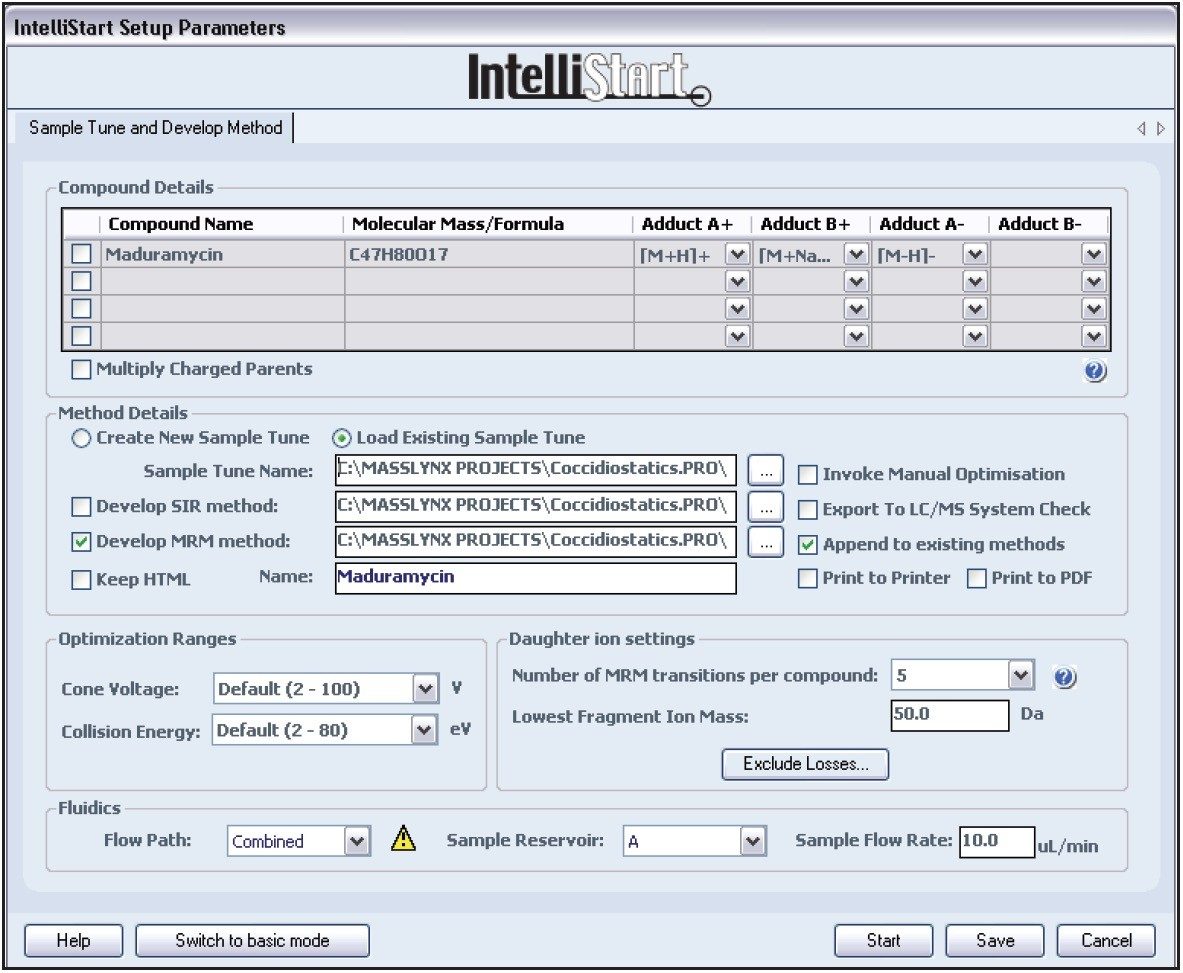
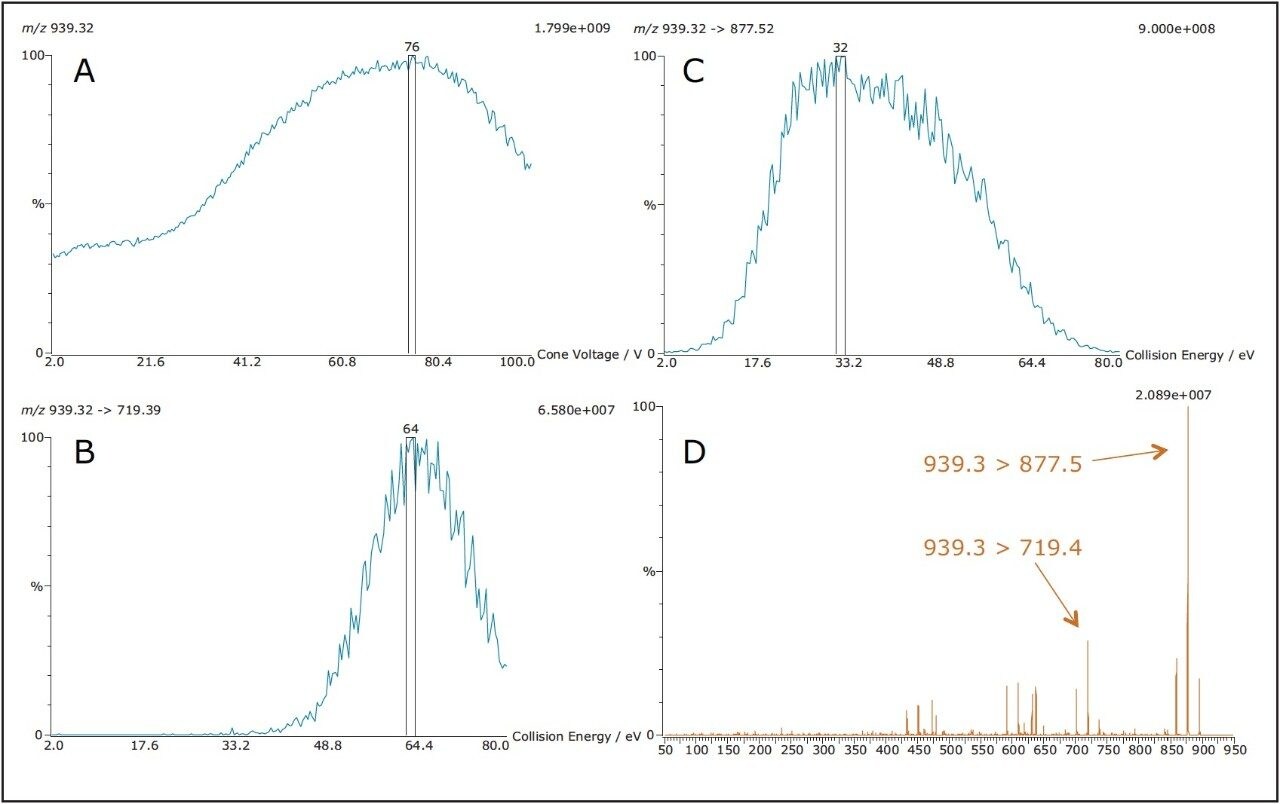
Compound tuning was accomplished using IntelliStart Software. IntelliStart automatically generates up to 5 MRM transitions per compound on the basis of either a compound mass or its elemental composition. The advantage is fact that multiple adducts can be selected simultaneously. This is particularly interesting for coccidiostatic agents that easily form sodium adducts. A screenshot of the IntelliStart wizard is shown in Figure 1. An extract of optimized MRM transitions for maduramycin can be found in Figure 2.

Screenshot of the Intellistart wizard
Figure 1. Screenshot of the Intellistart wizard for maduramycin with elemental composition C47H80O17 .
Extract from IntelliStart method development report
Figure 2. Extract from IntelliStart method development report showing optimization of cone voltage (A), optimization of collision energy for two transitions (B, C), and location of product ions (D) for the sodium adduct of maduramycin.

A separate MS function was automatically created for every individual compound. Table 3 shows an overview of all MRM transitions, including optimal cone voltage and collision energy. Two or three MRM transitions were chosen per component, except for the internal standards.