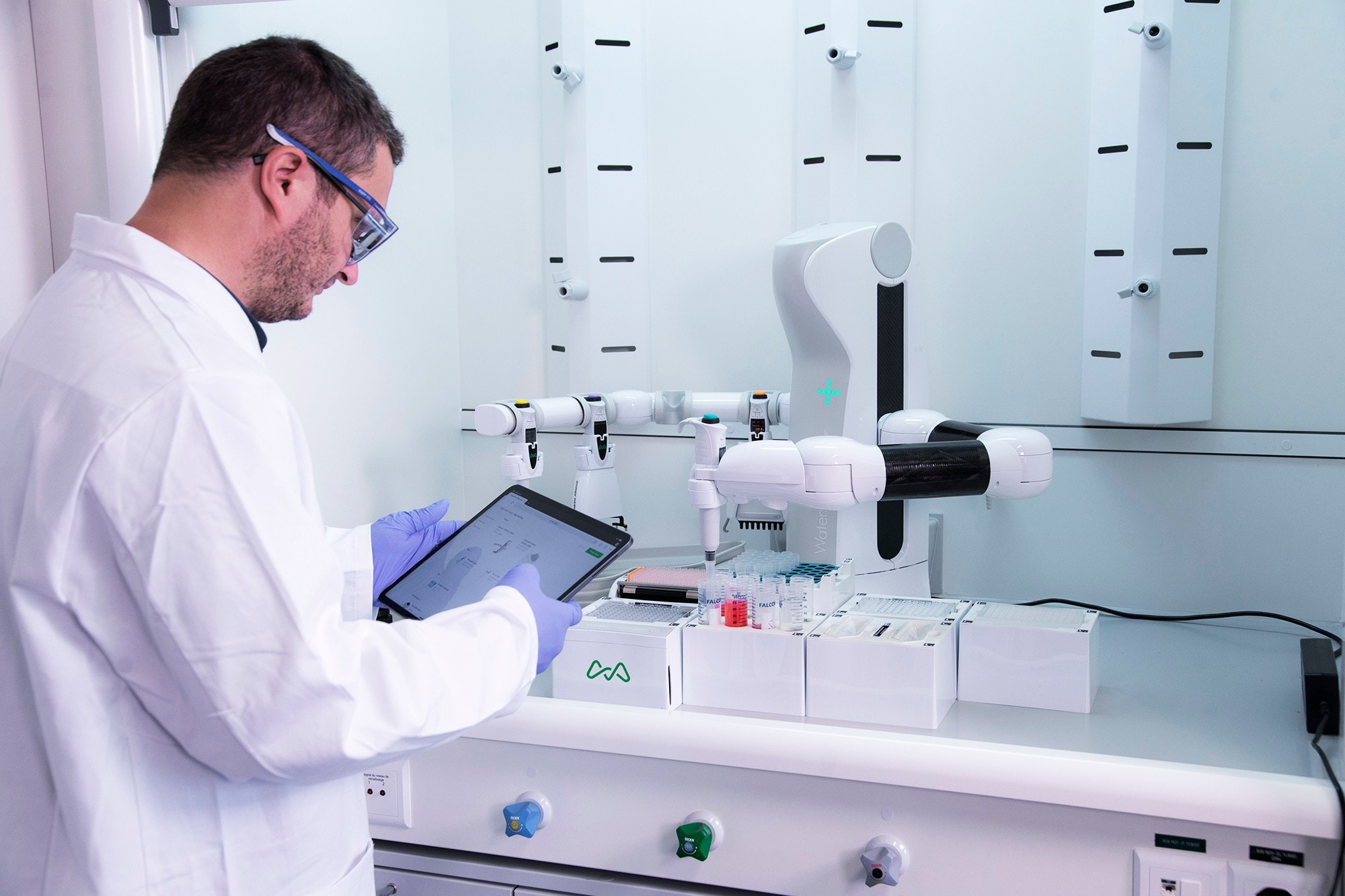
Waters MaxPeak Premier Columns with MaxPeak HPS Technology are specifically engineered to minimize surface interactions that drive non‑specific adsorption in AAV, mRNA, and other nucleic‑acid‑rich samples. This reduces passivation time, improves recovery, and delivers more reproducible results across workflows.
Waters GTxResolve Columns and ACQUITY Premier Oligonucleotide Columns limit secondary interactions that commonly suppress oligo recovery. Combined with optimized mobile phases and low‑adsorption instrument surfaces, these columns deliver cleaner peaks, higher recovery, and more consistent quantitation for ssDNA, dsDNA, and mRNA components.
The simplest way is with IEX-UV-UV, at 260 and 280nm. More advanced solutions like multi‑angle light scattering (MALS) with the appropriate GTxResolve SEC 450 Å, 1000 Å, and 2000 Å Columns, or CDMS, provide high‑resolution, non‑destructive quantitation of empty and full AAV capsids without relying on calibration curves. CDMS can further distinguish partially filled capsids, while MALS provides information on aggregation in-solution. Together, these solutions can measure capsid size, mass, titers, and heterogeneity directly, making them powerful for development, comparability, and scale‑up. ICH guidelines endorse orthogonal analytical methods to strengthen method validation and improve confidence in product quality.
For LNP‑mRNA products, MALS with FFF and RT‑MALS provide size, particle concentration, and payload‑related attributes in real time or offline. These measurements help assess LNP integrity and detect differences associated with encapsulation efficiency. When combined with LC‑MS‑based mRNA integrity and identity workflows, developers gain a complete picture of mRNA encapsulation and product quality.
Dynamic light scattering (DLS) and MALS measure particle size, size distribution, and polydispersity for mRNA‑LNP systems. Forprocess‑development environments, RT‑MALS (ultraDAWN Detector) provides real‑time monitoring of size and particle concentration duringproduction, helping track uniformity and detect instability events as they occur. Larger sub-visible particles can be investigated with the Aura backgrounded membrane imaging (BMI) Solution.
LC‑MS workflows enable identity and integrity confirmation for long‑chain nucleic acids. High‑resolution MS provides sequence mapping, intactmass verification, and detection of structural variants or degradation products. These tools support evaluation of capping efficiency, sgRNA purity,and mRNA structural integrity, critical for therapeutic activity and regulatory expectations.
Genetic medicine developers rely on orthogonal quantitation approaches. SEC‑MALS and FFF‑MALS measure capsid particle concentration andgenomic titer directly from light‑scattering intensity paired with in-line UV-UV, while complementary methods like UV, RI, and ddPCR quantify genome‑containing particles. Using both approaches helps reduce assay bias and improves dose accuracy across AAV programs.
The ultraDAWN RT‑MALS Detector delivers real‑time measurement of CQAs—including particle size, molar mass, particle concentration, and empty/full behavior, during chromatography, filtration, or formulation steps. This enables immediate feedback, more precise pooling decisions, and earlier detection of process drift.
Regulators expect strong analytical packages for AAV, mRNA, and LNP modalities. This typically includes:
Learn how Waters can help your lab future-proof today for the genetic medicinesof tomorrow.