
USP<787>: Tailored Guidance for Better Biologics

Understanding US<787> and its Impact on Pharmaceutical Quality with Tailored Guidance for Biologics
In the world of pharmaceuticals, quality is paramount. Ensuring the safety and efficacy of medications is not only a regulatory requirement but also a moral obligation to patients. To achieve this, regulatory bodies like the United States Pharmacopeia (USP) lay down guidelines and standards that pharmaceutical companies must adhere to. Two such standards, USP<787> and USP<788>, play a crucial role in maintaining the quality of pharmaceutical products, particularly in relation to particulate matter. Let’s delve into what these standards entail and how they compare.
What is USP<787>?
USP<787>, titled “Subvisible Particulate Matter in Therapeutic Protein Injections,” provides guidelines for assessing the presence of subvisible particulate matter in protein-based pharmaceutical products. These particulates, though not visible to the naked eye, can potentially impact product safety and efficacy. USP<787> outlines specific testing methods and acceptance criteria for detecting and quantifying these particulates, helping manufacturers ensure the quality of their protein injections.
Key Components of USP<787>:
- Testing Methods: USP<787> details various analytical techniques for detecting subvisible particulate matter, including light obscuration, microscopy, and flow imaging analysis. Each method has its advantages and limitations, allowing manufacturers to choose the most suitable approach based on their product characteristics.
- Acceptance Criteria: The standard sets forth acceptance criteria for particulate matter based on the size and nature of the particles. These criteria are crucial for determining whether a product meets quality standards or requires further investigation and potentially corrective action.
- Risk Assessment: USP<787> emphasizes the importance of risk assessment in evaluating the impact of particulate matter on product safety and efficacy. Manufacturers are encouraged to conduct thorough risk assessments to identify potential risks associated with particulate contamination and implement appropriate mitigation strategies.
Comparison with USP<788>:
While USP<787> focuses specifically on protein-based pharmaceuticals, USP<788> addresses particulate matter in injections as a whole, encompassing both protein and non-protein formulations. The key differences between the two standards lie in their scope and application:
- Scope: USP<788> is broader in scope, covering all injectable products, including both small-molecule drugs and biologics, whereas USP<787> specifically targets therapeutic protein injections.
- Testing Methods: While both standards prescribe similar testing methods for particulate matter analysis, USP<787> may have additional considerations specific to protein formulations, such as protein aggregation and particle morphology.
- Acceptance Criteria: The acceptance criteria outlined in USP<788> are generally applicable to all injectable products, whereas USP<787> may have more tailored criteria considering the unique characteristics of protein-based formulations.
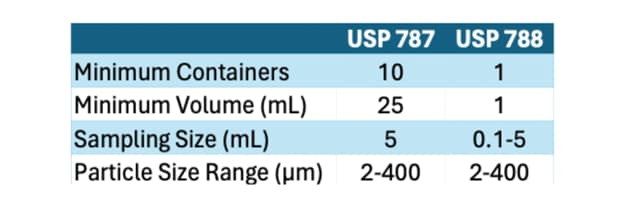
An important emphasis of USP<787> is that it acknowledges the limitations of light obscuration for protein-based particles and encourages additional methods like microscopy and image analysis for comprehensive characterization.
The Importance of Compliance
Adherence to standards like USP<787> and USP<788> is not just about regulatory compliance; it’s about ensuring patient safety and maintaining the reputation of pharmaceutical products. By following these guidelines, manufacturers can mitigate the risks associated with particulate contamination and uphold the quality of their products throughout the manufacturing process.
USP<787> plays a vital role in ensuring the quality and safety of therapeutic protein injections by providing comprehensive guidelines for detecting and assessing subvisible particulate matter. While similar in essence, USP<788> covers a broader spectrum of injectable products, highlighting the importance of understanding the specific requirements applicable to each product type. Ultimately, compliance with these standards is indispensable for pharmaceutical manufacturers committed to delivering safe and effective medications to patients worldwide.
How to Perform USP<787>
In the realm of pharmaceutical quality assurance, the ability to accurately detect and characterize subvisible particulate matter is paramount. One of the primary methods prescribed by USP<787> for this purpose is light microscopy. Let’s explore how light microscopy serves as a vital tool in the analysis of therapeutic protein injections and why its utilization is crucial for pharmaceutical manufacturers.
Key Advantages of Light Microscopy
- Particle Characterization: Light microscopy provides valuable insights into the characteristics of particulate matter, such as size, shape, and morphology. This information is essential for assessing the potential impact of particles on product safety and efficacy.
- High Resolution: Modern light microscopes offer high-resolution imaging capabilities, allowing for detailed examination of individual particles. This level of detail is crucial for distinguishing between different types of particulates and determining their origins.
- Real-time Analysis: Unlike some other analytical techniques, light microscopy facilitates real-time observation of particles, enabling immediate decision-making during the analysis process. This rapid feedback loop is invaluable for ensuring efficient and accurate detection of particulate contaminants.
Challenges and Considerations
While light microscopy is a powerful tool for particulate analysis, it does have certain limitations and challenges that must be addressed:
- Sample Preparation: Proper sample preparation is essential for obtaining reliable results with light microscopy. Care must be taken to ensure that samples are appropriately dispersed and mounted to facilitate clear imaging.
- Operator Skill: Interpreting microscopy images requires a certain level of expertise and experience. Trained operators are needed to accurately identify and characterize particulate matter, minimizing the risk of misinterpretation.
- Instrument Calibration: Regular calibration and maintenance of microscopy equipment are necessary to ensure accurate measurements and reliable performance over time.
Modern-Day Automated Light Microscopy with Aura Systems
With Aura PTx System, all these challenges and considerations are resolved. Aura Systems are based on membrane/filter microscopy and are USP<787> compliant. Utilizing high-contrast imaging techniques, Background Membrane Imaging (BMI) and Fluorescence Membrane Imaging (FMM), drug manufacturers can detect, count, and size particulate matter with high confidence and reproducibility:
- High Throughput: Reduce sample preparation risks by testing multiple samples. Aura Systems take 1 minute per assay.
- Fully Automated with Supporting CFR Software: Eliminate operator errors and bias. Aura Systems are fully automated and capture data without requiring operator expertise. Additionally, Particle Vue Software automatically identifies, sizes, and counts particles within a sample.
- Robust and Reliable Instrumentation: Aura Systems are low-maintenance, reliable instruments. For those requiring greater care and services, Waters provides a variety of service/maintenance programs and installation qualification/operational qualification (IQ/OQ).
The Role of Light Microscopy in USP<787> Compliance
In accordance with USP<787> guidelines, pharmaceutical manufacturers rely on light microscopy as a key tool for assessing the presence of subvisible particulate matter in therapeutic protein injections. By leveraging the capabilities of light microscopy, manufacturers can effectively identify and quantify particulate contaminants, thereby ensuring compliance with regulatory standards and upholding the quality of their products.
In conclusion, light microscopy and Aura PTx Systems play a pivotal role in USP<787> analysis, offering pharmaceutical manufacturers a reliable means of detecting and characterizing subvisible particulate matter in therapeutic protein injections. Despite its challenges, the benefits of using light microscopy for particulate analysis far outweigh the drawbacks, making it an indispensable tool in the quest for pharmaceutical quality assurance.
Related posts
Identifying Critical Quality Attributes in Drug Products: Your Key to Ensuring Safe and Effective Therapeutics
In drug manufacturing, there is no room for error. Every decision, from early formulation to final release, must ensure a product is safe, effective, and consistent. At the center of this process are critical quality attributes (CQAs), the measurable properties that define whether a drug meets its required standards. In this blog, we break down…

Unlocking Faster, More Confident Antibody Analytics with Modern Protein A Affinity Chromatography
Biologics developers today face unprecedented pressure: tighter timelines, increasingly complex antibody formats, and a growing need for real-time process understanding. Yet many analytical workflows still rely on methods that can’t deliver the speed, sensitivity, or depth required for modern bioprocessing. That’s where advances in Protein A (ProA) affinity chromatography are making a meaningful difference, reshaping…
Enzymatic Digestion: Accelerating Bioseparations with Novel Enzymes
The Role of Enzymes in LC-MS Analysis of Modern Biotherapeutics Enzymes are nature’s catalysts, enabling precise and efficient biochemical transformations. In analytical workflows, enzymatic digestion is a cornerstone technique for breaking down complex biomolecules into smaller, more manageable fragments. This process is critical for applications such as peptide mapping in protein characterization and oligonucleotide mapping…
Popular Topics
ACQUITY QDa (17) bioanalysis (12) biologics (17) biopharma (50) biopharmaceutical (59) biotherapeutics (24) case study (20) chromatography (14) data integrity (23) food analysis (12) HPLC (15) informatics (12) LC-MS (27) liquid chromatography (LC) (25) mass detection (16) mass spectrometry (MS) (61) method development (13) particle analysis (21)